Did you know that installing an air conditioner just one size too large for your living room can increase your energy consumption by up to 15 percent? It’s a common mistake we see across Sydney, where homeowners buy a powerful unit hoping for instant relief, only to face skyrocketing electricity bills and a system that “short cycles” constantly. We understand that you want your home to be a sanctuary from the 80 percent humidity that often hits our coastal suburbs in February. You deserve a solution that provides genuine comfort without the financial stress of an inefficient setup.
In this guide, we’ll help you accurately determine what capacity ac do i need for your specific Sydney property. We draw on our years of local experience to move beyond generic online calculators that ignore our unique housing styles and coastal conditions. You’ll learn how to calculate the exact kilowatt (kW) output required for your space, whether you’re in a sun-drenched apartment or a shaded brick veneer home. We’ll also explain how to account for Sydney’s specific climate variables so you can enjoy lower running costs and a perfectly cooled home all summer long.
Capacity isn’t about the physical dimensions of your indoor unit; it refers to the cooling and heating output measured in kilowatts (kW). When homeowners ask what capacity ac do i need, they’re really asking how much thermal energy the system can move out of their home per hour. In Sydney, this calculation is vital. Our local climate often delivers 35°C days with humidity levels that make the air feel much heavier. When you begin Understanding AC Capacity, you’ll see that a system must be sized to handle these peak loads without wasting energy during milder spring days.
We follow the “Goldilocks” principle for every installation. A system that’s too small will struggle to keep you cool, while a system that’s too large creates its own set of technical headaches. At PenAir, we take pride in being the trusted local specialists who get this balance right. We don’t rely on guesswork or high-pressure sales. Instead, we use our experience as a family-owned business to assess your home’s unique footprint, ensuring you receive a reliable solution that looks after your family for years to come.
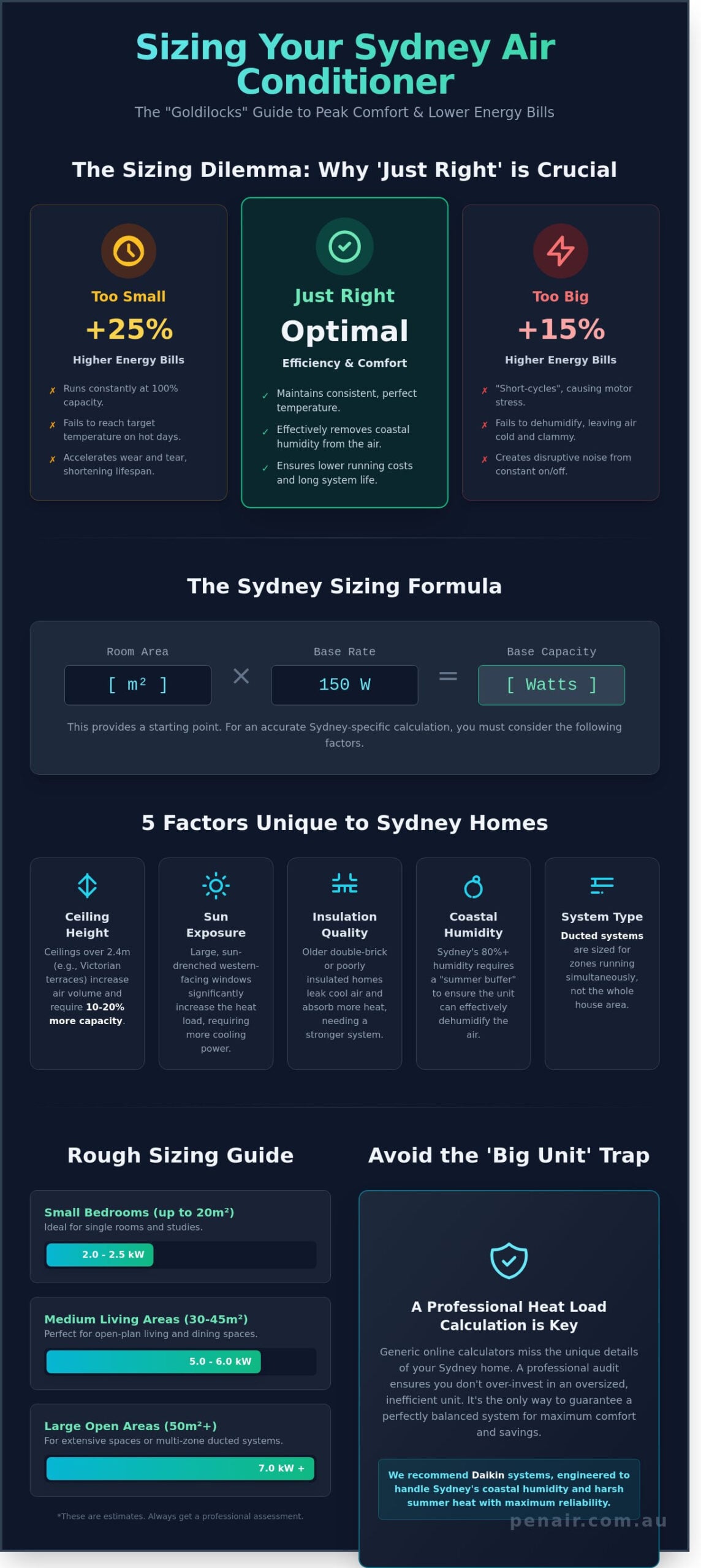
Installing a unit with insufficient kW output is a recipe for frustration and high costs. If the capacity is too low, the compressor must run at 100% speed indefinitely to try and reach your target temperature. This constant operation can lead to a 25% increase in your quarterly electricity bills compared to a correctly sized unit. On a blistering January afternoon in suburbs like Parramatta or Penrith, an under-sized system simply won’t keep up. You’ll find the temperature hovering at a sticky 26°C even when the thermostat is set to 21°C. This mechanical strain also accelerates wear, often leading to component failure years before the expected 15 year lifespan of a premium system.
It’s a common myth that “bigger is better” for air conditioning. If a system is too powerful for the space, it suffers from short-cycling. This means the unit turns on, blasts the room with cold air, and shuts off again within minutes because it hit the target temperature too fast. This rapid cycling is incredibly inefficient and puts massive stress on the motor. Because the unit doesn’t run long enough to complete a full cooling cycle, it fails to remove humidity from the air. You’re left with a room that feels cold but “clammy” or damp. You’ll also notice more noise as the heavy-duty fans kick in and out constantly, which can be quite disruptive in a quiet Sydney residential street. Finding the right what capacity ac do i need answer prevents these issues and ensures a dry, crisp, and comfortable indoor environment.
Determining the right size for your ducted system isn’t just about square metres. It’s about ensuring your home stays comfortable during a 38-degree January day without blowing your energy budget. To answer the common question, what size air conditioner do I need, we generally start with a baseline of 1.5kW of cooling capacity for every 10 square metres of living space. However, Sydney’s unique architecture requires some adjustments to this rule.
A Victorian terrace in the Inner West with 3.3-metre ceilings has a much larger air volume than a modern apartment in Mascot with 2.4-metre ceilings. If your ceilings are higher than the standard, you’ll likely need to increase your capacity by roughly 10% to 20% to account for that extra air. We also recommend a “Sydney Summer” buffer. Our local humidity makes the air feel heavier, so adding a slight margin ensures your system doesn’t struggle when the dew point climbs. It’s also vital to remember that ducted systems require a different calculation than split systems. While a split system cools one room, a ducted system is sized based on the total number of zones you plan to run at the same time.
While every home is different, these ranges provide a solid starting point for understanding what capacity ac do i need for typical Sydney room sizes:
Sydney’s microclimates play a massive role in system design. Homes on the Northern Beaches often benefit from coastal breezes that can lower the heat load on the building’s exterior. In contrast, Western Sydney suburbs often experience temperatures 5 to 8 degrees higher than the coast during peak heatwaves. We typically recommend Western Sydney residents increase their capacity by at least 10% to handle these extremes effectively.
Our team has been designing systems across these diverse regions since 1999, so we understand how a north-facing window in Parramatta affects your cooling needs differently than one in Manly. We take pride in being a family-owned business that treats your home comfort as our top priority. If you’re ready for a precise assessment, our expert consultants can visit your home to provide a tailored heat load calculation that guarantees performance.
When you ask yourself what capacity ac do i need, the answer involves much more than just measuring your floor space. At Peninsula Air Conditioning (PenAir), we have spent years helping Sydney families find the perfect fit, and we know that two houses with the exact same footprint can require completely different systems. A 1930s double-brick cottage in Ashfield has vastly different thermal properties compared to a modern, light-filled build in the Hills District.
Insulation quality is your first major variable. Older Sydney homes often lack ceiling or wall insulation, which means heat enters easily and stays trapped. Modern homes with high-density batts and reflective foil keep the cool air in, allowing for a smaller, more efficient unit. We also look at your ceiling height. If you have 3-metre ceilings instead of the standard 2.4-metre height, you have 25% more air volume to cool. This directly affects the load on your system.
Living near the coast is a dream, but salt air is a silent enemy of air conditioning hardware. On the Northern Beaches, salt spray can corrode the aluminium fins on your outdoor unit, reducing heat exchange efficiency by up to 15% within a few years. We frequently recommend units like Daikin’s Blue Fin range. This specialized coating protects the heat exchanger from salt damage. When we calculate what capacity ac do i need for coastal homes, we sometimes suggest a slightly higher capacity to ensure the system remains effective even as it ages in a harsh environment.
Sydney’s lifestyle revolves around indoor-outdoor living. While floor-to-ceiling glass doors look stunning, they act like a greenhouse. Even with high-quality tinting, standard glass allows significant heat gain. A room with 10 square metres of glass can require an extra 1.5kW to 2.0kW of cooling capacity compared to a room with standard windows. If you have invested in double glazing or heavy thermal curtains, we can often scale back the unit size. This saves you money on both the initial install and your quarterly energy bills.
Many Sydney homeowners fall into the trap of thinking a larger system guarantees a cooler home. In reality, an oversized unit is often less efficient and less comfortable. When a system is too large, it reaches the set temperature too quickly and shuts down, only to restart minutes later. This constant “short-cycling” spikes your electricity bills and puts unnecessary strain on the motor. Instead of guessing, we focus on helping you understand what capacity ac do i need based on the unique blueprint of your property.
As a family-owned business, we care more about your long-term comfort than making a quick sale on a massive unit you don’t actually need. A correctly sized system, professionally installed, typically pays for itself through energy savings within 3 to 5 years. By avoiding the “Big Unit” trap, you reduce your carbon footprint and keep your monthly running costs manageable.
During a PenAir site audit, we look beyond simple floor plans. We measure the total volume of your rooms in cubic metres, as high ceilings in Victorian terraces require significantly more cooling power than modern apartments. Our team also assesses your roof cavity to ensure there’s enough space for the ducting and the indoor fan coil unit. In older Sydney suburbs, we carefully check your existing electrical switchboard. If your home hasn’t been upgraded in 20 years, it might need a dedicated circuit to safely handle a powerful ducted system.
We often recommend Daikin inverter technology because it eliminates the old “all or nothing” approach to climate control. An inverter system acts like a car’s accelerator, gradually increasing or decreasing power to maintain a steady temperature. This flexibility means that even if you’re slightly unsure about what capacity ac do i need, the inverter can adjust its output to match the immediate load. For residents in the Northern Beaches, this technology is a lifesaver for neighbour relations. It runs much quieter than fixed-speed units, especially during those humid Sydney nights when the air is still.
We take pride in our consultative approach, ensuring you get a system that fits your lifestyle perfectly without overspending on power you’ll never use. Our goal is to provide quality service you can trust, backed by decades of local expertise.
Calculating the exact power required for your home goes beyond a simple floor plan measurement. While online tools offer a starting point, answering the question what capacity ac do i need requires a professional eye to account for ceiling heights, window orientations, and local insulation quality. At PenAir, we don’t believe in guesswork. We combine our technical expertise with premium Daikin technology to ensure your system performs efficiently on a 40-degree Sydney afternoon without skyrocketing your energy bills.
Sydney’s climate presents unique challenges, from sweltering humidity to corrosive salt air along the coast. We recommend Daikin systems because they are specifically engineered to handle these local conditions. Their advanced humidity control settings prevent that “sticky” indoor feeling during February heatwaves, while the built-in air purification features remove allergens and pollutants common in urban environments. If you live near the Northern Beaches, you’ll benefit from Daikin’s durable outdoor units. These systems feature specialized anti-corrosion coatings that protect internal components from salt-heavy winds, ensuring your investment lasts for years rather than seasons. As an authorized dealer, we provide the full weight of Daikin’s warranty and maintenance support to every customer we serve.
A generic “box” solution might seem cheaper initially, but an incorrectly sized unit leads to higher running costs and a shorter lifespan for the hardware. Our team focuses on finding the “Goldilocks” zone for your home: a capacity that isn’t so small it struggles to cool, yet isn’t so large that it cycles on and off constantly. This balance saves you money and provides a more consistent indoor temperature throughout the year.
We take pride in our reputation as a family-owned and operated business. Our goal is your long-term comfort, not a quick transaction. When you are ready to move from a rough estimate to a fixed formal quote, we visit your property to conduct a thorough site audit. We look at the small details, such as the number of occupants and the specific roofing materials, to ensure the capacity matches your lifestyle. Contact our family team at PenAir today for an expert sizing audit. Whether you are in the Northern Beaches or across the wider Sydney area, we are here to provide the peace of mind that comes with a perfectly sized air conditioning system.
Finding the answer to what capacity ac do i need involves more than a simple floor plan measurement. You’ve got to consider Sydney’s unique coastal humidity and the specific heat loads of your Northern Beaches or North Shore property. Since 1999, our family-owned team has helped locals navigate these variables to find the perfect balance between power and efficiency. We know that an oversized unit wastes energy, while an undersized one fails during a January heatwave. As an Authorised Daikin Specialist Dealer, we provide the technical precision required to ensure your system performs exactly when you need it most.
Don’t leave your home’s comfort to guesswork or generic online calculators. Our technicians bring over 25 years of local experience to every consultation, ensuring your new installation is tailored to your specific lifestyle. We’re here to help you achieve a cool, cost-effective home without the stress of technical jargon. Reach out to our friendly team today to get started on a solution that lasts for years to come.
Get a Professional AC Sizing Audit for Your Sydney Home
We look forward to helping you create a more comfortable living space for your family.
Yes, a 2.5kW unit is the standard choice for a typical Sydney bedroom measuring between 10 and 20 square metres. We find this capacity provides enough power to cool a room with 2.4m ceilings even when the outdoor temperature hits 35 degrees. If your bedroom faces west or has large windows without eaves, we might suggest a slightly larger 3.5kW model to handle the extra solar heat load.
You typically need a unit with a capacity between 7.1kW and 8.0kW for a 50 square metre open-plan living area. This calculation follows the industry standard of 150 watts per square metre for Sydney’s humid climate. If your home has an open staircase or connects directly to a kitchen with heat-generating appliances, we often recommend the higher end of that range to maintain a consistent 22 degree indoor environment.
Yes, ceiling height significantly changes the volume of air that your system must cool or heat. Most standard capacity guides assume a 2.4m ceiling, so if your Sydney home features 3m ceilings, you should increase your capacity requirement by approximately 25 percent. A room with 4m cathedral ceilings requires a much larger unit because the total cubic metres of air can be double that of a standard room.
You can often reduce your required capacity by 15 to 20 percent if your home features R-4.0 ceiling batts and double-glazed windows. These energy-efficient features create a tighter thermal envelope that prevents cool air from escaping. When we visit for a consultation, we check your insulation levels because a well-insulated home allows you to run a smaller, quieter system that costs less to operate throughout the year.
An oversized unit will frequently “short cycle,” which means it turns on and off too quickly without completing a full cooling cycle. This process prevents the system from removing humidity, leaving your room feeling cold but clammy. It also increases wear on the compressor and can raise your electricity bills by 10 to 15 percent because the motor uses the most energy during the start-up phase.
To determine what capacity ac do i need for a ducted system, we calculate the total floor area of the largest zones you intend to run simultaneously. For a standard 150 square metre Sydney home, a 12.5kW to 14kW system is usually sufficient. We don’t just measure the whole house; we look at your lifestyle to see which rooms need cooling at the same time to ensure peak efficiency.
Coastal homes in suburbs like Manly or Cronulla often face 10 percent higher humidity levels and corrosive salt air that affects heat exchange. We recommend units with “Blue Fin” or “Gold Fin” anti-corrosive coatings and slightly higher latent cooling capacities to pull moisture from the air effectively. This ensures your system doesn’t just lower the temperature but actually makes the air feel crisp and comfortable during a 70 percent humidity day.
Most modern reverse cycle systems in Sydney are sized based on their cooling capacity because our summers are typically more demanding than our winters. However, a unit’s heating output is often slightly higher than its cooling output; for example, a 7.1kW cooling unit might provide 8.0kW of heating. We ensure the system meets your needs for both seasons, especially since Sydney winter nights can drop to 5 degrees in inland suburbs.