Imagine it’s a humid 38-degree afternoon in Sydney, and your aircon suddenly stops, leaving you with nothing but a blinking light and a cryptic error code. It’s a stressful moment, especially when you’re worried about the potential cost of a technician visit during a peak summer heatwave. We understand that your home’s comfort is a top priority, and often, a simple system reboot is all that stands between you and a cool lounge room. Learning how to reset Daikin air conditioner controller units is a vital skill for any Sydney homeowner, as it allows you to clear minor glitches and regain control of your climate immediately.
We know you want to ensure your system is running efficiently without spending money on unnecessary service calls. In this guide, we will walk you through the exact steps to reset various models, including the Daikin AirHub Touch and the Nav Ease Wall Controller. You will learn how to perform a safe power cycle and how to determine if a fault code indicates a minor hiccup or a more serious mechanical issue. Our goal is to provide the peace of mind that comes from expert local knowledge, helping you get your home back to the perfect temperature with confidence.
Modern air conditioning systems from Daikin Industries are marvels of engineering, but they’re also essentially high-powered computers. Just like your laptop or smartphone, the sophisticated circuit boards inside your unit can occasionally experience a software “hang” or a logic error. In our experience across Sydney, these glitches are often triggered by external factors rather than internal failures. For instance, the sudden power surges that accompany our intense summer storms or minor fluctuations in the local electrical grid can confuse the system’s sensors. These events cause the software to lock up as a protective measure, requiring a manual refresh to get things moving again.
If you live in coastal suburbs like Palm Beach or along the Northern Beaches, salt air can also play a role. While Daikin units are built for durability, microscopic salt particles can sometimes cause temporary sensor interference, leading to an unnecessary error code. Learning how to reset Daikin air conditioner controller settings is the first step in determining if you’re facing a simple electronic hiccup or a genuine mechanical issue. It’s a practical diagnostic tool that every homeowner should have in their kit.
There is a distinct difference between a “soft reset” and a “hard reset”. A soft reset involves using the buttons on your wall-mounted or handheld controller to clear a message or restart the interface. A hard reset is more thorough; it involves cutting power at the outdoor isolator switch. This switch is usually a large white handle located near your outdoor condenser unit. Turning this off for a few minutes allows the system to completely drain its residual energy and force a full system reboot, which often clears deeper software conflicts that a simple button press cannot reach.
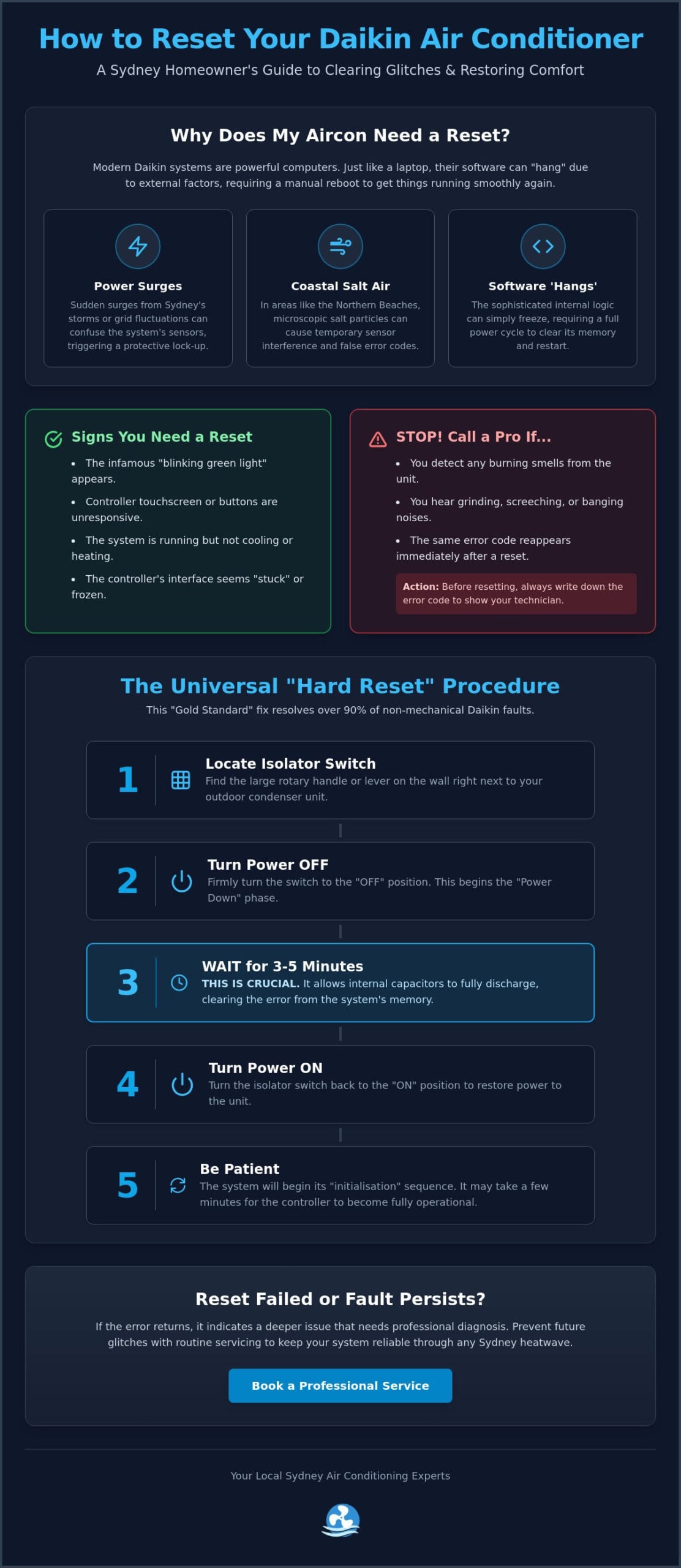
You’ll usually know something is wrong when you see the “blinking green light” on your indoor unit. This is the system’s way of saying it has detected an anomaly and has entered a protective “fail-safe” mode. You might also notice unresponsive touchscreens or frozen buttons on your wall-mounted unit. Sometimes, the system is running but not cooling or heating as you’ve organised. If the interface feels “stuck”, a reset is often the quickest path back to comfort.
While a reboot fixes many issues, it isn’t a cure-all. You should never attempt a reset if you detect a burning smell or hear grinding noises coming from either the indoor or outdoor unit. These are clear indicators of mechanical failure or electrical shorts. Additionally, if an error code reappears immediately after you’ve learned how to reset Daikin air conditioner controller models, don’t keep trying. Repeatedly clearing a fault can mask a serious compressor problem, potentially leading to more expensive repairs. Always write down the specific alphanumeric code before you wipe the memory so you can tell your technician exactly what happened.
When your wall unit isn’t responding and the usual button presses fail, it’s time to perform the “Gold Standard” fix. This procedure resolves roughly 90% of non-mechanical faults we see across Sydney homes. While learning how to reset Daikin air conditioner controller menus is helpful for minor errors, a hard reset clears the system’s internal logic boards more effectively by completely removing power. It’s the most reliable way to force the indoor and outdoor units to communicate properly again.
The first step is to locate your outdoor isolator switch. This is usually a large white or grey rotary handle or lever located on the wall right next to your outdoor condenser unit. Once you find it, turn the switch to the “OFF” position. This begins the “Power Down” phase. You must wait exactly 3 to 5 minutes before turning it back on. This delay is crucial because the electrical capacitors inside the Daikin system need time to fully discharge their stored energy. If you flick the switch back on too quickly, the microprocessors may retain the old error state, and the reset will fail.
After the wait is over, turn the isolator back to the “ON” position. You’ll hear the system begin its “initialisation” sequence. During this time, the indoor and outdoor units perform a digital handshake to synchronise their settings. It may take a few minutes for the controller to become fully operational again, so please be patient while the system stabilises. If you find this process daunting or the switch is difficult to reach, you can always reach out to our local team for a bit of over-the-phone guidance.
In many Northern Beaches home layouts, the outdoor unit is tucked away down a side passage or mounted high on a wall bracket. If you can’t find a dedicated isolator switch near the unit, your next best option is the main electrical switchboard. Look for a circuit breaker clearly labelled “AC” or “Air Conditioning”. If the outdoor isolator appears weathered or stuck due to the salt air, do not force it. Using the switchboard is a safer alternative that achieves the exact same result for your system’s electronics.
Your safety is our absolute priority. An isolator switch is the primary safety disconnect for HVAC units. While it is perfectly safe to operate this external switch, you must never attempt to open the electrical panels of the indoor or outdoor units yourself. Always ensure your hands are dry and you are standing on a dry surface before touching any electrical switches or controllers. To keep your system in peak condition and reduce the frequency of these glitches, we recommend annual professional maintenance to check all electrical connections and sensor accuracy.
Daikin technology has evolved significantly over the years, which means the process for a reboot depends entirely on which generation of tech is installed in your home. A system installed in a 2015 Mona Vale renovation will have a very different interface compared to a 2026 smart home setup. Understanding the nuances of your specific interface is key when learning how to reset Daikin air conditioner controller units effectively without causing further confusion for the system’s logic board.
The Nav Ease (BRC1E63) is the reliable, backlit workhorse found in many ducted systems across Sydney. If your screen is displaying a minor error, the “Cancel” button is your primary tool; holding it down for five to ten seconds can often clear temporary “intermittent” faults. If you have recently cleaned your filters, you’ll need to navigate the menu to the “Reset Filter Indicator” to clear the maintenance reminder. Should the screen remain blank after a power restoration, give it ten minutes to re-establish communication with the indoor unit before assuming there is a hardware failure.
Modern homes often feature the sleek Madoka (BRC1H61) Bluetooth interface. This controller uses a circular touch ring rather than traditional buttons. To access the service menu for a reset, you typically need to hold the “Menu” touch-point while scrolling through the hidden settings. If you are using the Daikin Airbase app and find it unresponsive, the issue often lies in the Wi-Fi module rather than the aircon itself. We often find that following U.S. Department of Energy maintenance guidelines for regular cleaning prevents the sensors in these high-tech controllers from triggering “false positive” errors in the first place.
For split systems, the reset process is usually handled via the handheld remote. Before attempting a deep reset, always replace the batteries with fresh ones; weak voltage can cause the remote to send garbled signals that the indoor unit ignores. Most Daikin remotes feature a tiny, recessed “Reset” button that requires a paperclip or a pin to press. If your model lacks this pinhole, a common sequence involves holding the “On/Off” button while simultaneously pressing the “Temp Up” and “Temp Down” buttons. This forces the remote to resynchronise its frequency with the wall unit, which is a common fix if the controller seems to have “lost” its connection.
If you have followed the steps on how to reset Daikin air conditioner controller units and the error code disappears only to return ten minutes later, you are likely dealing with a persistent fault rather than an intermittent glitch. A glitch is typically a one-off software hang caused by a minor power fluctuation; a persistent fault indicates that a physical or electrical component is genuinely struggling. Before you assume the worst, we recommend taking a quick walk outside to inspect your condenser unit. In Sydney, we often find that outdoor units are obstructed by fallen gum leaves or, quite commonly, local lizards seeking warmth near the circuit boards. These physical blockages can trigger safety sensors, and no amount of resetting will fix the issue until the obstruction is cleared. If the unit is clear but the fault remains, a professional air conditioning service is the next logical step to clear deep-seated system errors and protect your warranty.
When a reset fails, the alphanumeric code on your screen is your best diagnostic tool. Common codes like U4 usually point to a communication error between the indoor and outdoor units, which might mean a data cable has come loose or a terminal board has failed. An L5 code is more serious, as it often indicates an inverter fault or a compressor issue. Some codes are simply maintenance prompts to clean your filter, while others are urgent warnings to stop using the unit immediately to prevent further damage. For a comprehensive breakdown of what these icons mean for your specific system, check out our guide on Daikin Air Conditioner Symbols Explained.
We always advise our local community to follow the “three strikes” rule. If your system trips the circuit breaker or displays the same fault three times in a row, stop attempting to reset it. Forcing a compressor to start when a capacitor has already failed or when there is a refrigerant leak puts immense strain on the motor. Continuing to reset a failing system can turn a simple component fix into a total system replacement. Investing in timely air conditioning repairs is the most cost-effective way to ensure long-term reliability and keep your home comfortable. If your Daikin is still refusing to cooperate after your best efforts, get in touch with our friendly team to book a professional diagnostic visit.
Knowing how to reset Daikin air conditioner controller units is a valuable skill for any homeowner, but the ultimate goal is to ensure those frustrating glitches don’t happen in the first place. Most electronic “hangs” and sensor faults are actually preventable through consistent care. Over time, dust and microscopic debris build up on sensitive internal components, which can cause the system to work harder and eventually trigger a safety shutdown. In our humid Sydney climate, this buildup can also lead to moisture-related sensor errors that a simple reboot won’t permanently fix. By keeping the internals clean, you ensure the computerised heart of your system can “breathe” and function without the stress that leads to software errors.
As a Daikin Specialist Dealer, we take a proactive approach to system health. Regular professional cleaning and calibration ensure that your sensors are reading accurately, which significantly reduces the frequency of those blinking lights. This is particularly vital for ducted air conditioning systems, where the complexity of the ductwork and zone controllers requires a steady hand and technical expertise to maintain. A well-maintained system doesn’t just run more reliably; it also operates with much higher energy efficiency, saving you money on your quarterly power bills while extending the lifespan of your investment.
For those living along the Northern Beaches, a pre-summer service is a vital step to combat the corrosive effects of salt air and high humidity. These local environmental factors can cause premature wear on electrical terminals and sensors if left unchecked. By organising a professional check-up before the peak heat hits, you can avoid the stress of a system failure on a 40-degree day and the potential for expensive emergency repairs. It’s about being prepared so you can enjoy your home’s comfort without a second thought.
We have been a family-owned fixture in the Sydney community since 1999, bringing over 25 years of local expertise to every job. Our team, based in Warriewood, understands the specific needs of households across the region. A professional diagnostic check from our specialists goes far beyond a simple reset. We inspect the refrigerant levels, test the electrical draw of the compressor, and deep-clean the coils to ensure everything is performing to the manufacturer’s high standards. We pride ourselves on being honest, hardworking, and deeply rooted in our community.
Don’t wait for an error code to appear before you think about your system’s health. We invite residents in Mona Vale, Palm Beach, and the surrounding areas to organise a comprehensive maintenance visit today. Our consultative style ensures you get the best advice for your specific setup without any high-pressure tactics. No worries, we’ll get your comfort back on track and ensure your home remains a sanctuary all year round.
Mastering how to reset Daikin air conditioner controller units is a valuable first step in managing your home climate, especially when dealing with minor glitches after a Sydney summer storm. We have covered the essentials of power cycling your system and navigating specific model interfaces like the Nav Ease and Madoka. However, if a fault persists after a reboot, it is usually a sign that your system requires a more thorough technical assessment to prevent long-term damage to the compressor or electronics.
As an Authorised Daikin Specialist Dealer and a family-owned Sydney business since 1999, we are here to provide the expert support you need. Our fully licensed and insured HVAC technicians have the local experience to diagnose complex issues that a simple reset cannot fix. Whether you need a routine pre-summer check or a detailed repair, our team is committed to looking after your household’s well-being. Book a Professional Daikin Service with PenAir Today to ensure your system remains reliable through the peak heat. We look forward to helping you stay cool and relaxed in your own home.
You can reset your system by switching off the power at the outdoor isolator switch or your home’s main electrical switchboard. This method is the most effective way to perform a hard reset if your handheld remote is missing or unresponsive. Simply turn the switch to the “OFF” position, wait for five minutes, and then turn it back on to allow the system to re-initialise.
A blinking green light after a reboot indicates that the system has detected a persistent mechanical or electrical fault that a reset cannot clear. While learning how to reset Daikin air conditioner controller units can resolve minor software “hangs”, a light that continues to flash means the safety sensors have triggered again to protect the compressor from damage. You should note any error codes and contact a specialist.
A standard power cycle typically won’t wipe your programmed weekly schedules, but it might reset the current time and date on older models. Most modern Daikin controllers feature a small amount of internal memory designed to preserve your custom settings during short power outages. If your clock starts flashing after a reset, you’ll simply need to re-enter the correct time to resume your normal schedule.
We recommend leaving the power off at the isolator or circuit breaker for exactly 3 to 5 minutes. This specific duration ensures that all residual electrical charge has completely drained from the system’s internal capacitors. If you restore power too quickly, the microprocessors may retain the old error state, which prevents the system from starting with a completely fresh logic sequence.
The U4 code signifies a communication failure between your indoor and outdoor units. This is one of the most common codes we see in Sydney, often caused by a loose data wire or a temporary signal interruption. While a hard reset can sometimes clear a “ghost” U4 error, a persistent code usually requires a technician to check the physical wiring and terminal boards.
Yes, a heavily blocked filter can definitely cause your controller to display error codes or appear frozen. Restricted airflow leads to internal temperature imbalances that confuse the system’s sensors, often resulting in a protective shutdown to prevent the indoor coils from icing up. Regularly cleaning your filters is the best way to prevent these “false” faults from interrupting your comfort.
No, there is no dedicated “reset” button on the outdoor condenser unit itself. The only way to reset the outdoor component’s electronics is to use the large white isolator switch located on the wall nearby or the dedicated circuit breaker in your electrical board. Operating this switch performs a full power cycle for both the indoor and outdoor components simultaneously.
You should only reset your system when you encounter a specific operational glitch or a software “hang”. It isn’t a substitute for regular maintenance. If you find you are constantly searching for how to reset Daikin air conditioner controller settings to keep the unit running, it’s a clear sign that an underlying mechanical issue needs professional attention to ensure long-term reliability.