Imagine waking up at 3 AM in your Sydney home, not because of a noise outside, but because you’re struggling to breathe through a blocked nose again. For the 2.8 million Australians living with asthma, this isn’t just a bad night; it’s a daily reality that impacts your quality of life. We understand how frustrating it is to clean your house constantly only to see dust return or to worry about mould growth in our humid coastal air, from the Northern Beaches to the Eastern Suburbs. You want your home to be a sanctuary, not a source of respiratory triggers.
Finding the best air conditioning for allergies and asthma Australia shouldn’t feel like deciphering a technical manual full of confusing marketing jargon. This guide will help you cut through the noise and discover which systems actually deliver on their health claims. We’ll explore the latest “Sensitive Choice” technologies from brands like Daikin, explain how to manage humidity effectively, and show you how a professional maintenance routine from our team at Peninsula Air Conditioning (PenAir) can keep your indoor air fresh and clean for your family. It’s time to stop guessing and start breathing easier in your own home.
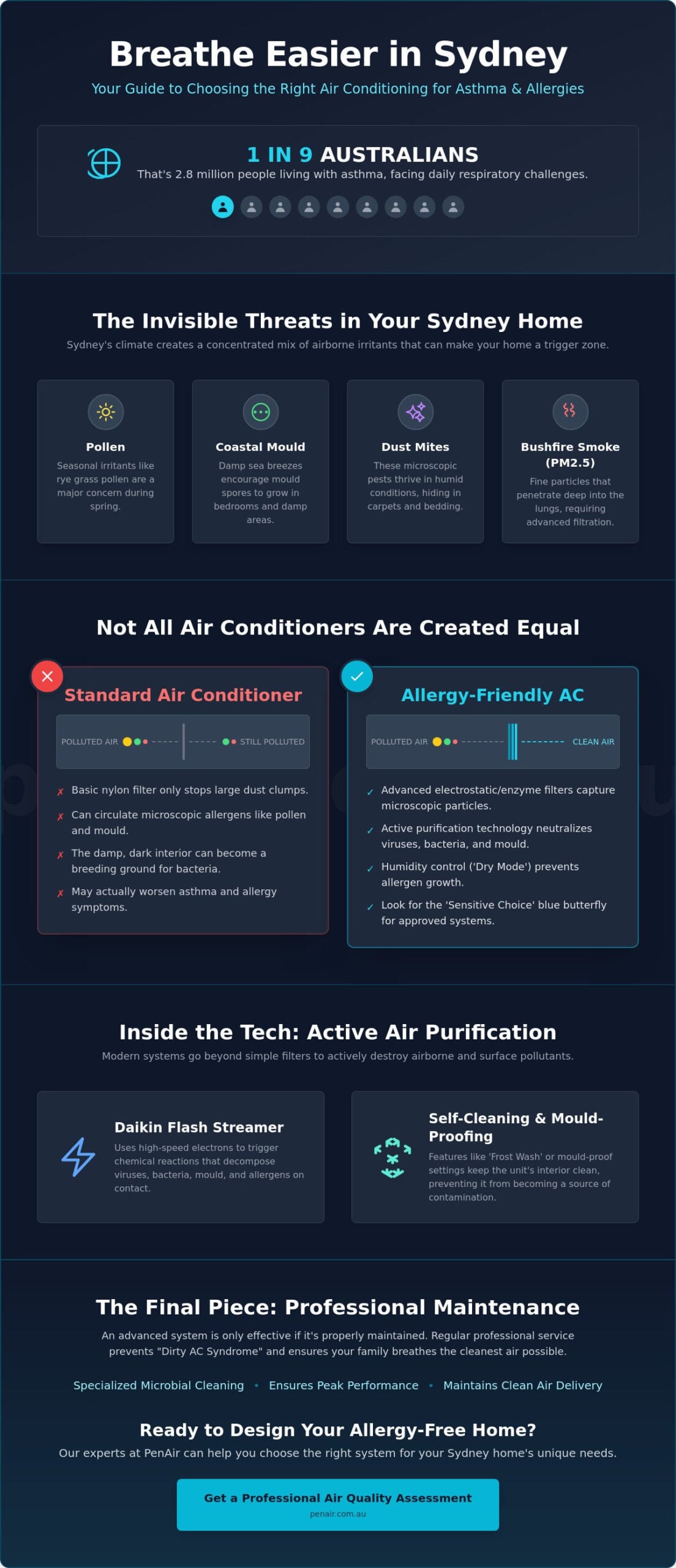
Safe, healthy living starts with the air we breathe inside our own four walls. Understanding Indoor Air Quality (IAQ) involves looking at how pollutants, humidity levels, and ventilation impact our respiratory health. This is a critical issue for our community; as of April 2026, data from the National Asthma Council Australia shows that one in nine Australians, or approximately 2.8 million people, live with asthma. In a coastal city like Sydney, the air might feel fresh outside, but indoor environments can trap a concentrated mix of triggers that make daily life difficult for sensitive residents.
Local homes face a specific set of challenges that can’t be solved by a one size fits all approach. We often see families struggling with rye grass pollen during the spring, while the damp sea breeze brings coastal mould spores into bedrooms in the Northern Beaches and Eastern Suburbs. Dust mites also thrive in these conditions, hiding in carpets and bedding. When you’re searching for the best air conditioning for allergies and asthma Australia, you need a system that does more than just move air around. It must be capable of capturing these specific local irritants before they reach your lungs.
It’s a common mistake to assume that any cooling system will improve your health. In reality, a standard air conditioner with basic nylon mesh filters might actually worsen your symptoms. These simple filters are designed to protect the machine’s internal parts from large dust clumps, not to protect your family from microscopic allergens. Without advanced filtration, a unit can become a dark, damp home for bacteria. This is why choosing the best air conditioning for allergies and asthma Australia requires looking closely at the purification technology under the hood.
High humidity is a major hurdle for homeowners in suburbs near the water. When indoor humidity levels climb above 60%, it creates a perfect breeding ground for dust mites and mould colonies. This is particularly noticeable in coastal Sydney properties where the salt air and moisture are constant. Dry Mode is a primary tool for allergen suppression that reduces humidity without significantly dropping the temperature. By keeping your home’s moisture levels in check, you’re actively preventing the growth of the very triggers that cause waking up with a blocked nose or wheezing.
Seasonal bushfire haze remains a serious concern for the Sydney basin. These events fill the air with fine particulate matter, known as PM2.5, which are tiny enough to travel deep into the respiratory system. Standard filters are useless against these microscopic threats. High quality systems use advanced electrostatic or enzyme filters to trap these particles. During periods of poor outdoor air quality, we always recommend using your system’s recirculation mode to ensure you’re cleaning the air already inside your home rather than pulling in smoke from outside.
When you’re looking for the best air conditioning for allergies and asthma Australia, you need to look beyond the temperature display. High quality units act as a 24-hour air treatment plant for your home. While basic models rely on a simple nylon mesh to catch hair and large dust, premium systems use electrostatic and enzyme filters to grab microscopic particles. These advanced filters don’t just hold the dust; they often use special coatings to break down allergens on contact. This prevents the “filter blowback” that occurs when an old, dirty filter starts releasing particles back into your living room.
Modern technology has moved toward active purification. Daikin’s Flash Streamer technology is a standout, using high speed electrons to decompose viruses, bacteria, and mould. Panasonic’s nanoe™ X works similarly by releasing hydroxyl radicals to inhibit pollutants. This level of protection is vital because the health effects of poor indoor air quality can range from mild throat irritation to severe asthma attacks. We often recommend units with built-in sensors that detect spikes in dust or smoke and automatically ramp up the purification level in real-time. Self-cleaning functions, such as “Frost Wash” or mould-proof settings, are also essential. These features dry out the internal heat exchanger after use, ensuring that your system doesn’t become a damp breeding ground for the very triggers we discussed earlier.
It helps to understand that there are two ways to clean your air. Mechanical purification involves a physical barrier, like a filter, that traps particles as air passes through. Electronic purification, such as ionisers or streamers, actually deactivates the biological threat. For the most robust protection, we suggest a system that combines both. While you might see mentions of HEPA filters, these are rare in residential split systems because they restrict airflow. Instead, look for high Clean Air Delivery Rate (CADR) ratings which show how efficiently the unit cleans a specific room volume. This combination ensures that the best air conditioning for allergies and asthma Australia provides a multi-layered defense for your family.
Controlling moisture is just as important as filtering dust. We find that many families in Sydney coastal suburbs benefit from using the “Dry Mode” during our humid months. Lowering humidity helps stabilize the respiratory tract and prevents the heavy, “wet” air that makes breathing difficult for asthma sufferers. Daikin air conditioning leads the market here with their Ururu Sarara technology, which can precisely control humidity without over-cooling your room. Keeping your home at a steady 24°C is often better for your health than rapid, icy bursts of air that can shock sensitive airways.
Choosing the right features can feel overwhelming, but our team at Peninsula Air Conditioning (PenAir) is here to help you navigate these technical specs. If you’re unsure which technology fits your home’s layout, we can provide a consultative audit to find your perfect match. Chat with our local experts today to see how these systems can transform your indoor environment.
When you see a small blue butterfly on a product in Australia, it carries a lot of weight for your family’s health. This symbol belongs to the National Asthma Council Australia’s Sensitive Choice program. It’s an independent initiative that identifies products and services that may benefit people with asthma and allergies. Choosing the best air conditioning for allergies and asthma Australia often starts with this certification. Research consistently shows the direct link between asthma and indoor air quality, so having a system that has been rigorously reviewed provides genuine peace of mind.
The Daikin US7, also known as the Ururu Sarara, is widely considered the gold standard for indoor air quality. It’s unique because it doesn’t just cool or heat; it can humidify, dehumidify, and even bring in fresh, filtered outdoor air without you needing to open a window. This level of control is rare in residential systems. While many brands claim to help with respiratory health, as of May 2026, Daikin is the only split-system air conditioner brand approved by the Sensitive Choice program to carry that blue butterfly symbol. This includes their popular Alira X, Zena, and Cora models, which we frequently install for families across the Mornington Peninsula.
The secret behind Daikin’s success is their Flash Streamer technology. This system discharges high-speed electrons that collide with and decompose protein chains in allergens like pollen and mould. It works alongside a Titanium Apatite Deodorising Filter to trap microscopic particles and neutralize odours. Because these electrons are so effective at breaking down the structure of pollutants, the air coming out of the unit is significantly cleaner than the air going in. We find this technology is a game-changer for residents in suburbs like Mount Martha or Mornington where seasonal pollens can be particularly aggressive.
While Daikin holds the exclusive Sensitive Choice butterfly for split systems, Panasonic offers a compelling alternative with their nanoe™ X technology. This system uses hydroxyl radicals, which are often called “nature’s detergent,” to inhibit pollutants and odours. One major benefit of Panasonic units is their ability to run the air purification mode independently of the cooling or heating function. This means you can keep cleaning your air 24 hours a day with very low energy consumption. For homes in the Sydney basin that experience high levels of traffic pollution or seasonal haze, this constant purification can be a significant advantage.
Choosing between these premium brands depends on your home’s specific needs. Daikin tends to lead in humidity control and ventilation, while Panasonic offers versatile purification. Because these systems use complex sensors and advanced hardware, they require a “Specialist Dealer” for installation. Our team at Pen Air is trained to calibrate these units correctly, ensuring the sensors accurately detect local contaminants. A poor installation can bypass these health benefits entirely, which is why we take a consultative approach to every home we look after.
Hardware is only half the battle. Even if you purchase the best air conditioning for allergies and asthma Australia, a poor installation or neglected maintenance can turn a premium system into a health liability. We often encounter “Dirty AC Syndrome” in local homes. This happens when dust and moisture accumulate inside the dark, damp recesses of the unit, creating a literal mould factory. Every time you turn the system on, it blows microscopic spores and old dander directly into your breathing zone. A simple filter rinse under the tap isn’t enough to stop this; it requires a deep, professional approach to keep the air truly pure.
Correct sizing during the installation phase is equally vital for respiratory health. Many homeowners believe that a more powerful unit is always better, but an oversized system leads to “short-cycling.” This means the unit reaches the target temperature so quickly that it shuts off before it has a chance to properly dehumidify the air. You’re left with a cold but “sticky” room, which is the ideal environment for dust mites to thrive. Our team ensures your system is perfectly calibrated to your room’s volume to maintain that critical balance of temperature and low humidity. If you want to ensure your home remains a sanctuary, book your professional air quality service with Pen Air today.
A comprehensive air conditioning service Sydney must go beyond the basics to protect sensitive family members. We focus on a microbial deep clean that targets the barrel fan and the drain pan, areas where bacteria often hide. This level of care ensures that the advanced purification technology you’ve invested in, like Daikin’s Streamer, can actually do its job effectively without being overwhelmed by internal buildup.
While split systems are excellent for single rooms, ducted air conditioning Northern Beaches offers a superior solution for larger family homes. Modern ducted setups allow for secondary filtration modules to be integrated directly into the main air path. These modules can catch significantly more particulate matter than a standard unit. Zoning technology also provides a unique health benefit; you can isolate a “clean air room” for a child with severe asthma, ensuring their sleeping environment remains free from the triggers present in the rest of the house.
We believe that a healthy home is built on local knowledge and personal accountability. While big-box retailers might sell you a box, they don’t live in your neighborhood or understand the specific challenges of coastal mould in Warriewood or the heavy pollen counts on the North Shore. As a family-owned business serving these communities since 1999, we take your family’s health personally. We’ve spent over 25 years refining our approach to ensure that your climate control system doesn’t just change the temperature but actually improves the air you breathe. Our goal is to provide you with the peace of mind that comes from knowing your home comfort is in safe, capable hands.
Our consultative approach sets us apart from standard installers. When we perform a site audit, we aren’t just measuring room dimensions; we’re conducting a comprehensive air quality assessment. This includes looking for potential mould risks, identifying dust accumulation zones, and discussing your family’s specific respiratory needs. By taking the time to understand these factors, we can recommend the best air conditioning for allergies and asthma Australia specifically tailored to your home’s layout and local environment. We pride ourselves on craftsmanship and a genuine care for the local residents we serve.
We are proud to be an authorised Daikin Specialist Dealer. This status gives our customers exclusive access to the latest 2026 models featuring upgraded air purification firmware that isn’t available through general retailers. These systems are designed to work in tandem with the Sensitive Choice program’s standards, providing a level of protection you can trust. We don’t believe in a one-size-fits-all solution. Instead, we match the right filtration technology to your specific allergy profile, whether you need heavy-duty pollen capture or advanced smoke deactivation. This ensures your system delivers on its health claims from the moment it’s switched on.
Precision and cleanliness are the hallmarks of a Pen Air installation. We treat your home with the same care we’d treat our own, ensuring that the manufacturer’s indoor air quality (IAQ) ratings are preserved through meticulous setup and sealing. Whether you’re in Sydney’s Eastern Suburbs, the Northern Beaches, or the North Shore, our team is ready to help you design a sanctuary where your family can breathe easy. It’s time to move beyond standard cooling and invest in a system that looks after your well-being. Contact PenAir today for an asthma-friendly AC quote and experience the difference that local expertise and traditional values make for your home environment.
Creating a healthy home environment is about more than just picking a brand from a shelf. It requires a strategic combination of the right hardware, precise installation, and ongoing care. We’ve seen how Daikin’s “Sensitive Choice” technology can transform a living space, but its performance depends on keeping the internal components free from mould and dust. Our specialised microbial deep-clean maintenance services ensure your system stays as effective as the day it was installed.
As a family-owned and operated business serving our community since 1999, we’re proud to be an authorised Daikin Specialist Dealer. We understand the unique climate challenges of our local suburbs and the peace of mind that comes from knowing your family is breathing clean air. Selecting the best air conditioning for allergies and asthma Australia is an investment in your well-being that pays off every single day. You don’t have to settle for air that triggers your symptoms.
Breathe easier with a professional Daikin installation from PenAir; get your free quote today. We look forward to helping you breathe better every day.
The Sensitive Choice program is a National Asthma Council Australia initiative that helps consumers identify products that are asthma and allergy-friendly. Air conditioners carrying the blue butterfly symbol have undergone independent expert reviews to ensure they effectively manage triggers. As of 2026, Daikin remains the only split-system brand approved to carry this certification, giving our customers confidence that their unit meets the highest standards for respiratory health.
Modern air conditioning helps by filtering out common triggers like pollen, dust, and fine particulate matter before they enter your lungs. By providing constant air purification and moisture control, these systems create a stable environment that reduces the risk of attacks. Choosing the best air conditioning for allergies and asthma Australia means investing in a system that actively deactivates biological threats rather than just cooling the air.
We recommend cleaning your primary filters every two weeks if you or your family members suffer from severe allergies. Regular rinsing prevents the buildup of pet dander and dust, which can otherwise break down and bypass your system’s secondary purification layers. While home cleaning is essential, you should also book a professional microbial clean once a year to remove mould and bacteria from the internal components we can reach.
You generally don’t need a separate portable purifier if your system uses advanced technology like Daikin’s Flash Streamer. These built-in purifiers are designed to deactivate viruses and mould as air passes through the unit, providing whole-room protection. However, in very large open-plan homes on the Mornington Peninsula, a secondary purifier can sometimes help in “dead air” zones where the main system’s circulation might be less effective.
Both systems offer excellent health benefits, but ducted air conditioning provides more comprehensive whole-home protection. Ducted setups allow us to install high-capacity filtration modules in the main air path, cleaning every room simultaneously. Split systems are often better for creating targeted “clean zones” in specific areas like a bedroom, where you can maintain a purified environment for a better night’s sleep without running the whole house.
Mould inside your unit will cause it to blow microscopic spores directly into your home, often leading to a musty smell and increased wheezing. This growth typically happens in the dark, damp areas like the drain pan or the barrel fan. If you notice a smell or a spike in symptoms, it’s vital to call our team for a microbial deep clean rather than using hardware store sprays that don’t reach the source.
Most primary filters are permanent and only require regular washing with water, so they don’t cost anything to maintain. Specialized secondary filters, such as Titanium Apatite or enzyme filters, usually need replacing every two to three years. We find that the cost of these replacements is very reasonable when compared to the significant health benefits and the peace of mind they provide for sensitive family members.
Dry Mode is highly effective because it lowers indoor humidity to levels where dust mites simply cannot survive. These pests require humidity levels above 60% to thrive and breed, so keeping your home between 40% and 50% is a powerful way to reduce triggers. Using this function on your best air conditioning for allergies and asthma Australia is one of the most effective ways to manage the humid coastal air we often experience.