If you’re waiting for a government cheque to arrive in the mail after upgrading your cooling, you might be waiting forever. In 2026, the secret to saving isn’t a post-purchase rebate; it’s an upfront discount applied directly to your quote before the work even begins. We understand that trying to lower your electricity bills while deciphering complex government criteria can feel like a full-time job. Most Sydney homeowners are eager to switch to a premium Daikin system but feel stuck between rising energy costs and confusing fine print.
This guide simplifies everything you need to know about energy efficient air conditioning rebates NSW 2026. You’ll learn how to navigate the Energy Savings Scheme (ESS) and the Peak Demand Reduction Scheme (PDRS) to secure significant discounts on high-efficiency units. We promise to show you a clear path toward a premium system without the paperwork headache. We’ll preview the eligibility rules, explain why our team handles the technical certificates for you, and help you organise a professional installation that keeps your home cool and your running costs low.
The year 2026 marks a significant turning point for Sydney homeowners looking to upgrade their home comfort. While many people still use the term “rebate,” the reality is much more convenient for your household budget. Under the current state schemes, you don’t have to pay full price and wait months for a government cheque to arrive in the mail. Instead, the incentive acts as an upfront discount that we apply directly to your installation quote. This shift is a core part of how the state aligns with Australia’s national energy policy, focusing on immediate financial relief to encourage greener choices.
The primary goal here is two-fold. The NSW government wants to lower household emissions by getting rid of power-hungry old units while simultaneously reducing the massive strain on our electricity grid during those sweltering Sydney summer afternoons. By choosing a high-efficiency system now, you’re helping the whole community stay powered up. 2026 is a critical year to act because these specific incentive levels are tied to current scheme targets that may change as we get closer to the next decade. Taking advantage of these energy efficient air conditioning rebates NSW 2026 ensures you get the best technology at a significantly reduced entry price.
Gone are the days of filling out endless forms after your unit is already on the wall. The NSW government moved toward upfront discounts to remove the “sticker shock” often associated with premium technology. By allowing accredited providers to create energy certificates on your behalf, we can reduce the initial cost of split system air conditioning or ducted upgrades immediately. This means your out-of-pocket expense is lower from the very first day. It’s a much more helpful, consultative way to make high-end engineering accessible for local families without the typical paperwork headache.
Most residential households and small businesses across the state can access these incentives. The main requirement is that you must be replacing an existing, inefficient unit rather than just adding a brand-new one where none existed before. Sydney residents are a major priority for these schemes because our high population density puts the most pressure on the grid during peak times. We ensure that every installation is performed by a technician who understands the strict compliance rules, which is a mandatory requirement to lock in your discount. If you have an old “energy guzzler” that’s been rattling for years, you are exactly who these incentives were designed for.
To truly understand how to save on your new cooling system, you need to know how two different government programs work in tandem. The Energy Savings Scheme (ESS) is the long-standing powerhouse of NSW energy policy. It focuses on long-term efficiency by rewarding homeowners who swap out old, power-hungry units for modern technology. However, in 2026, the Peak Demand Reduction Scheme (PDRS) has become equally important. While the ESS looks at total energy saved over a year, the PDRS specifically targets the “summer afternoon challenge” when Sydney’s electricity grid is under the most intense pressure. Together, these schemes provide the framework for energy efficient air conditioning rebates NSW 2026, ensuring your upgrade is more affordable.
The magic happens through the creation of certificates. When we install a high-efficiency system in your home, it generates Energy Savings Certificates (ESCs) and Peak Reduction Certificates (PRCs). These aren’t just pieces of paper; they have a tangible market value. As your accredited installer, we calculate the value of these certificates based on the projected energy savings of your new unit and apply that value as a direct discount on your quote. This system ensures that the most efficient technology receives the highest level of financial support, making premium brands much more accessible for local families.
The math behind your discount is quite straightforward. Higher efficiency equals more certificates, which leads to a bigger upfront discount. Units with 5-star ratings or higher are the gold standard here. In the 2026 market, the value of an ESC is tied to state-wide energy targets. By choosing a system that exceeds the Greenhouse and Energy Minimum Standards (GEMS), you maximise the number of certificates generated. We track these market values daily to make sure the discount on your invoice reflects the best possible current rate, helping you secure a premium system for a significantly lower initial investment.
Sydney’s grid faces its toughest test between 2:30 pm and 8:30 pm from November through to March. This is the peak demand window. The PDRS rewards systems that can maintain your comfort without spiking electricity usage during these hours. Daikin’s advanced inverter technology is a perfect fit for this requirement. Unlike older units that constantly cycle on and off at full power, an inverter system ramps up and down smoothly. This “smart” power usage helps stabilise the local grid and earns you additional PRCs. If you’re ready to see how these combined incentives apply to your specific home, you can reach out to our local team for a helpful, no-pressure chat about your options.
It is vital to remember that these certificates can only be generated by a licensed, accredited provider. The NSW government has strict safety and compliance standards for 2026 to ensure that every discounted system is installed correctly and that old, inefficient units are decommissioned safely. We handle all the technical paperwork and certificate registration on your behalf. This gives you peace of mind knowing that your installation isn’t just saving you money, but is also fully compliant with the latest state regulations and safety protocols.
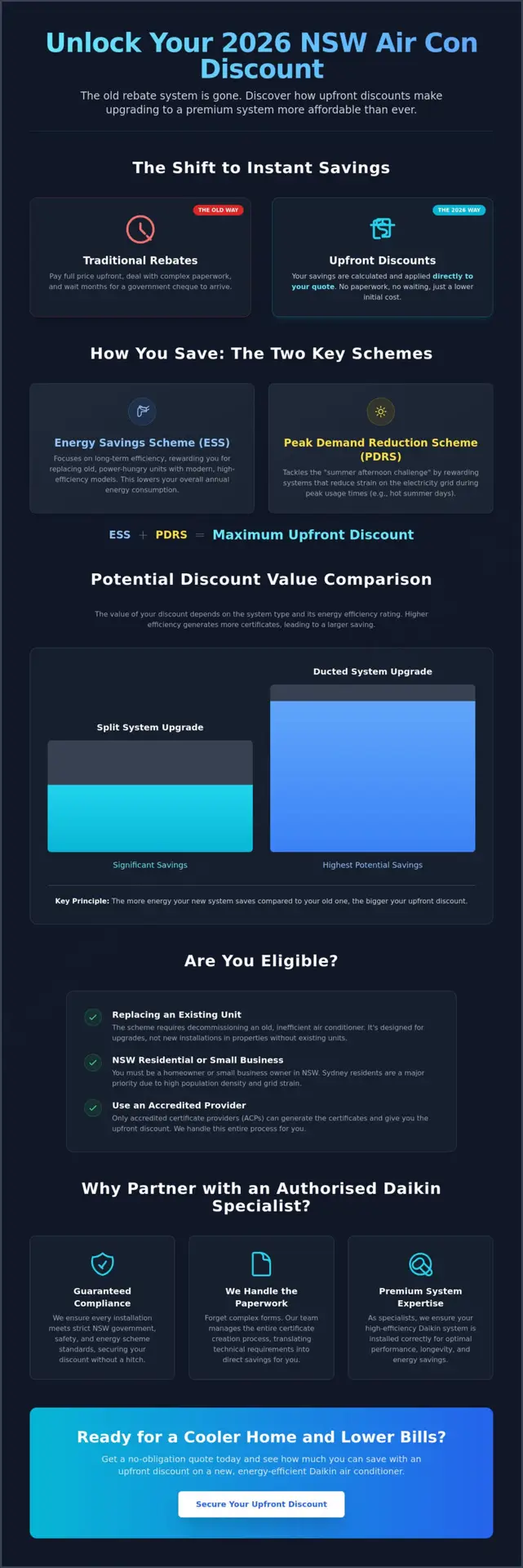
Choosing between a single split system and a whole-home ducted upgrade isn’t just about how many rooms you want to cool; it’s a strategic decision that affects your final discount. In the current 2026 landscape, the larger the potential energy saving, the larger the upfront incentive. If you’re upgrading a 15-year-old ducted system, you’re likely sitting on a goldmine of potential certificates. These older units often consume three times more power than a modern Daikin inverter system. Replacing them doesn’t just lower your bills; it generates a high volume of Energy Savings Certificates, leading to a much more substantial reduction in your installation quote than a single-room upgrade would.
For those living near the coast, there is an extra layer to consider. Sydney’s salt air can lead to rapid corrosion of outdoor units, which eventually forces the system to work harder and lose efficiency. When we help you select a unit for energy efficient air conditioning rebates NSW 2026, we prioritise models with specialised heat exchanger protection, like Daikin’s Blue Fin technology. This ensures your system maintains the high-efficiency ratings required by the GEMS register for years to come. Investing in a premium build now protects your eligibility for these incentives and prevents the performance dip that often plagues cheaper, non-specialised alternatives in our local climate.
If you’re looking for the most significant financial incentive, ducted air conditioning on the Northern Beaches is often the way to go. For a standard 4-bedroom Sydney home, the discount for a full ducted upgrade can range from $1,000 to $1,200. This is largely due to advanced zoning technology. By only cooling the rooms you’re actually using, you drastically reduce your peak demand. This efficiency is highly valued under the PDRS, as it directly supports grid stability during those punishing February heatwaves. It’s a win for your wallet and a win for the community.
While ducted systems offer the largest total discounts, high-efficiency split systems provide excellent ROI for targeted areas. For a new 6kW system installation, you can typically expect an upfront discount of approximately $550. If you’re replacing an existing, older 6kW split system, that incentive can rise slightly to around $560. To qualify for any NSW incentive in 2026, the unit must be a reverse cycle system. We’ve found that Daikin’s US7 and Premium Inverter series sit in the “rebate sweet spot,” offering the high star ratings needed to maximise your certificate value while providing the reliable comfort our neighbours expect.
There’s a common myth that multi-split systems are always ineligible for these schemes. While the rules are more complex for these setups, eligibility often comes down to the specific combination of indoor and outdoor units and their listing on the Greenhouse and Energy Minimum Standards (GEMS) Register. Rather than guessing, it’s always best to have a professional check the current 2026 compliance list. We take the guesswork out of the process, ensuring that the system you choose is both technically superior and fully eligible for the maximum available discount.
Securing your discount isn’t a matter of luck; it’s a matter of following a specific, regulated process. First, you need to confirm that your existing air conditioner is eligible for decommissioning. This means the old unit must be an inefficient system that is being replaced by a high-efficiency model. Once that’s settled, the next step is selecting hardware that meets the strict 2026 GEMS standards. Not every model on the Australian market qualifies for energy efficient air conditioning rebates NSW 2026, so checking the register before you buy is a vital part of the journey.
The most critical part of the process is engaging a licensed Sydney installer who is an authorised partner of an Accredited Certificate Provider (ACP). Many homeowners don’t realise that the installer acts as the technical bridge between your home and the state energy schemes. We handle the complex side of things by working with these ACPs to generate your certificates. When you receive your formal quote, the discount should be clearly itemised as an upfront reduction. If a provider offers a “cashback” or a verbal promise instead of a clear, transparent line item on the invoice, it’s a sign they may not be following the official 2026 protocols.
Daikin’s 2026 range is engineered specifically for our unique Australian conditions. However, even the best hardware won’t guarantee a discount if the system design is poor. We ensure that your system is sized correctly for your specific home layout, which is a key requirement for compliance. By working with a Daikin Specialist Dealer, you’re getting a team that understands how to marry premium engineering with the latest NSW energy regulations. This professional design ensures your system performs as promised and that your incentive is secured.
The final step involves a few essential pieces of paperwork. You’ll need to sign a nomination form before the installation begins. This form officially authorises us to create the Energy Savings Certificates or Peak Reduction Certificates on your behalf. During the install, our technicians take specific photos of the old unit being removed and record serial numbers of the new system as part of a compliance audit. This trail of evidence is what protects your financial incentive. A “cheap” installation might skip these steps, but doing so could void your eligibility and leave you paying full price for the system.
The decommissioning process is also a non-negotiable part of the 2026 rules. Your old, inefficient unit must be professionally removed and disposed of to ensure it never ends up back on the grid. We take care of this entire process, providing you with peace of mind that your upgrade is both environmentally responsible and fully compliant with state law. If you’re ready to see if your old unit qualifies for an upgrade, you can book a site assessment with our Sydney team to confirm your eligibility today.
Securing a discount is only half the battle. The real challenge lies in ensuring your new system continues to deliver on its energy-saving promises long after the installation team has left. Navigating the strict compliance rules for energy efficient air conditioning rebates NSW 2026 requires more than just a tool belt; it requires a deep understanding of the Greenhouse and Energy Minimum Standards (GEMS) Register and the technicalities of the Peak Demand Reduction Scheme. As a family-owned business looking after Sydney families since 1999, we take a consultative approach. We move beyond being simple “rebate hunters” to become your partners in long-term home comfort.
Our team at PenAir ensures that every installation meets the rigorous standards set by both Daikin and the NSW Government. This dual layer of accountability gives you peace of mind that your system is sized correctly, installed safely, and fully compliant with the latest energy regulations. We don’t just sell you a box; we design a solution. This expertise is vital for a reliable air conditioning service in Sydney, as a poorly designed system can lead to higher running costs that quickly eat away at your initial discount. We pride ourselves on honest, hardworking service that prioritises your household’s well-being over a quick transaction.
Sydney is a city of micro-climates. The humid afternoons in the Inner West require a different cooling strategy than the salt-heavy air of the Northern Beaches. Our local team understands these nuances perfectly. We know how salt-air corrosion can degrade a unit’s efficiency, potentially voiding the energy savings that the government schemes are designed to reward. By choosing a local specialist, you ensure your hardware is matched to your specific environment. You can contact PenAir for a rebate-ready quote that accounts for your home’s unique location and cooling needs.
The cheapest unit that qualifies for a rebate might seem like a bargain, but it often costs more in repairs and lost efficiency over time. Maintaining that “as-new” performance is essential. Regular air conditioning cleaning keeps your filters and coils clear, ensuring the unit doesn’t have to work harder than necessary. This proactive care preserves the high-efficiency ratings that earned you the discount in the first place. Since 1999, we’ve built our reputation on integrity and fair pricing. We are here to look after your system for its entire lifespan, ensuring you enjoy the full financial and comfort benefits of your 2026 upgrade for many years to come.
Upgrading your cooling system doesn’t have to be a complex journey through government fine print. By focusing on upfront discounts rather than post-purchase claims, you can access the latest Daikin technology while keeping your initial costs manageable. We’ve seen how the right combination of high-efficiency hardware and professional design can drastically lower your running costs while supporting Sydney’s grid stability. Taking advantage of energy efficient air conditioning rebates NSW 2026 is the smartest way to future-proof your home against rising electricity prices.
As an authorised Daikin Specialist Dealer serving Sydney since 1999, our team of fully licensed and insured technicians is here to ensure your installation is seamless and compliant. We take pride in our honest, consultative approach and our deep roots in the local community. Don’t let another sweltering summer catch you off guard with an inefficient unit. Request a Rebate-Optimised Quote from PenAir Today and let us help you find the perfect cooling solution for your household. We look forward to looking after your home environment for years to come.
No, the 2026 incentive is provided as an upfront discount on your installation quote rather than a post-purchase cash refund. This means you don’t have to fill out complex forms or wait for a cheque to arrive in the mail after the work is finished. We handle the creation of the energy certificates and apply the financial benefit directly to your invoice, making premium technology more affordable from the start.
No, DIY installations are not eligible for any government incentives under the current schemes. To qualify for energy efficient air conditioning rebates NSW 2026, the installation must be performed by an accredited installer. This requirement ensures that the system is installed safely and meets all state compliance standards. We manage the technical paperwork and serial number verification to ensure your discount is secured correctly and legally.
No, eligibility for these schemes is not means-tested or restricted to low-income earners. All households and small businesses in NSW can potentially access the incentives regardless of their annual income levels. The program’s primary goal is to improve the overall energy efficiency of the state’s housing stock and reduce grid pressure. If you’re replacing an old, inefficient unit with a high-efficiency model, you’re likely to qualify for the discount.
Any brand can qualify as long as the specific model is listed on the Greenhouse and Energy Minimum Standards (GEMS) Register. While we specialise in Daikin due to their superior performance in Sydney’s coastal conditions, the incentive is tied to the unit’s efficiency rating rather than the brand name. We always recommend choosing a model with a high star rating to maximise the number of energy certificates and the resulting discount.
Your old air conditioner must be professionally decommissioned and removed from your property as a mandatory part of the process. This rule ensures that inefficient units are permanently taken off the grid rather than being moved to another room or sold second-hand. We take care of the entire removal and recycling process, providing the necessary evidence to the government that the old unit has been disposed of responsibly and safely.
Yes, small businesses in NSW are eligible for the same energy-efficient incentives as residential households. This is a practical way for local Sydney business owners to reduce their overheads and lower their carbon footprint simultaneously. Whether you’re upgrading a retail shopfront or a small office space, the process remains the same; the discount is applied upfront to your quote by an accredited installer based on the energy certificates generated.
You can realistically secure a discount between $1,000 and $1,200 for a whole-home ducted system upgrade. The exact value depends on the energy savings your specific model generates and the current market price of Energy Savings Certificates (ESCs). Because ducted systems offer the largest potential for total energy reduction, they typically attract the highest incentive levels available under the energy efficient air conditioning rebates NSW 2026 framework.
These specific incentives are only available for upgrading or replacing existing units, not for new home builds. The primary objective of the NSW energy schemes is to remove old, high-energy-usage systems from the electricity grid. If you’re building a brand-new home that doesn’t have an existing system to decommission, you won’t be eligible for these particular certificate-based discounts, though you’ll still benefit from the long-term savings of a high-efficiency system.