Your Annual Fire Safety Statement (AFSS) is no longer just a box-ticking exercise. As of February 2026, the formal legislation of AS 1851 in New South Wales has turned HVAC compliance into a high-stakes legal requirement for every facility manager in the city. We understand the pressure you’re facing, especially when you’re balancing these new mandates against rising energy costs and the 19% reduction in HFC refrigerant quotas. It’s a lot to manage while trying to prevent a total system failure during a sweltering Sydney January.
We’ve been part of the Sydney community since 1999, and we know that a reliable commercial air conditioning maintenance Sydney agreement is your best defence against these operational headaches. This guide will show you how to protect your building’s assets, ensure 100% compliance for your next audit, and significantly reduce your energy bills through expert optimisation. We’ll walk you through the essential components of a 2026-ready contract, from Daikin-specialist diagnostics to the critical updates in Green Star Performance v2 standards, ensuring your facility remains a safe and productive environment for everyone inside.
A commercial air conditioning maintenance Sydney agreement is far more than a simple checklist or a recurring bill. It’s a proactive service framework designed to keep your building’s infrastructure running at peak performance. We’ve seen a significant shift in how facility managers approach their mechanical services. The old “break-fix” model, where help is only summoned once a system fails, is being replaced by strategic asset management. This modern approach treats your HVAC systems as critical investments that require consistent care to remain efficient and compliant.
The difference between residential servicing and commercial contractual obligations is vast. While a home system might only need an occasional filter change for comfort, commercial systems carry heavy regulatory weights. You’re managing fire safety integration, complex air distribution, and high-capacity machinery that must work around the clock. We understand that in a commercial setting, a system failure isn’t just an inconvenience; it’s a direct threat to your building’s operational budget and tenant satisfaction.
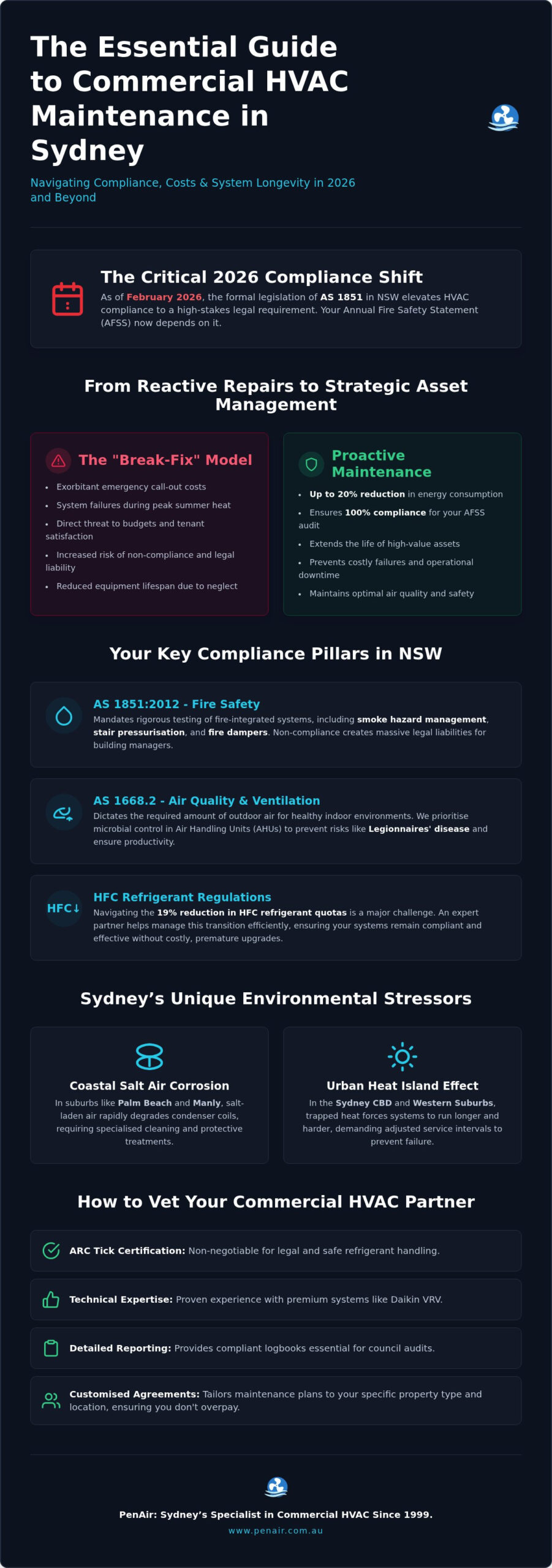
Regular tuning is one of the most effective ways to slash your building’s overheads. Research indicates that regular maintenance can reduce energy consumption by up to 20% in large commercial buildings by ensuring every component operates without unnecessary strain. This consistency is vital for extending the life of high-value assets like Daikin VRV systems. By catching minor wear and tear early, we help you avoid the exorbitant costs of emergency call-outs during peak Sydney summers when the demand for technicians is at its highest.
Sydney’s geography creates specific stressors that a generic maintenance plan simply won’t cover. In coastal suburbs like Palm Beach and Manly, salt air corrosion is a constant threat that can degrade condenser coils rapidly if they aren’t treated and cleaned correctly. Conversely, buildings in the Sydney CBD and Western Suburbs must contend with the urban heat island effect, where trapped heat forces systems to run longer and harder than those in cooler, leafier areas. Sydney’s coastal humidity accelerates component wear in commercial condensers by promoting rapid oxidation and moisture-related electrical faults. We adjust our service intervals based on your specific Sydney postcode to ensure your equipment survives the local elements.
Compliance is the backbone of modern facility management. In NSW, the regulatory landscape shifted significantly in February 2026 when AS 1851:2012 was formally legislated. This change means your commercial air conditioning maintenance Sydney plan must include rigorous testing of fire-integrated systems. It’s no longer just about keeping tenants comfortable; it’s about ensuring that smoke hazard management and stair pressurisation systems function perfectly during an emergency.
Failure to maintain these systems creates massive legal liabilities for facility managers. If an incident occurs and the mechanical ventilation fails to control smoke because of missed service intervals, the building owner and manager are held directly accountable. This is why the Annual Fire Safety Statement (AFSS) is such a critical requirement for Sydney commercial properties. We ensure every fire damper and mechanical air handling unit is inspected according to the strict schedules mandated by Australian Standards.
Beyond fire safety, AS 1668.2 dictates the amount of outdoor air required for healthy indoor environments. In high-density Sydney office blocks, poor ventilation often leads to reduced productivity and health issues. We prioritise microbial control in Air Handling Units (AHUs) to prevent the growth of harmful bacteria like Legionnaires’ disease. Following AIRAH’s HVAC Hygiene Guideline is our standard practice to ensure your air quality exceeds minimum compliance.
A compliant maintenance logbook is your best friend during a council audit. It must contain detailed records of every inspection, repair, and test conducted on the system. At PenAir, we provide the precise documentation building compliance officers look for. These records don’t just keep the council happy; they’re also essential for protecting your manufacturer warranty. If you chat with our team about your specific site, we can show you how we structure our reporting to make your next audit completely stress-free. This level of detail is exactly what sets a professional commercial air conditioning maintenance Sydney agreement apart from a generic service call.
Choosing a “one-size-fits-all” service plan often results in a mismatch between your building’s actual needs and the care it receives. We’ve seen many Sydney facility managers either overpay for redundant visits or, more dangerously, suffer from under-servicing that leads to premature equipment failure. A generic contract doesn’t account for whether you’re managing a high-traffic retail centre in the Inner West or a quiet strata complex on the North Shore. Each environment places different stresses on your mechanical plant, and your agreement should reflect that reality.
Building usage is a primary factor in determining your maintenance schedule. Industrial sites might deal with higher dust levels that clog filters faster, while retail spaces face constant door-openings that force units to work harder. Tenant density also plays a massive role; a floor packed with workstations generates significantly more heat than a sparsely populated warehouse. This increased load directly impacts the required frequency of commercial air conditioning servicing to prevent component burnout. We work with you to structure a contract that scales alongside your building’s occupancy levels, ensuring you only pay for the protection you actually need.
A high-quality agreement is built around scheduled preventative visits, typically ranging from monthly to quarterly depending on the age and condition of your assets. It isn’t just about a quick visual check; it must include the replacement of consumables like high-efficiency filters, belts, and lubricants to keep everything running smoothly. Most importantly, your contract should offer peace of mind through guaranteed response times for emergency HVAC repairs in Sydney. When a system goes down during a 40-degree heatwave, knowing our team will be there as a priority is invaluable for tenant retention and business continuity.
Daikin VRV systems have become the gold standard for Sydney commercial properties due to their energy efficiency and modular flexibility. As an authorised Daikin Specialist Dealer, we provide a technical edge that general contractors can’t match. We have direct access to specialised diagnostic software and genuine parts that ensure your system stays within manufacturer specifications. Using genuine Daikin parts is critical because they are specifically engineered to maintain the precise tolerances and energy efficiency ratings of your system over its entire lifespan. This expertise is a core part of how we provide reliable commercial air conditioning maintenance Sydney wide, protecting your high-value assets for the long term.
Selecting a maintenance partner is a long-term strategic decision that directly impacts your building’s safety and your annual budget. We recommend a structured vetting process to ensure you aren’t just hiring a “guy with a van” but a professional team capable of managing complex mechanical plants. The right partner for your commercial air conditioning maintenance Sydney requirements should provide a blend of technical mastery and administrative transparency.
Start by verifying the basics: licensing, ARC tick certification, and comprehensive insurance coverage. These are non-negotiable for any commercial site. Beyond the paperwork, look for a provider with a deep local heritage. A family-owned business that has operated since 1999 offers a level of stability and accountability that “fly-by-night” operators simply cannot match. You need to know that the team looking after your commercial VRV systems today will still be there to honour warranties and provide support five years from now.
Transparency is the final piece of the puzzle. Modern facility management relies on data, so ensure your provider uses digital asset tracking and provides clear, itemised reports after every visit. This documentation is vital for council audits and internal financial reporting.
Sydney’s traffic and geography make a local presence essential for rapid response times. Choosing a provider based in Warriewood or the Northern Beaches means your technician is never too far away when a critical system fails. Local specialists also possess a better understanding of the specific building codes enforced by various Sydney local councils. Whether your facility uses large-scale ducted air conditioning or intricate multi-split arrays, a team with local knowledge can navigate the logistical challenges of your specific suburb far more efficiently than a cross-city contractor.
Don’t be afraid to ask tough questions about technician training and manufacturer certifications. A professional HVAC partner invests heavily in their team to ensure they stay ahead of the latest diagnostic technologies. For critical commercial infrastructure, verify that the provider offers 24/7 support. Systems don’t always wait for business hours to fail, and you need the reassurance that help is available whenever a crisis hits. If you’re looking for a partner that combines technical edge with local reliability, reach out to our Sydney team today to discuss a service plan that fits your facility’s unique needs.
We started PenAir in 1999 with a simple goal: to provide Sydney businesses with a level of mechanical expertise that felt personal. Over the last 25 years, we’ve remained a family-owned and operated business, even as the industry has become dominated by large corporate firms. This independence is our greatest strength. When you partner with us for your commercial air conditioning maintenance Sydney, you aren’t dealing with a faceless call centre. You have direct access to our owners and a team that treats your building’s infrastructure as if it were our own. We offer tailored maintenance programmes designed for Sydney’s unique commercial landscape, ensuring your specific site needs are always met.
This commitment to local warmth doesn’t mean we compromise on professional standards. We combine traditional values like punctuality and integrity with a modern understanding of energy efficiency and high-tech diagnostics. Our longevity in the Sydney market is built on long-term community relationships rather than quick transactions. We take pride in looking after the well-being of the facilities we serve, ensuring every system we touch operates at its absolute best.
Every successful relationship begins with a clear understanding of your building’s current status. Our process starts with a comprehensive site audit where we create a detailed asset register of your entire plant. We don’t believe in guesswork; we document every unit, its age, and its current condition. This transparency allows us to build a customised service schedule that aligns perfectly with your budget and compliance needs. We provide proactive upgrade recommendations that focus on maximising energy efficiency, helping you reduce overheads while maintaining a comfortable environment for your tenants. For international property managers or those looking for similar standards overseas, providers specialising in air conditioning installation Surrey apply the same meticulous approach to tailoring systems for long-term commercial efficiency.
Arranging a professional review of your current HVAC systems is a straightforward process. We understand that transitioning from an old provider can feel like a daunting task, but we’ve refined our onboarding process to make it completely painless. We handle the heavy lifting, from reviewing your existing service logs to identifying immediate compliance gaps. If your current provider is under-servicing your equipment or failing to meet your reporting needs, we can help you make a clean break. Contact the PenAir team today to discuss a tailored maintenance contract for your Sydney property and experience the difference that 25 years of local expertise makes.
Managing a facility in Sydney requires a constant balance between strict compliance and operational efficiency. We’ve explored how the 2026 legislation of AS 1851 has changed the landscape, making precise documentation and regular testing non-negotiable for your next Annual Fire Safety Statement. By moving away from generic service schedules and embracing a tailored agreement, you protect your high-value assets while keeping energy costs under control. It’s about more than just cooling; it’s about strategic risk management for your property.
Our team has been part of the local community since 1999. As an authorised Daikin Specialist Dealer, we bring a technical edge to every site audit across the Northern Beaches, North Shore, and Sydney CBD. We take pride in our family-run heritage, offering the personal accountability that larger corporations often lack. Investing in a professional commercial air conditioning maintenance Sydney plan ensures your system remains reliable during those intense summer heatwaves. Secure your building’s comfort with a PenAir Commercial Maintenance Contract today. We’re ready to look after your facility’s well-being for the long term.
A standard commercial air conditioning maintenance Sydney agreement provides a structured schedule of preventative visits, typically quarterly or monthly depending on your building’s needs. We focus on cleaning filters, checking electrical connections, and testing the performance of high-value assets like Daikin VRV systems. You also receive detailed service logs that are essential for meeting your legal reporting obligations. This proactive approach helps identify minor wear before it turns into a major operational failure.
NSW legislation, specifically AS 1851:2012, mandates monthly or quarterly inspections for systems integrated with fire safety measures, such as smoke dampers and stair pressurisation fans. For general comfort cooling, frequency is determined by the building’s usage and manufacturer specifications. We recommend aligning your service intervals with your Annual Fire Safety Statement (AFSS) requirements to ensure you remain fully compliant with current local council regulations and avoid potential legal liabilities.
Most maintenance agreements cover the labour for scheduled inspections and minor consumables like lubricants or standard filters. Major repairs, such as compressor replacements or large-scale component failures, are typically quoted separately. In cases where aging systems reach the end of their operational life and require full equipment overhaul or replacement, building operators often consult dedicated commercial contractors such as J3 Mechanical Services to execute complex mechanical installations. However, having a contract in place often gives you access to priority response times and reduced labour rates for those unexpected issues. This structure allows you to budget for routine care while protecting your equipment from the high costs of total neglect.
The Annual Fire Safety Statement (AFSS) is a mandatory document for Sydney commercial buildings that proves every fire safety measure is working correctly. Your mechanical services provider is vital here because they must certify that the air conditioning system’s fire dampers and smoke control fans meet Australian Standards. Without this professional sign-off, you cannot submit your statement to the local council, which can lead to significant fines and insurance complications for the building owner.
Regular maintenance is a primary driver for improving your building’s NABERS energy rating. By ensuring that sensors are calibrated and coils are clean, your system doesn’t have to work as hard to maintain the set point. A well-tuned commercial air conditioning maintenance Sydney programme can reduce energy consumption significantly, helping you move toward a higher star rating. This not only lowers your operational costs but also increases the market value of your property.
Choosing an authorised Daikin Specialist Dealer like PenAir ensures your technicians have the specific training required for complex VRV and VRF systems. We have direct access to Daikin’s proprietary diagnostic software and genuine replacement parts, which general contractors often lack. This technical edge means we can pinpoint issues faster and ensure your system operates exactly as the manufacturer intended, protecting your long-term investment and maintaining your warranty status for high-value commercial hardware.
While some providers only work nine-to-five, we offer priority support for our commercial contract holders to handle critical failures whenever they occur. If your system goes down on a weekend or a public holiday, having a formal agreement ensures you aren’t stuck at the back of the queue. We understand that certain commercial environments, like data centres or high-density offices, require immediate attention to prevent significant financial or operational losses during Sydney heatwaves.
Maintenance fees for commercial equipment are generally considered a deductible operating expense for Australian businesses under current ATO guidelines. These costs are part of the necessary upkeep of your income-producing assets, much like other building management services. We always recommend consulting with your accountant or tax professional to understand how these deductions apply to your specific financial situation. It’s a smart way to manage your building’s health while effectively optimising your annual tax position.