
In Sydney, 73% of initial strata applications for air conditioning gain first-time approval, yet the remaining quarter stall over easily avoidable technical oversights. If you’re wondering what rules dictate where you can position an outdoor compressor, you aren’t alone. Understanding body corporate rules for external aircon units can feel daunting, especially when you’re balancing common property boundaries, committee expectations, and concerns about compressor noise upsetting next-door neighbours.
You deserve a comfortable home without the stress of strata disputes or unexpected breach notices. Securing approval hinges on acoustic compliance, aesthetic concealment, and proper common property classification. In this 2026 guide, we’ll show you how to navigate your obligations under the Strata Schemes Management Act, prepare a clear application that gets signed off the first time, and select a quiet, energy-efficient outdoor unit that satisfies every building guideline.
Living in a multi-residential complex means your comfort choices intersect directly with shared property laws. Clear body corporate rules for external aircon units exist to protect building aesthetics, prevent acoustic disturbance between neighbours, manage condensation runoff, and safeguard structural waterproofing. In apartment blocks across New South Wales, the external envelope of the building, including exterior walls, balcony slabs, and ceiling cavities, is almost universally classified as common property under the registered strata plan.
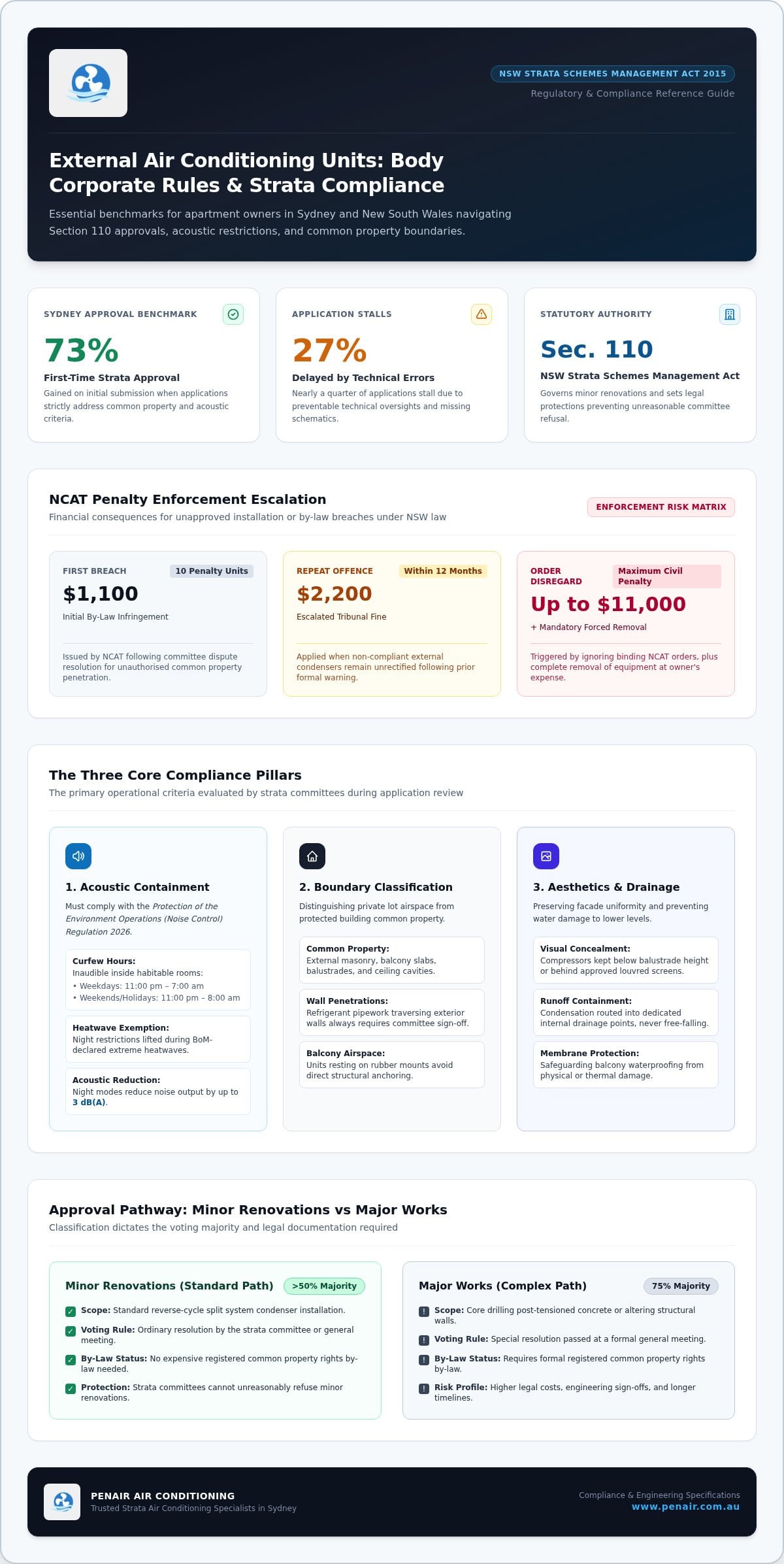
Installing an outdoor condenser is legally categorised under Section 110 of the NSW Strata Schemes Management Act 2015. This statutory framework sets clear paths for lot owners to make improvements while protecting the collective building. Skipping this approval framework carries real risks. As of early 2026, the NSW Civil and Administrative Tribunal (NCAT) can issue fines up to 10 penalty units ($1,100) for a first by-law breach, escalating to $2,200 for repeat offences within 12 months. Disregarding formal NCAT orders can trigger civil penalties reaching $11,000 for individual lot owners, alongside mandatory orders to remove non-compliant equipment at your own expense.
Balcony tiles, balustrades, and external perimeter walls usually sit outside your private lot boundary. A firm grasp of understanding strata title principles makes it clear why drilling into external masonry to anchor bracketry immediately triggers common property oversight. Penetrating boundary brickwork affects shared assets, which is why mounting an outdoor condenser directly to an external wall requires formal scrutiny. Conversely, placing a condenser on anti-vibration rubber mounts resting on your private balcony airspace avoids wall fixings, though running the necessary refrigerant lines into your living room will still involve a wall penetration that requires formal committee consent.
Strata legislation treats home improvements according to their structural impact. Installing a reverse-cycle split system air conditioning condenser typically falls under the “minor renovations” definition, which streamlines the consent pathway:
Strata committees do not reject air conditioning applications on a whim. Instead, their decisions rest on three core operational pillars: acoustic containment, architectural preservation, and safe condensate disposal. Navigating body corporate rules for external aircon units successfully requires submitting a detailed engineering strategy for each area rather than vague assurances.
Noise remains the leading trigger for neighbour disputes in medium- and high-density schemes. Under the Protection of the Environment Operations (Noise Control) Regulation 2026, residential air conditioning must not be audible inside an adjoining habitable room between 11:00 pm and 7:00 am on weekdays, or 11:00 pm and 8:00 am on weekends and public holidays. An essential safety net introduced in 2026 exempts systems from these night-time restrictions during extreme heatwaves declared by the Bureau of Meteorology. To protect your neighbours and stay well within residential sound pressure curves, practical design measures matter:
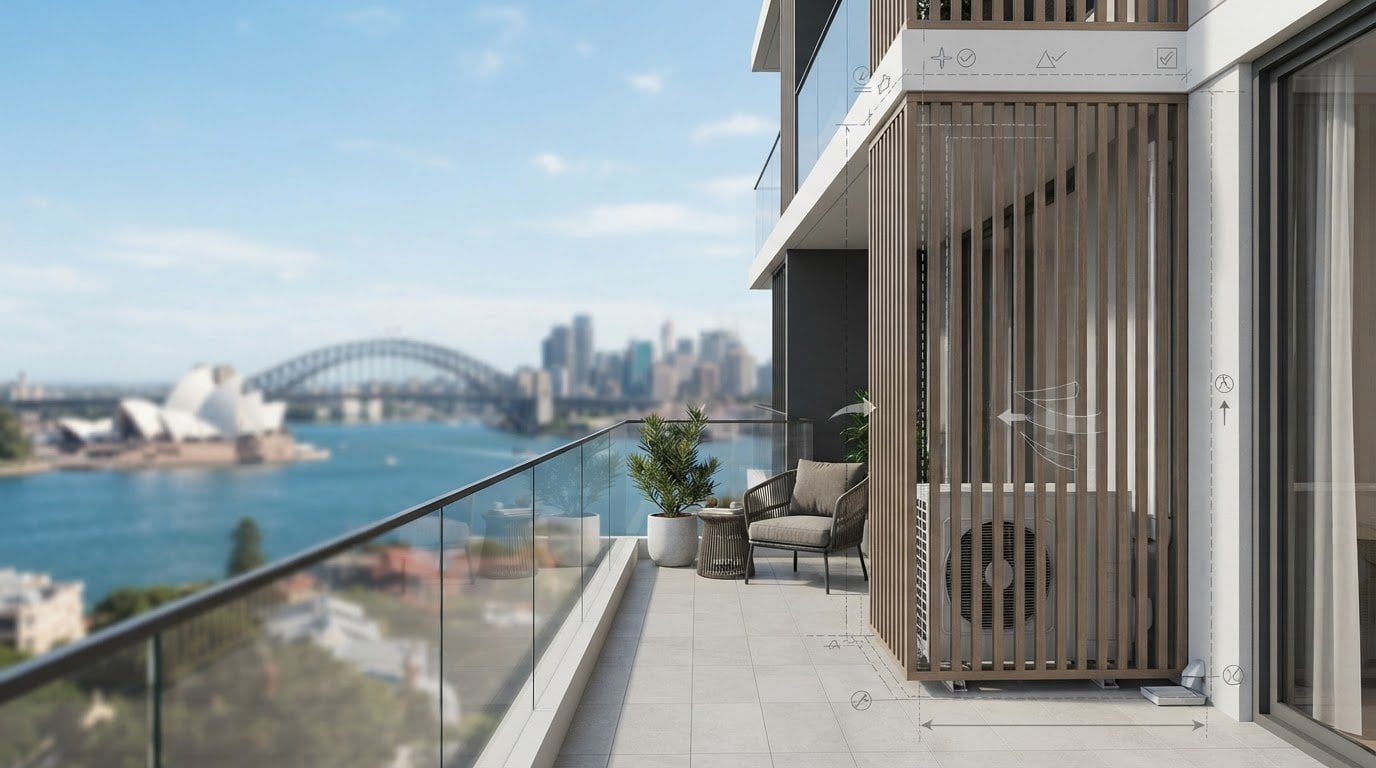
Architectural consistency preserves building value across the scheme. Committees enforce strict aesthetic guidelines to stop haphazard external alterations from fracturing the streetscape. Most by-laws require outdoor condensers to sit entirely below the solid balcony balustrade line, ensuring they remain completely invisible from the street below. If an outdoor unit sits in an exposed corner, schemes frequently require custom powder-coated aluminium louvred screening matched to the facade palette. All external copper pipework and electrical conduit must also run inside colour-matched metal trunking rather than raw, unpainted capping.
Draining condensate water directly across balcony tiles or allowing it to drip over building edges is strictly forbidden. A cooling split system extracts several litres of moisture per hour on humid Sydney afternoons. Water left to pool causes slip hazards, stains facade render, and damages waterproofing membranes on lower properties. Compliant drainage must connect permanently into an approved internal waste tundish, a dedicated rainwater downpipe, or an internal laundry drain. Where natural gravity fall is impossible to achieve across long pipe runs, we integrate compact, whisper-quiet condensate removal pumps directly into the indoor casing.
If you’re unsure how to route drainage or satisfy your committee’s visual guidelines, you can speak with our team to plan a compliant balcony installation.
Securing consent for an air conditioning upgrade doesn’t have to be an uphill battle. When you follow a structured submission process, body corporate rules for external aircon units provide a clear, predictable pathway. You can keep your application moving smoothly through five practical steps:
Strata committees scrutinise the tradespeople working on shared property just as closely as the equipment itself. Submitting incomplete paperwork causes administrative stalls that stretch typical approval timeframes well past the standard four to eight weeks. A complete submission pack must include:
In most schemes, the strata committee holds delegated authority to evaluate and approve minor renovations without convening an Annual General Meeting. Decisions are typically reached during scheduled committee meetings or via electronic voting papers between formal sittings. To protect the owners corporation, approval often comes attached to standard conditions, including an indemnity agreement making the lot owner responsible for all future maintenance, servicing, and waterproofing integrity around pipe penetrations. Partnering with an experienced installer like PenAir ensures your technical documentation satisfies committee criteria the first time, preventing avoidable deferrals and keeping your project on schedule.
Balcony footprints in Australian apartments are precious commodities. Selecting equipment that delivers reliable cooling without dominating your outdoor entertaining zone requires balancing physical dimensions, energy consumption, and sound output. Satisfying body corporate rules for external aircon units depends largely on specifying modern inverter machinery engineered for compact multi-residential spaces.
Floorplan layouts dictate whether a single condenser or a multi-head configuration makes the most practical sense. Split systems account for 78% of apartment air conditioning installations in Sydney because they offer targeted, efficient climate control without requiring extensive ductwork chases. When evaluating your layout, consider the mechanical footprint:
High-density living leaves no margin for noisy, vibrating condensers. Selecting premium equipment built with DC inverter scroll compressors ensures variable cooling capacity, eliminating the disruptive stop-start clatter of obsolete on-off systems. For coastal complexes across the Eastern Suburbs or Northern Beaches, outdoor machinery also requires anti-corrosion coil treatments, such as specialised acrylic or epoxy fin coatings, to prevent salt air breakdown.
Authorised Daikin outdoor units feature aerodynamic fan blades and sound-dampening insulation around the compressor housing, making them a benchmark for tight residential boundaries. Choosing a whisper-quiet split system air conditioning installation gives your strata committee confidence that acoustic tolerances won’t be breached during sweltering summer nights.
Ready to upgrade your apartment comfort? Contact PenAir today to find the ideal low-profile outdoor condenser for your balcony layout.
Navigating body corporate rules for external aircon units is substantially easier when your installer understands strata law inside out. PenAir has operated as a family-owned Sydney HVAC specialist since 1999, helping apartment owners modernise their living spaces without committee friction. We don’t just supply equipment; we look after your entire installation pathway, from preliminary wall scanning to final commissioning.
Our technicians conduct meticulous on-site audits before pen touches paper on an application. We examine your sub-board electrical capacity, plan neat, non-invasive refrigerant pipe routes, and map compliant condensate discharge directly to verified drain points. As an authorised Daikin Specialist Dealer, we combine premium Japanese acoustic engineering with licensed trade craftsmanship, delivering peaceful indoor comfort that keeps your building executive satisfied.
Committee rejection usually stems from incomplete engineering details. Our team removes that hurdle by compiling a comprehensive submission package tailored specifically for your scheme’s secretary or managing agent. We supply full technical specifications, official decibel data sheets, and verified trade insurance certificates upfront.
During the installation phase, our licensed technicians fit anti-vibration neoprene footings, precision-moulded architectural trunking, and high-grade acoustic dampening materials. This thorough approach ensures your outdoor condenser operates within council residential noise curves while blending smoothly into the building facade. Learn more about why choose us to see how our team delivers compliant, stress-free strata climate installations across Sydney.
Decades of field experience give our technicians unmatched insight into local municipal standards and unique regional strata challenges. Whether dealing with salt-spray exposure on beachfront balconies or strict architectural by-laws in heritage urban complexes, we tailor every mechanical layout to fit the building’s physical realities. Our mobile crews provide specialist strata support across Sydney, including:
If you’re planning an apartment upgrade and want to ensure your installation passes committee review without delays, contact our friendly team to arrange a detailed site inspection today.
Securing modern apartment climate control doesn’t need to be an intimidating ordeal. By respecting common property boundaries, selecting whisper-quiet inverter systems, and addressing condensate drainage properly, you can satisfy every strata committee requirement with complete confidence. When you understand how body corporate rules for external aircon units operate, gaining approval becomes a straightforward, predictable process rather than a source of neighbourhood tension.
PenAir has been family-owned and operated in Sydney since 1999. As an authorised Daikin Specialist Dealer, we provide complete strata application and acoustic documentation support, taking the guesswork out of compliance from your initial site audit through to final sign-off. Let our experienced technicians design a discreet, energy-efficient system tailored directly to your building’s architectural standards.
Book a compliant strata air conditioning assessment with PenAir today to get your project moving and enjoy reliable, peaceful apartment comfort with genuine peace of mind.
Under NSW strata legislation, an owners corporation cannot unreasonably withhold consent for minor renovations like air conditioning. An NCAT appeal panel confirmed that outright bans without genuine technical justification, such as serious structural risk or unresolvable acoustic failure, are unlawful. If your application satisfies all building acoustic, aesthetic, and drainage criteria, the committee must provide clear, reasonable grounds if they decide to refuse it.
Yes, you generally still require approval even for like-for-like system replacements. Modern body corporate rules for external aircon units usually mandate notification because modern units feature different physical dimensions, airflow rates, and acoustic ratings compared to older models. Submitting an application ensures updated equipment specifications, contractor trade licences, and current insurances are formally recorded on the scheme roll, protecting you from future compliance disputes.
Under the Protection of the Environment Operations (Noise Control) Regulation 2026, residential air conditioners must not be audible inside an adjoining habitable room between 11:00 pm and 7:00 am on weekdays, and 11:00 pm to 8:00 am on weekends. Official Bureau of Meteorology heatwaves provide an exemption to this rule. Strata schemes may also enforce stricter daytime decibel thresholds within their registered by-laws.
A strata committee cannot legally dictate which equipment brand you purchase, but they can enforce strict aesthetic standards regarding exterior appearance. Schemes regularly mandate the colour of pipe trunking, require powder-coated screening louvres that match the building facade, or insist that condensers sit below balustrade railings. As long as your chosen hardware complies with acoustic, dimension, and visual guidelines, the brand choice remains yours.
The best location is on the balcony floor tucked into an unobtrusive corner, positioned completely below the solid balustrade line. This placement keeps the condenser hidden from street view and shields it from driving rain and direct coastal winds. Always mount the unit on heavy-duty anti-vibration pads away from adjoining bedroom windows, leaving sufficient airflow clearance around the coil for proper heat exchange.
Installing an unapproved system breaches standard body corporate rules for external aircon units and can trigger swift legal action. The strata committee can issue a formal Notice to Comply, followed by NCAT enforcement proceedings. NCAT has the authority to order the immediate removal of the equipment at your expense, alongside civil penalties reaching up to $1,100 for a first offence.
The lot owner is entirely responsible for any damage inflicted on common property during installation. Strata approvals typically incorporate a standard indemnity deed or conditional by-law binding the owner to maintain the equipment and repair surrounding building assets. This responsibility covers fixing cracked exterior render, repairing compromised balcony waterproofing membranes, and resolving any structural water leaks originating from the wall penetrations.