Is your air conditioner actually cooling your home, or is it just a very expensive fan that rattles through the night? Many Sydney homeowners find themselves stuck in a cycle of endless repairs, hoping to squeeze one more summer out of a struggling unit. However, ignoring the clear signs you need a new aircon can lead to sweltering nights and energy bills that take the joy out of the season. We understand the frustration of a weak system that can’t handle our local humidity, especially when it starts disturbing the neighbours with every cycle.
You deserve a home environment that feels like a sanctuary, not a sauna. In this 2026 guide, we’ll show you exactly how to identify when your current system has reached its limit and why upgrading to a modern, whisper-quiet Daikin might be the smartest financial move you make this year. We’ll explore seven telltale indicators that it’s time for a change, the benefits of the NSW Energy Savings Scheme, and how the latest R32 systems can slash your monthly running costs while providing total peace of mind with a long-term warranty.
Sydney’s climate is undeniably beautiful, but it’s also remarkably tough on mechanical equipment. While a standard Heating, ventilation, and air conditioning (HVAC) system might have a theoretical lifespan of fifteen years, the reality in our local suburbs is often quite different. We see systems that struggle much earlier due to the unique combination of high coastal humidity and intense summer heatwaves. Whether you have a compact split system in an apartment or a large ducted system for a family home, understanding these local environmental pressures is the first step in recognising the signs you need a new aircon.
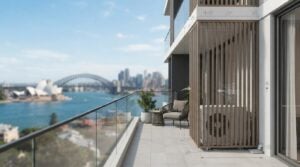
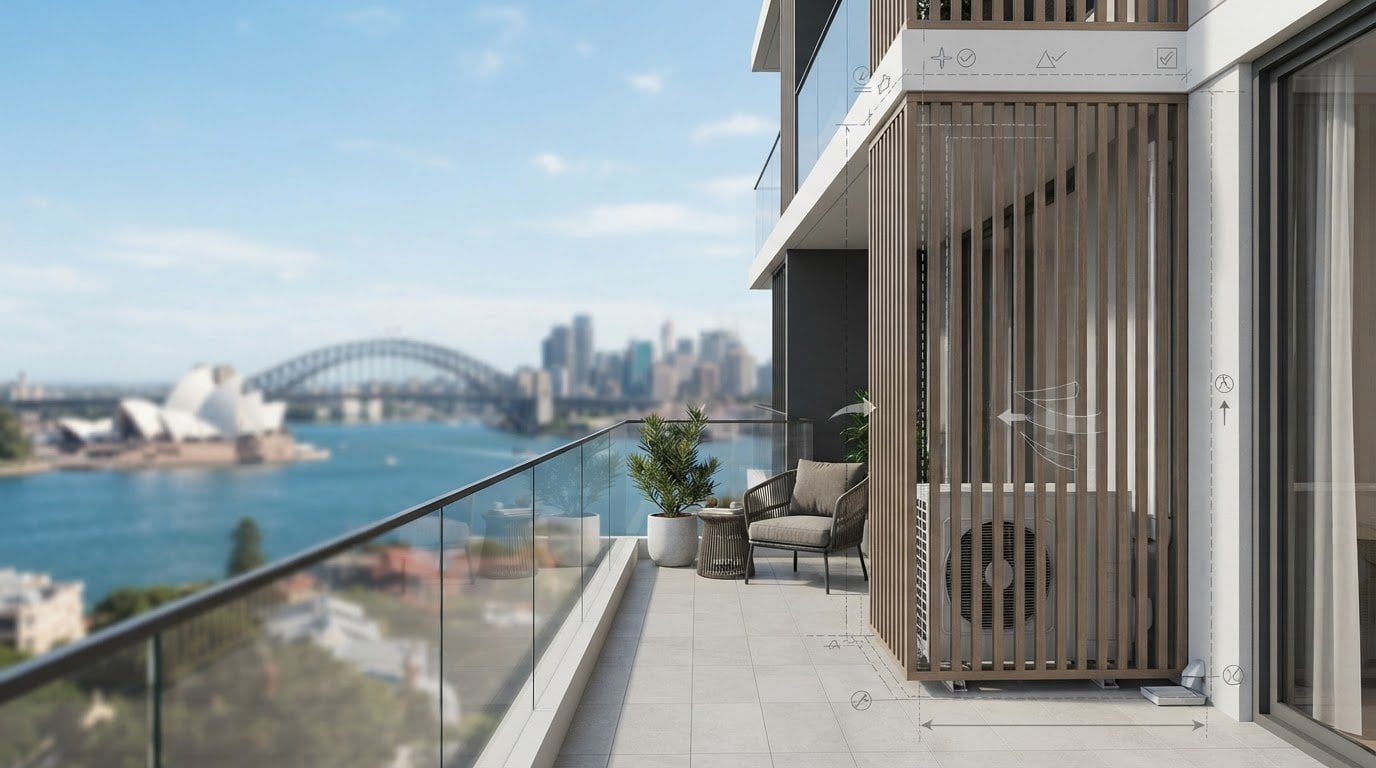
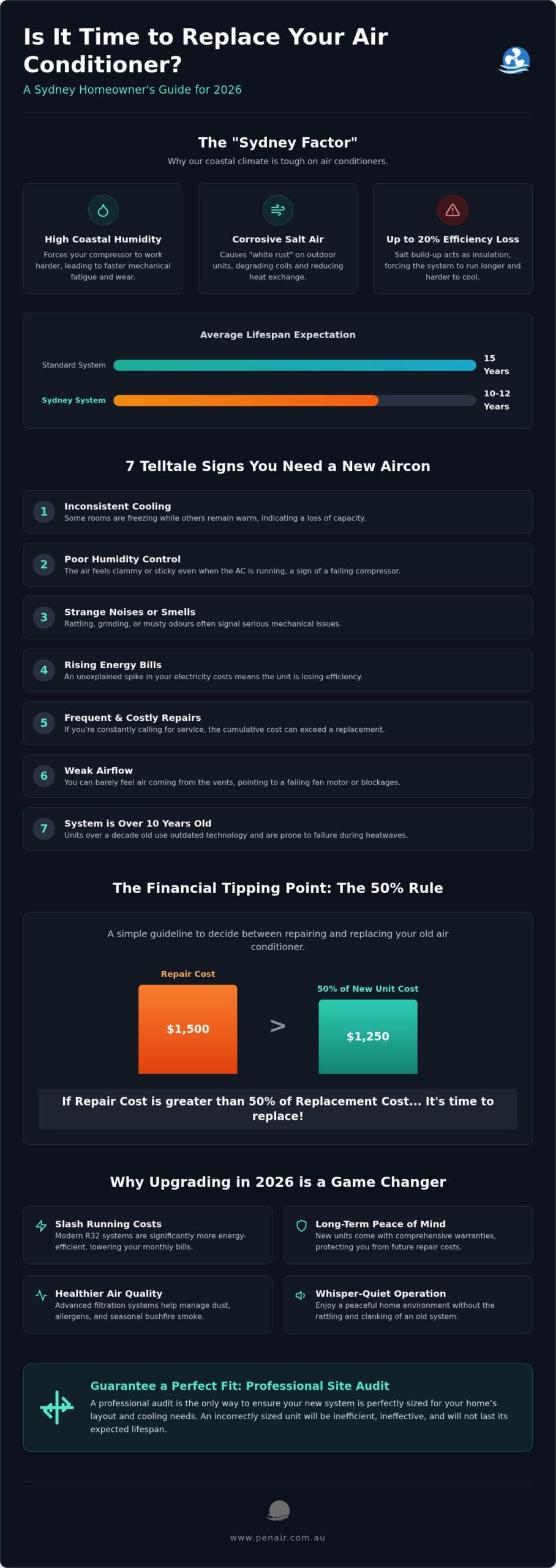
The location of your property plays a massive role in how quickly your system ages. A unit positioned on a balcony in Manly, for example, might show significant wear after just seven or eight years compared to an identical unit in the Inner West. This discrepancy is largely due to the “Sydney factor,” where salt air and high moisture levels work together to degrade components from the outside in. When the humidity levels spike, your compressor has to work significantly harder to dehumidify the air, leading to faster mechanical fatigue than what you might find in a drier climate.
If you live near the water, your outdoor condenser is under constant attack. Salt air causes what we call “white rust,” a form of zinc oxidation that appears as a powdery substance on the aluminium fins. Over time, this corrosion pits the copper coils and eats away at the heat exchange surfaces. This isn’t just an aesthetic problem. These deposits act as a layer of insulation, preventing the system from shedding heat effectively. We find that salt build-up can reduce efficiency by up to 20% before the system eventually fails. To combat this, we often recommend specific anti-corrosion coatings for coastal installations to help our neighbours protect their investment.
For homeowners in 2026, the 10 to 12-year mark is generally the “danger zone” for modern systems. While a well-maintained system can sometimes defy the odds and reach 15 years, our erratic weather patterns make this less common. Sydney has seen a shift toward more extreme cycles of heat and humidity, which places immense strain on older, non-inverter compressors. If your unit was installed over a decade ago, it likely lacks the smart technology needed to manage these fluctuations efficiently. Keeping a close eye on how your system performs during a February humidity spike is one of the most reliable signs you need a new aircon before a total breakdown occurs.
Your air conditioner should be a silent partner in your home’s comfort, quietly maintaining the perfect temperature while you go about your day. When it starts to struggle, the symptoms are often subtle at first. You might notice the airflow feels a little weaker than it used to, or perhaps the unit sounds laboured when it finally kicks in on a hot afternoon. These performance dips are some of the most reliable signs you need a new aircon, indicating that internal components are no longer operating at peak efficiency.
We often find that homeowners grow accustomed to a system that isn’t quite right. They start using floor fans to help circulate the air or adjust the thermostat to extreme settings just to get a response. This extra effort shouldn’t be necessary. A modern, healthy system should reach your desired temperature quickly and hold it there without constant manual intervention.
One of the most common complaints we hear from Sydney families is that their home has developed micro-climates. One bedroom feels like an ice box while the lounge room remains uncomfortably warm. This usually happens because the system can no longer maintain the static pressure required to push air through the entire ducting network or across the room. Additionally, an aging system loses its ability to strip moisture from the air. If the indoor air feels clammy or sticky despite the unit running, the compressor is likely failing to reach the necessary cooling cycle. While a faulty thermostat can sometimes cause these issues, a pattern of inconsistent cooling across multiple zones often points to a system that is simply past its prime.
We often tell our customers to trust their senses. A healthy system should produce a gentle hum, not a symphony of mechanical distress. Squealing or grinding noises usually suggest that the motor bearings are failing, while a persistent rattling often points to a loose fan or a compressor reaching the end of its life. Frequent clicking sounds every time the unit starts are also a red flag, as they often signal a failing electrical relay or capacitor.
Smell is equally important. A musty, dirty sock odour is a clear indicator of bacteria or mould growth affecting your unit’s internal hygiene. While professional cleaning can often resolve this, a pungent burning smell is a different story. This usually indicates scorched wiring or an electrical component that is overheating. If you have noticed these sensory warnings, it is worth having an expert assess your system’s condition before a minor fault turns into a complete breakdown.
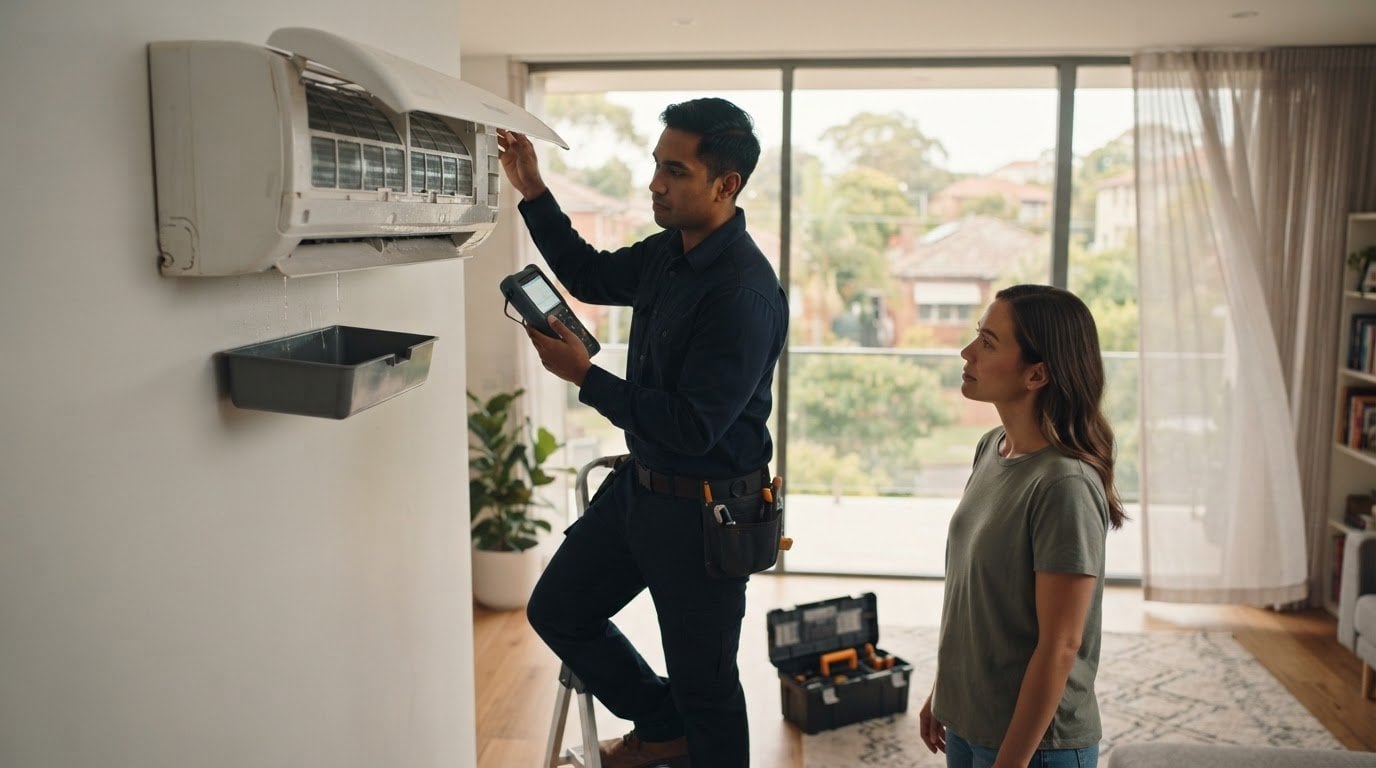
Deciding between one more fix and a total upgrade is a common dilemma for Sydney families. One of the clearest signs you need a new aircon is when you find yourself on a first-name basis with your local technician. We suggest using the “50% Rule” as a practical guide. If your system is over ten years old and the quoted repair cost exceeds half the price of a modern replacement, the investment in old technology rarely makes sense. Air conditioning specialists such as ProServ Las Vegas often advise a similar benchmark, noting that continuing to patch up an inefficient unit quickly costs more than upgrading. At this stage, you are essentially paying to keep a declining asset on life support.
Beyond the immediate repair bill, you have to consider the “zombie” factor. These are older units that still blow cool air but consume massive amounts of electricity to do so. By 2026 standards, the energy efficiency of a new Daikin inverter system is significantly higher than models from just a decade ago. These modern units use advanced sensors to adjust their power output, avoiding the expensive “all or nothing” energy spikes common in older machines.
An aging system often works twice as hard to provide half the comfort of a modern unit. When components like the compressor or fan motor begin to degrade, they draw more current to compensate for their lack of efficiency. While professional air conditioning repairs can resolve specific mechanical faults, they cannot upgrade the base efficiency of an old machine. Research shows that upgrading to a high-efficiency reverse-cycle system can save homeowners between $200 and $600 per year on electricity bills. For a 15-year-old unit, these savings alone can help offset the cost of a new installation over just a few summers, making the “cheap” repair look quite expensive in the long run.
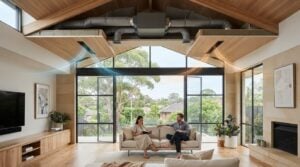
Investing in a new system isn’t just about avoiding a breakdown; it’s about long-term financial strategy. A new ducted air conditioning system is a significant asset that can increase the resale value of a Sydney property, as buyers increasingly prioritise energy-efficient homes. You also gain the security of a fresh 5-year manufacturer warranty. This eliminates the “repair lottery” that comes with older units, where one fix is often followed by another different failure months later. When we look at the reduced running costs, the total lack of repair bills, and the added property value, the payback period for a modern system is often shorter than most people expect.
Upgrading your climate control in 2026 isn’t just about replacing a rattling outdoor unit; it’s about embracing a completely different standard of living. If you have been monitoring the signs you need a new aircon, you’re likely aware of how much technology has progressed. Today’s systems are designed with the 2026 shift toward R32 refrigerant in mind, which offers a much lower Global Warming Potential of 675 compared to older gases. This transition ensures your home remains future-proofed against evolving environmental regulations while delivering superior thermal performance.
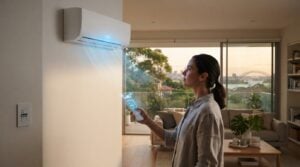
The days of walking into a sweltering house and waiting thirty minutes for the air to move are over. With integrated Wi-Fi and smart home connectivity, you can pre-cool your home while you’re still on the commute back from the city or finishing up a grocery run. Modern multi-split systems provide the ultimate flexibility, allowing you to set different temperatures for every room in the house. This precise zoning means you only pay to cool the spaces you are actually using, which is a major factor in reducing those peak-summer energy bills. It also brings an end to the “thermostat wars” in family homes, as everyone can enjoy their own personalised comfort zone without compromise.
In Sydney, our air quality can be quite variable, particularly during the humid months or when seasonal bushfire smoke drifts across the basin. Modern Daikin systems are now equipped with Streamer Technology, a sophisticated purification system that uses high-speed electrons to neutralise allergens and bacteria. This provides a level of protection that older units simply cannot match. Advanced 2026 filtration systems are now engineered to capture 99% of microscopic particles, ensuring the air your family breathes is as clean as it is cool. The enhanced dehumidification capabilities of these modern units are also essential for preventing the stubborn mould growth that often affects coastal properties. It’s about looking after your household’s well-being as much as their comfort.
If you would like to explore which of these new technologies best suits your property, we invite you to reach out for a professional assessment tailored to your needs.
We have been a proud part of the Northern Beaches community since 1999. Our Warriewood-based team doesn’t just look at the square metres of your rooms. We take a holistic view of your property’s thermal envelope. Our experts examine several key factors during a site audit:
As an authorised Daikin Specialist Dealer, we have the technical expertise to recommend a system that balances peak power with daily efficiency. Our philosophy is strictly consultative. We’re here to provide the solution you actually need for long-term comfort, reflecting our identity as a family-owned business built on trust rather than high-pressure sales tactics.
We understand that having tradespeople in your home can be disruptive to your routine. That is why we prioritise punctuality and professional accountability, ensuring we leave every site as clean as we found it. On installation day, our team manages the entire process from start to finish. This includes the careful decommissioning of your old system and the responsible recycling of all components. We ensure your new Daikin is commissioned precisely to meet the 2026 energy standards, giving you immediate access to the lower running costs and smart features we’ve explored.
If you have noticed the signs you need a new aircon, don’t wait for the first 40-degree day of the season to take action. You can book a professional assessment with our local team today to ensure your home remains a sanctuary of cool, quiet comfort for years to come.
Identifying the signs you need a new aircon is the first step toward reclaiming your home’s comfort. Whether you’ve noticed the “zombie” effect on your energy bills or your system is struggling against the Northern Beaches salt air, acting before a total breakdown ensures you stay in control. By choosing to upgrade, you’re not just buying a machine; you’re investing in whisper-quiet operation and the significant health benefits of 2026 filtration technology.
As a family-owned business serving our neighbours since 1999, we’re here to help you navigate these choices without the pressure. As an Authorised Daikin Specialist Dealer, our team provides the expert guidance needed to tailor a system for your specific property layout. We invite you to Book Your Free Home Assessment with Sydney’s AC Experts today. Let’s make sure your family enjoys the reliability and peace of mind they deserve this season. We look forward to helping you create the perfect indoor environment.
In our experience serving Sydney since 1999, most systems last between 10 and 15 years. However, our local climate plays a massive role in this timeline. Properties on the Northern Beaches or near the harbour often see systems reach their limit closer to the 10-year mark due to salt air and high humidity. Regular professional servicing is the best way to extend this lifespan, but environmental wear eventually takes its toll on any outdoor unit.
We generally recommend the “50% Rule” for older systems. If the cost of a single repair exceeds half the price of a new, energy-efficient unit, replacement is usually the smarter financial choice. Older systems often enter a cycle of frequent breakdowns where “one more fix” quickly adds up. You also miss out on the lower running costs and the peace of mind that comes with a fresh five-year manufacturer warranty on a new system.
If your system still blows warm air after a professional clean, it often points to a more serious mechanical issue. This could be a significant refrigerant leak, a failing compressor, or a faulty four-way valve. While minor issues are easily fixed, persistent warm airflow is one of the primary signs you need a new aircon. It suggests the core components can no longer manage the heat exchange process effectively enough to cool your home.
Absolutely. Salt air is incredibly corrosive and causes “white rust” on the aluminium fins and copper coils of your condenser. This corrosion creates a layer of insulation that prevents the system from shedding heat, forcing the compressor to work much harder. Over time, this leads to higher energy bills and eventual component failure. We often recommend specialised anti-corrosion coatings for our coastal customers to help protect their outdoor units from these harsh local conditions.
Homeowners who upgrade from an older, fixed-speed system to a modern Daikin inverter model can typically save between $200 and $600 per year on electricity. These savings come from advanced sensors and inverter technology that adjust power output to match your needs exactly. Instead of constantly stopping and starting at full power, a new system maintains a steady, efficient temperature, which significantly reduces your household’s total energy consumption during peak summer months.
A failing compressor often gives several warning signs before it quits entirely. You might hear loud grinding or clunking noises when the outdoor unit starts, or notice the system frequently tripping your home’s circuit breaker. Excessive vibration or a unit that takes a long time to begin cooling are also red flags. These mechanical failures are often the final signs you need a new aircon before the unit stops working entirely during a Sydney heatwave.
Yes, all new Daikin residential systems installed by an authorised specialist dealer come with a comprehensive five-year parts and labour warranty. This provides significant protection compared to an old system where you’re responsible for every repair bill. Having this coverage ensures that if any component fails, it’s repaired at no cost to you. It’s a major factor in the long-term ROI when deciding whether to fix an aging unit or invest in a new one.
Most residential ducted replacements are completed within one to two days. Our team at PenAir organises everything from the decommissioning of your old unit to the final commissioning of the new Daikin hardware. If your existing ductwork is in good condition, the process is quite straightforward. However, if we need to replace old, leaky ducts to improve your energy efficiency, it might take a little longer to ensure every room receives perfect airflow.