What if the highest-rated unit isn’t the most efficient choice for your home? When comparing energy efficient ducted air conditioning Sydney options, the star rating is only part of the picture. System size, duct design, zoning and your household’s heating and cooling habits all affect energy use and comfort.
Choosing a system can feel complicated, especially when electricity bills matter and technical specifications are difficult to compare. A well-designed system sized for your home may suit you better than the largest or highest-rated model. The goal is to match the equipment and layout to your home and daily routines.
This guide explains what affects ducted system efficiency in Sydney, how to read the Zoned Energy Rating Label and what to ask during a professional home assessment. You’ll also find practical guidance on sizing, zoning, operation and maintenance. PenAir is a family-owned Sydney business operating since 1999, with site audits and system commissioning included in its installation service.
Choosing energy efficient ducted air conditioning Sydney homeowners can feel comfortable with means looking beyond a unit’s star rating. Efficiency is about delivering the heating or cooling your household needs while using energy effectively. Even a highly rated system may perform poorly if it’s not suited to the home, installed properly or operated to match how rooms are used.
Rated efficiency describes a unit’s performance under specified test conditions. Whole-system performance reflects how efficiently the installed system heats or cools your home in everyday use. The distinction is useful when comparing products: a rating provides a reference point, but it can’t account for every factor affecting comfort and energy use after installation.
In simple terms, efficiency compares the energy a system uses with the heating or cooling it delivers. The principles behind heating, ventilation, and air conditioning (HVAC) show why equipment and air distribution need to work together. With ducted air conditioning, installation quality and operating conditions also affect real-world performance. Poorly designed or installed ductwork, for example, can prevent the system from delivering comfort as intended.
Before comparing models, check their current efficiency ratings and the conditions under which they were tested. Australia’s Zoned Energy Rating Label presents ratings for different climate zones. Compare the information relevant to Sydney rather than relying on a single headline figure, and ask the installer how the rating relates to the proposed system and your home.
Every home has different heating and cooling needs. Ceiling height affects the volume of air to condition. Room layout influences how air can be distributed, while insulation and glazing affect how readily heat enters or leaves. Your occupancy patterns and preferred temperatures also influence when and how the system runs.
Sydney homes vary in design and condition, including homes in the same suburb or of a similar age. A site assessment can identify the layout, insulation, glazing and practical installation constraints before equipment is selected. This gives the installer a sounder basis for matching capacity and system design to your household than a broad rule of thumb can provide.
PenAir’s Sydney air conditioning services include ducted system design and installation, with site audits and commissioning as part of the installation service. An assessment helps connect equipment ratings with the conditions the system will face in your home.
Once you understand what your home needs, the next step is designing a system to meet those needs without unnecessary complexity. Capacity, zone layout and ductwork all affect how well conditioned air reaches the rooms you use. A thoughtful design can support comfort and efficient operation, but no single feature guarantees lower bills.
System capacity should be based on a heat-load assessment, not floor area alone. A qualified professional can assess how the home gains and loses heat, then recommend capacity suited to its conditions and your household’s needs. Ask what assumptions were used and how the assessment informs the proposed system.
Relevant details include the home’s orientation, window size and glazing, insulation, ceiling height, room layout and how each space is used. A sun-exposed living area used throughout the day may have different needs from a shaded bedroom used mainly at night. There’s no universal capacity formula that accounts for every home.
An oversized system may cycle more than needed, while an undersized one may struggle to maintain comfort. Either can undermine efficient operation.
Zoning divides a ducted system into areas that can be managed separately. If your household mainly uses living spaces during the day and bedrooms at night, suitable zoning can let you condition selected areas instead of every zone at once. Ask how the proposed zones reflect your routine and whether the controls will be straightforward to use.
Duct design matters as well. Ask where the ducts will run and how the design accounts for insulation and sealing. Poorly considered routes or gaps can affect how effectively air reaches the intended rooms. A site assessment can identify practical constraints, while commissioning checks that the installed system operates as intended.
Some ducted systems use inverter technology to adjust output as demand changes. Operation and efficiency vary by model, so check current manufacturer information and ratings for the exact system being proposed. Compare documented details instead of assuming all inverter systems perform the same way.
When comparing energy efficient ducted air conditioning Sydney options, consider the design as well as the equipment. PenAir’s installation process includes site audits and system commissioning. To discuss system design for your home, contact the PenAir team and ask about your options.
Start your comparison with your household’s needs, then check how each proposed system addresses them. Manufacturer specifications describe equipment under stated conditions, not how it will perform in every Sydney home. Ask for current documentation for the exact model and clarify how the proposed design, installation and commissioning relate to your property.
Use this table to guide your conversation with the installer. The right choice depends on your rooms, routines and comfort preferences. No single feature is universally best.
| Feature | What to compare | Question it answers |
|---|---|---|
| Capacity | Proposed capacity and the assessment behind it | How was this selection matched to my home’s heating and cooling needs? |
| Zoning | Which rooms are grouped together and can be controlled separately | Can the zones follow how we use different areas through the day? |
| Controls | Control options and how straightforward they are to operate | Can everyone in the household set the system as intended? |
| Operating modes | Available modes and the manufacturer’s description of their operation | Which settings suit our comfort needs in different conditions? |
| Efficiency information | Current ratings, test conditions and model documentation | What do these figures tell me, and what do they not predict about my home? |
Ask for the current Zoned Energy Rating Label and supporting manufacturer information, then check the rating for the relevant Australian climate zone. Also ask what the proposed design and installation include, including commissioning. This separates documented equipment specifications from expected performance in your particular home.
Ducted air conditioning may suit households seeking discreet air distribution across several rooms, provided the property can accommodate a suitable design. Consider where ducts could run, which rooms need conditioning and whether zoning can reflect your routine. It won’t suit every home or budget, so weigh those preferences against other system types, including split systems.
For details about system design and installation, explore PenAir’s ducted air conditioning service. If you’re assessing energy efficient ducted air conditioning Sydney options, compare specifications alongside a property-specific assessment to focus on what matters for your home.
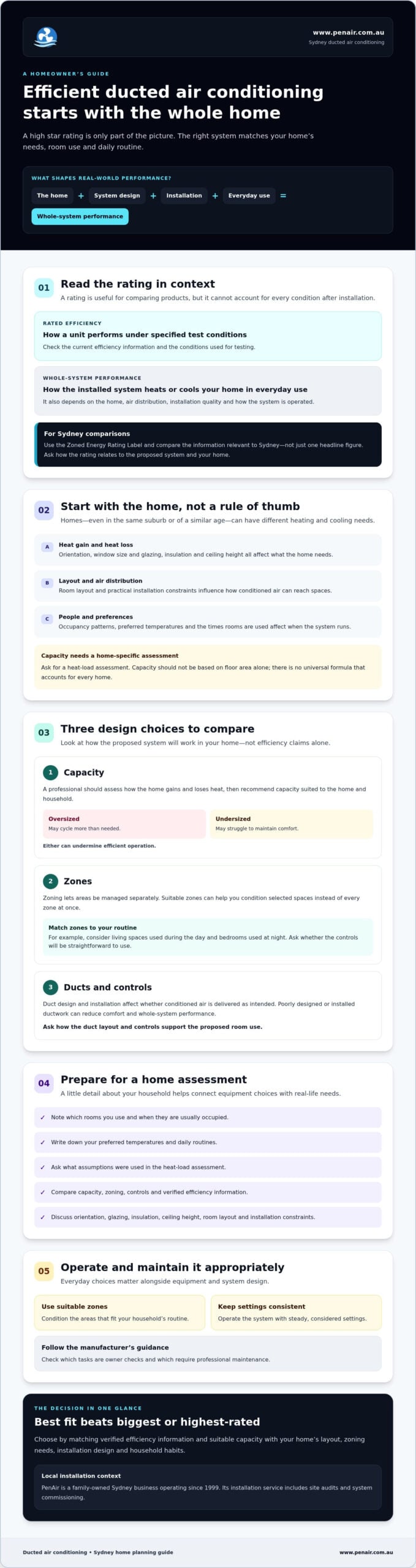
A little preparation makes a site assessment more useful. Before requesting a proposal, write down how your household uses the home and what you want the system to do. This helps the installer consider your comfort needs alongside the practical details of the property.
Use the visit to understand the reasoning behind the proposal, not just the equipment selection. Ask how the capacity, zone layout and duct design were matched to your home. Find out what the installation includes, who will carry out the work and who is responsible for commissioning. Ask what commissioning covers and how you’ll be shown to use the controls.
PenAir serves the Northern Beaches, North Shore, Inner West and Eastern Suburbs from its Sydney base. Learn more about its Sydney air conditioning services and ask how a site assessment can inform a ducted system design. This can be especially useful when comparing energy efficient ducted air conditioning Sydney options and seeking recommendations based on your property rather than a generic estimate.
Ready to discuss your home’s layout, comfort needs and installation considerations? Contact PenAir to arrange a conversation about a tailored assessment.
After installation, everyday settings and timely care help your ducted system operate as intended. Practical habits can support comfort, but the right approach depends on the system, your home and the manufacturer’s instructions. There’s no single setting or routine that suits every household.
Use the zones that match where people are spending time, if your system allows separate zone control. For example, you might condition living areas during the day and select bedroom zones later instead of running every zone by default. Keep settings consistent and comfortable, and avoid frequent large adjustments without a reason.
Follow the manufacturer’s guidance for operating modes, controls and owner checks. Depending on the system, this may include checking or cleaning accessible filters as directed. Don’t remove covers or attempt work on electrical or mechanical components. If you’re unsure what you can safely check, refer to the manual or ask a technician.
If airflow changes, rooms become harder to keep comfortable, or the system behaves differently than usual, professional servicing may help identify an issue. A technician can assess the system and advise whether it needs attention. Maintenance supports reliable operation, but can’t guarantee a particular level of efficiency or a set reduction in energy use.
PenAir provides ducted air conditioning service and maintenance across Sydney. Its family-owned team has operated since 1999, and PenAir is an authorised Daikin Specialist Dealer. For details about available work, see the air conditioning servicing information. Check the manufacturer’s maintenance guidance and discuss any symptoms you’ve noticed with a qualified professional.
Choosing energy efficient ducted air conditioning Sydney homeowners can rely on involves more than selecting equipment. Suitable design, commissioning, everyday use and ongoing care all contribute to how a system serves your home. If you’re planning an installation or have questions about your current ducted system, contact PenAir to discuss your home and its requirements.
Good results come from matching equipment to your home and household, not choosing by star rating alone. An assessment helps guide capacity, zoning and duct design. Comparing current specifications and planning how you’ll use the system gives you a clearer basis for deciding, while suitable operation and ongoing maintenance can help it work as intended.
If you’re considering energy efficient ducted air conditioning Sydney homeowners can feel confident about, local experience matters. PenAir is family-owned and operated in Sydney, has been in business since 1999, and is an authorised Daikin Specialist Dealer. Its licensed and insured team provides ducted system installation and service.
Talk with PenAir about an energy-efficient ducted system for your Sydney home. Discussing your property and comfort needs is a practical next step towards finding a system that suits your household.
It can use a considerable amount, but consumption varies with system capacity, efficiency, operating time, selected zones, home conditions and your electricity tariff. A large home running several zones for long periods will use energy differently from a smaller home conditioning only occupied areas. Manufacturer consumption figures can help with comparisons, but actual use depends on the installed system and how you operate it.
A system is energy efficient when it delivers the comfort your household needs while using energy effectively. Suitable capacity, well-designed and installed ductwork, appropriate zoning and controls all contribute, as does the unit’s verified efficiency rating. For energy efficient ducted air conditioning Sydney homes need a design matched to their layout and use. Ask for current model documentation and confirm that installation and commissioning are included in the proposal.
Neither type is always more efficient. Ducted systems distribute air through ducts and may suit households seeking comfort across several rooms. A split system conditions a particular area, which may suit a home with more localised needs. Compare suitable models and consider how many rooms you’ll heat or cool, how often you’ll use them and your property layout. An assessment can help clarify which system better fits your household.
Ask a qualified professional to assess your home and recommend capacity based on its heating and cooling needs. Floor area alone isn’t enough. The assessment should consider details such as orientation, glazing, insulation, ceiling height, layout and how rooms are used. Sydney homes vary, so avoid relying on a universal formula or rule of thumb. Ask the installer to explain how the assessment supports the proposed capacity.
Zoning can help you manage comfort in different parts of the home and, where the system allows, condition selected areas instead of every zone at once. For example, your household might use living-area zones during the day and bedroom zones later. The benefit depends on the design and your routine. Use the controls as intended, and ask the installer how the zones are configured for your system.
There isn’t one servicing interval that suits every system. Check the manufacturer’s maintenance guidance and consider how often the system runs and the conditions it operates in. Arrange professional attention if airflow changes, the system behaves unusually or rooms become harder to keep comfortable. Regular maintenance can help identify issues affecting operation, but it doesn’t guarantee a particular efficiency level or energy-bill reduction.
An inverter can adjust a system’s output to respond to changing demand, but that doesn’t guarantee lower energy use in every home. Results depend on the specific model, system design, installation and operating conditions. Check current manufacturer specifications and the unit’s verified efficiency information instead of relying on the inverter label alone. Ask an installer to explain how the proposed model is expected to suit your home and usage.