
Imagine hosting a summer lunch in your beautiful Sydney home, only to find you’re sweating over the stove while your guests are shivering on the lounge just ten meters away. This “thermal tug-of-war” is a common frustration for many local families who love the look of modern architecture but struggle to keep it comfortable. Achieving consistent climate control with ducted air conditioning for open plan living areas requires more than just a powerful motor. It demands a strategic approach to airflow and intelligent sensor placement.
We understand how frustrating it is when your energy bills climb because you’re cooling a massive, empty void just to get a bit of relief in the kitchen. You shouldn’t have to choose between a sleek, minimalist interior and a home that actually feels good to live in. Our team believes that your comfort should be seamless, reliable, and tailored to how you actually use your space.
This 2026 guide will show you how to master the art of cooling large spaces without the clutter of wall units or the sting of wasted electricity. We’ll explore the latest in smart zoning, the impact of new AS 1851 fire safety standards on system design, and how the NSW Energy Savings Scheme can provide an upfront discount of up to $736 on your installation.
Modern Sydney architecture relies on the seamless flow of open-plan living. It connects our kitchens to our lounges and brings the outdoors in. However, cooling these expansive volumes of air requires a level of engineering that standard systems can’t match. Choosing ducted air conditioning for open plan living areas is the gold standard because it treats the space as a single, cohesive environment rather than a collection of separate rooms.
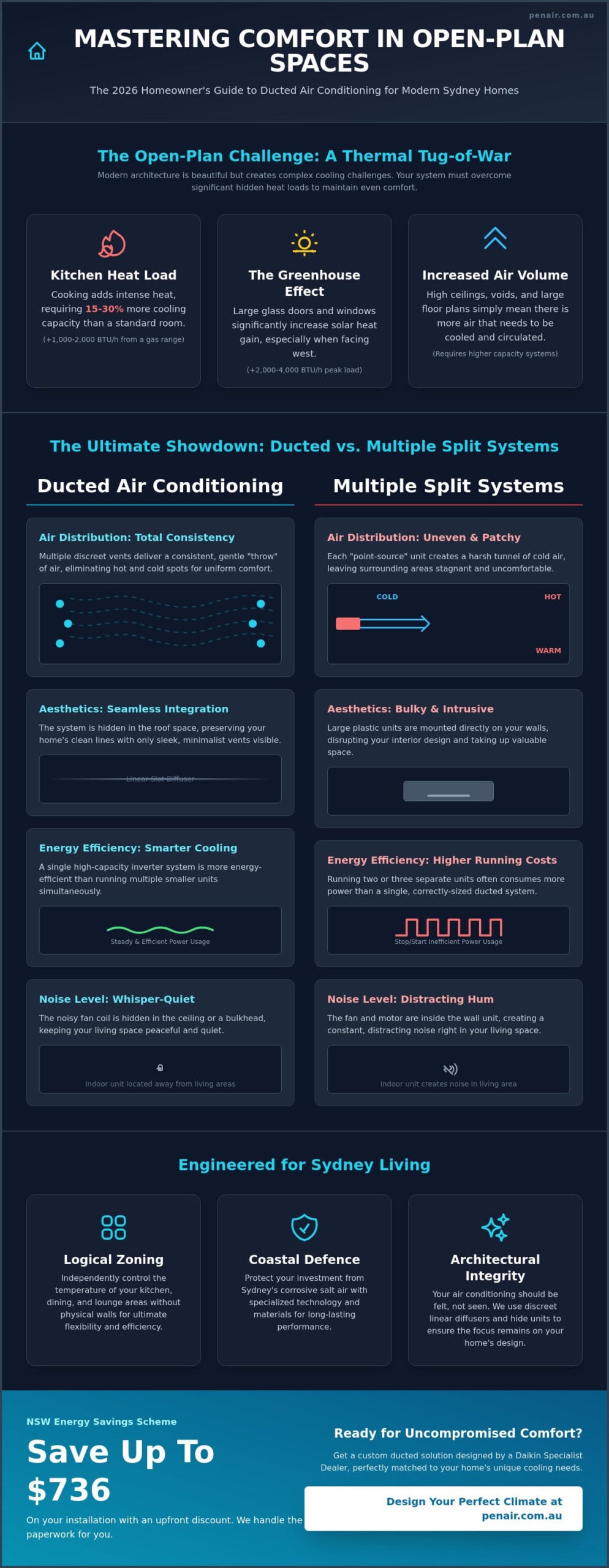
We often see homeowners consider installing multiple split systems to manage a large area. This approach usually backfires. Running two or three separate units is less efficient than one high-capacity ducted inverter system. A ducted setup provides a consistent “throw” of air that reaches every corner. This prevents those annoying hot spots near the dining table while the lounge area feels like a fridge. It’s about moving a high volume of air quietly and effectively.
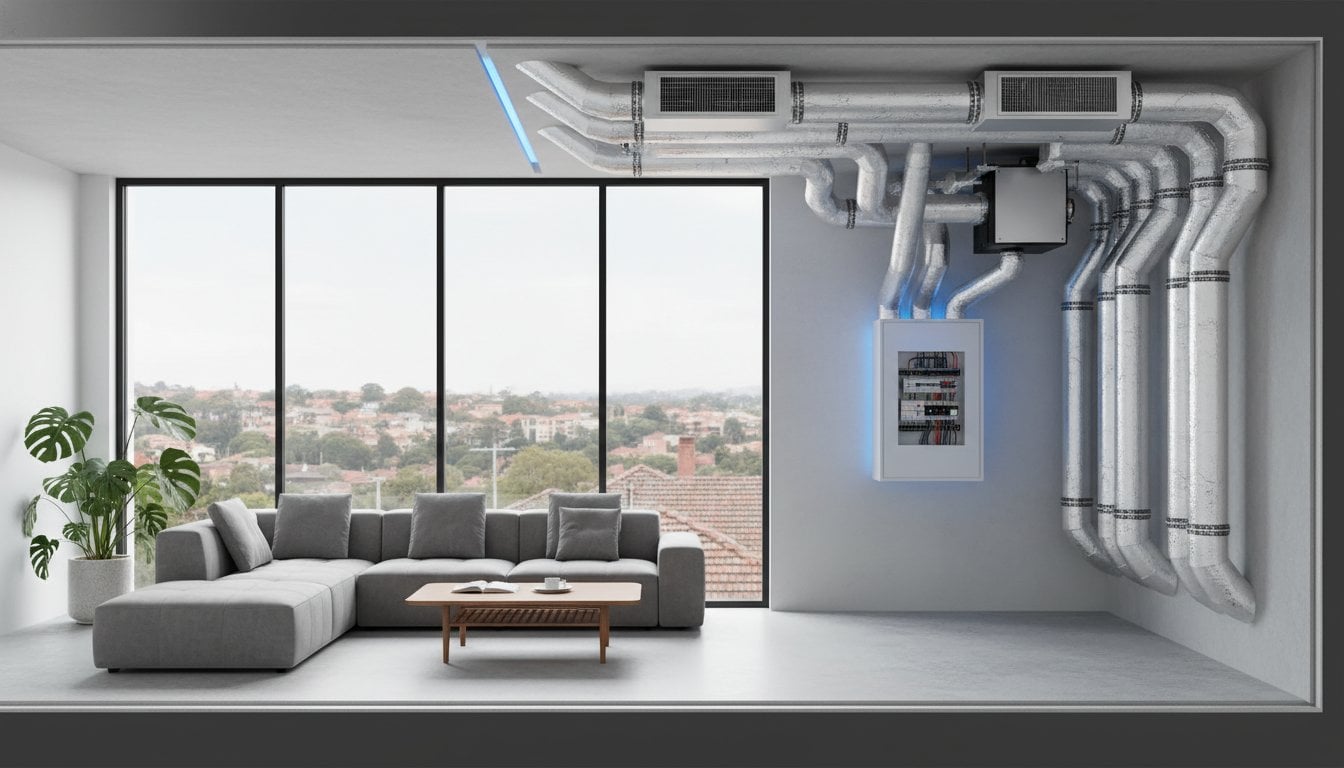
The secret to this success lies in the balance of Heating, ventilation, and air conditioning (HVAC). While vents deliver the cool air, return air grilles do the heavy lifting of removing heat. In a large open area, strategically placed return grilles pull warm, stale air out of the room. This allows the system to maintain a steady temperature without overworking the compressor, which keeps your energy bills more manageable during a long Sydney summer.
Open-plan areas that include a kitchen generally require 15-30% more cooling capacity than a standard room of the same size. Cooking is a major heat source; a gas range can add 1,000-2,000 BTU/h of heat to your home. We also have to account for the “greenhouse effect” from large floor-to-ceiling glass bifold doors. Windows facing south or west can increase the peak cooling load by 2,000-4,000 BTU/h. If your design includes high ceilings or voids, the cooling requirement jumps again because there is simply more air to manage.
We believe your air conditioning should be felt, not seen. High-end Sydney renovations often feature beautiful exposed beams or minimalist ceilings. Ducted systems allow us to maintain these clean lines. We often use linear slot diffusers instead of standard circular grilles to provide a sleek, premium look that disappears into the architecture. If you have limited roof space, we can tuck indoor units into discreet bulkheads. This keeps your walls clear for artwork and ensures the focus remains on your home’s design features.
When choosing between a high-wall split and ducted air conditioning for open plan living areas, the decision often comes down to how you want the air to move. A split system is a “point-source” cooler; it blasts air from one specific location. In a large, sprawling room, this often creates a tunnel of cold air right in front of the unit while the far corners remain stagnant and warm. Ducted systems use multiple vents to distribute air evenly. This ensures the entire volume of the room reaches your set temperature at the same time, providing a much more consistent level of comfort.
Energy efficiency is another major factor for Sydney families. Modern ducted systems use advanced inverter technology to ramp up or down based on the actual cooling demand. For more information on how these systems operate, you can look at this U.S. Department of Energy guide to central air conditioning. By maintaining a steady speed rather than constantly stopping and starting, ducted units often achieve better seasonal energy efficiency ratios (EER) than several smaller splits running simultaneously. It’s a smarter way to manage your home’s climate without overworking your hardware.
We also need to consider the acoustic environment of your home. A large split system has the fan and motor right there on your lounge room wall. When you’re trying to watch a movie or host a dinner, that constant hum can be distracting. With a ducted installation, the indoor fan coil is hidden in the roof space and the compressor is tucked away outside. This keeps the noise where it belongs: away from your living space, allowing you to enjoy your home in peace.
We’ve seen many Sydney homeowners try to “brute force” their cooling with a single 9kW split system. This usually leads to uncomfortable drafts and “cold spots.” If your living area is L-shaped, a split system simply cannot “turn the corner” to reach the kitchen or dining nook effectively. Maintenance is also simpler with a single ducted unit. You only have one set of filters to clean and one outdoor unit to service, rather than managing multiple wall heads spread across your home.
While the initial investment for a ducted system is higher than a single split, the long-term value is significant. In the competitive Sydney property market, especially in areas like the Northern Beaches or the Hills District, a fully integrated ducted system is a “must-have” for many buyers. It’s a permanent asset that adds tangible resale value to your property. Smart zoning also helps you manage daily costs. By only cooling the zones you’re using, some industry professionals report you can reduce your running expenses by up to 30%. If you’re weighing up these options, our team can help you find a ducted system that fits your floor plan perfectly.
A common misconception about climate control is that you need a door to define a zone. In modern Sydney homes, we often face the “Zoning Paradox.” This is the challenge of creating distinct temperature precincts within a single, expansive area. When designing ducted air conditioning for open plan living areas, we use “Logical Zoning” to address this. Instead of dividing by rooms, we divide by how you use each part of the space. This allows you to maintain a crisp 22 degrees in the kitchen while allowing the lounge to remain slightly warmer during a quiet afternoon.
To make this work, we rely on advanced controllers like the Daikin Airbase system. These smart interfaces let you manage your home’s climate from a smartphone or tablet. You can group specific vents into precincts, giving you the power to direct airflow exactly where it is needed. For those interested in the technical foundations of these setups, this Heating, ventilation, and air conditioning (HVAC) overview explains the mechanics of air distribution. By using intelligent sensors placed away from direct sunlight and drafty windows, the system gets an accurate reading of the “true” temperature in each precinct.
We also have to consider the health of the system itself. When you close off several zones in a large home, air pressure can build up within the ducts. To prevent this, we design “spill zones.” These are typically high-traffic areas where excess air can safely discharge. This prevents the system from over-pressurizing, which protects the motor and stops those annoying whistling sounds from under doors or through vents. It’s a small detail that makes a big difference in the daily comfort of your home.
The kitchen is the engine room of the home, and it generates a lot of heat. As noted in the U.S. Department of Energy guide on central air, managing internal heat gains is vital for efficiency. During meal preparation, a gas range can add up to 2,000 BTU/h to the room. By zoning the kitchen separately, we can increase the airflow rate to this specific area without freezing everyone out in the lounge. We can even program “Entertaining Scenarios” that pre-cool the kitchen before guests arrive, ensuring the space stays comfortable even when the oven is at full tilt.
For the ultimate level of precision, we often recommend Variable Air Volume (VAV) systems. These use motorized dampers to adjust the amount of air flowing through each individual duct rather than just turning them on or off. This allows for incredibly fine-tuned control. It helps balance the air pressure across your entire living space, preventing uneven suction and ensuring that the air moves quietly and gently. This level of engineering ensures your ducted air conditioning for open plan living areas performs reliably for years to come.
Living in Sydney brings unique challenges that go far beyond choosing a brand of air conditioner. When we design ducted air conditioning for open plan living areas, we have to account for our local climate, council regulations, and even the age of your home. A system that works in a suburban block in Penrith might not be the right choice for a home on the Northern Beaches. We take a consultative approach to ensure your investment stands up to the specific conditions of your neighborhood.
Noise regulations are a major factor in our city. Sydney councils have strict decibel limits for outdoor condenser units, especially in high-density areas. We work with you to find a placement that provides enough airflow for the unit to breathe while keeping things quiet for your neighbors. We also ensure every installation complies with the Australian Standard 1851 (AS 1851) for fire safety, which became legislated in NSW in February 2026. This is particularly important for systems integrated with fire mode fans in modern developments.
Energy costs are always a concern for local families. We focus on optimizing your system to take advantage of NSW energy cycles. One of the best ways to manage the initial cost is through the NSW Energy Savings Scheme. As of May 2026, eligible homeowners can receive an upfront discount of up to $736 on their installation quote. This is a direct reduction applied by accredited providers, not a cashback offer, making premium comfort more accessible for our community.
If you live in Manly, Warriewood, or anywhere near the coast, salt air is your biggest enemy. It can corrode standard heat exchangers in just a few years. To prevent this, we specify “Blue Fin” technology, which uses a specialized epoxy coating on the condenser fins to resist salt damage. We also recommend a tailored maintenance schedule for coastal zones. Regular rinsing of the coils and professional inspections help prevent pitting and ensure your system lasts as long as it should in high-humidity areas.
Retrofitting a ducted system into an older Federation home or a 1970s brick house requires a bit of creativity. Many modern “skinny” blocks have very little roof cavity space. In these cases, we often look at underfloor ducted options. By running the ductwork beneath the house and using floor registers, we can cool large open areas without needing a massive ceiling void. Before you choose a unit, a local expert site audit is essential. We check that your ductwork meets the R1.5 insulation standard to guarantee your system runs at peak efficiency. Ready to see what’s possible in your space? You can book a Sydney site audit with our team to get started.
Choosing the right hardware is only half the battle. The success of ducted air conditioning for open plan living areas depends heavily on the quality of the installation and the experience of the team behind it. With over 25 years of experience serving the Sydney community, our team at PenAir has seen every architectural challenge imaginable. We’ve worked in everything from high-ceilinged industrial lofts to sprawling coastal renovations. This gives us a deep understanding of how air behaves in large, wall-less environments.
As a Daikin Specialist Dealer, we provide more than just a brand name. This status gives our customers access to premium hardware and extended warranties that aren’t available through general retailers. It means our technicians are factory-trained to understand the specific nuances of Daikin’s inverter technology and smart control systems. We don’t just provide a quote based on floor area. We engineer a solution that accounts for your home’s orientation, window sizes, and your family’s lifestyle.
Our “Consultation First” approach is designed to give you peace of mind. We take the time to walk through your home and discuss how you actually use your space. This ensures that the zoning strategies and sensor placements we discussed earlier are perfectly aligned with your needs. We believe in building long-term relationships with our neighbors. This is why we prioritize helpful, expert advice over high-pressure sales tactics.
A complex ducted retrofit can be invasive, so we take extra care to protect your home during the process. Our team uses drop sheets and floor protection to ensure we leave your space exactly as we found it. We also fabricate custom ductwork to ensure maximum airflow efficiency and minimum noise. Once the installation is complete, we provide a comprehensive hand-over. We’ll teach you how to master your zone controller and set up your smartphone apps for easy remote access.
Keeping your system in peak condition is vital for energy efficiency and warranty compliance. Our professional air conditioning service Sydney is designed to catch small issues before they become expensive problems. If something does go wrong, our local team is ready to provide fast-response air conditioning repairs across the Northern Beaches and the surrounding regions. We are committed to looking after your household’s well-being for the life of your system. Ready to upgrade your home’s comfort? Contact PenAir for a custom open-plan design consultation today.
Creating the perfect indoor environment in a large, open space is about more than just picking a powerful unit. It involves a careful balance of airflow engineering, smart sensor placement, and a deep understanding of how our local Sydney climate affects your home. By choosing a system designed for your specific floor plan, you ensure consistent comfort without the burden of high energy bills.
Investing in ducted air conditioning for open plan living areas is a significant step toward future-proofing your property’s value and your family’s well-being. We bring over 25 years of local expertise to every project, ensuring your system handles everything from coastal salt air to high-ceiling heat traps. As a family-owned and operated business since 1999, we take pride in providing the reliable, honest service that our neighbors deserve.
Our team is ready to help you navigate the technical details and find the right solution for your unique needs. Get a Custom Ducted Design Quote for Your Open-Plan Home and experience the reassurance of working with an Authorised Daikin Specialist Dealer. We look forward to helping you create a cool, quiet sanctuary for your family to enjoy.
Yes, ducted air conditioning for open plan living areas is superior because it provides balanced air distribution through multiple vents. Unlike split systems that create a single blast of air, a ducted setup eliminates hot spots. This is especially true in L-shaped rooms where a single wall unit cannot reach every corner effectively. It ensures the whole room reaches a consistent temperature simultaneously.
Running costs depend on your system’s efficiency rating and how you use your zones. Modern inverter technology allows the system to adjust its power output to match the cooling demand, which prevents wasted energy. By using smart zoning to only cool the areas you’re currently occupying, you can keep your electricity bills manageable. We recommend checking your specific energy provider’s peak and off-peak rates for accurate budgeting.
Yes, we can retrofit ducted systems into most existing homes, provided there is sufficient roof or underfloor space. For homes with limited ceiling voids or cathedral ceilings, we often utilize underfloor ducting with floor registers. Our team conducts a thorough site audit to determine the most discreet path for the ductwork. This allows you to enjoy whole-home comfort without a major structural renovation.
We typically recommend at least two to three logical zones for a large open-plan space. This allows you to prioritize cooling in the kitchen during meal preparation while keeping a gentler airflow in the lounge area. Using multiple sensors ensures the system doesn’t overwork one area while ignoring another. It’s about creating precincts of comfort that match how you actually live in your home.
Daikin is widely considered a top choice for Sydney coastal conditions due to its robust build quality and specialized coatings. We specifically recommend units with Blue Fin technology to protect the external heat exchanger from salt air corrosion. This is vital for homes in suburbs like Manly or Warriewood. Choosing a brand with a strong local support network ensures you have access to parts and specialized technicians when needed.
Ducted systems are significantly quieter than split systems because the noisy components are located away from your living space. The indoor fan coil is tucked in the roof, and the compressor is outside. In the living area, you’ll only hear a gentle rustle of air from the vents. Most modern units are designed to operate well below the decibel limits set by Sydney local councils.
Yes, a professionally installed ducted system is a highly desirable feature that can increase the resale value of your property. In competitive markets like the Northern Beaches, buyers often view whole-home climate control as a standard requirement for premium homes. It represents a permanent, integrated solution that adds to the overall appeal and comfort of the house. It’s an investment that pays off in both lifestyle and equity.
We recommend a professional service at least once a year to keep your system running efficiently. Regular maintenance is especially important in open-plan areas where the system may deal with higher dust levels or kitchen grease. This includes cleaning filters, checking refrigerant levels, and inspecting the ductwork for leaks. Keeping your system serviced also ensures your manufacturer’s warranty remains valid for its full term.