What if the most significant factor in your home’s comfort isn’t the air conditioner itself, but the infrastructure hidden behind your walls? It’s a common concern for Sydney families who feel ready to upgrade, only to find that the hidden costs of ducted air conditioning installation can quickly lead to unexpected budget blowouts. We know how confusing it feels to navigate talk of electrical phases and roof space constraints when you just want a reliable way to keep your family cool.
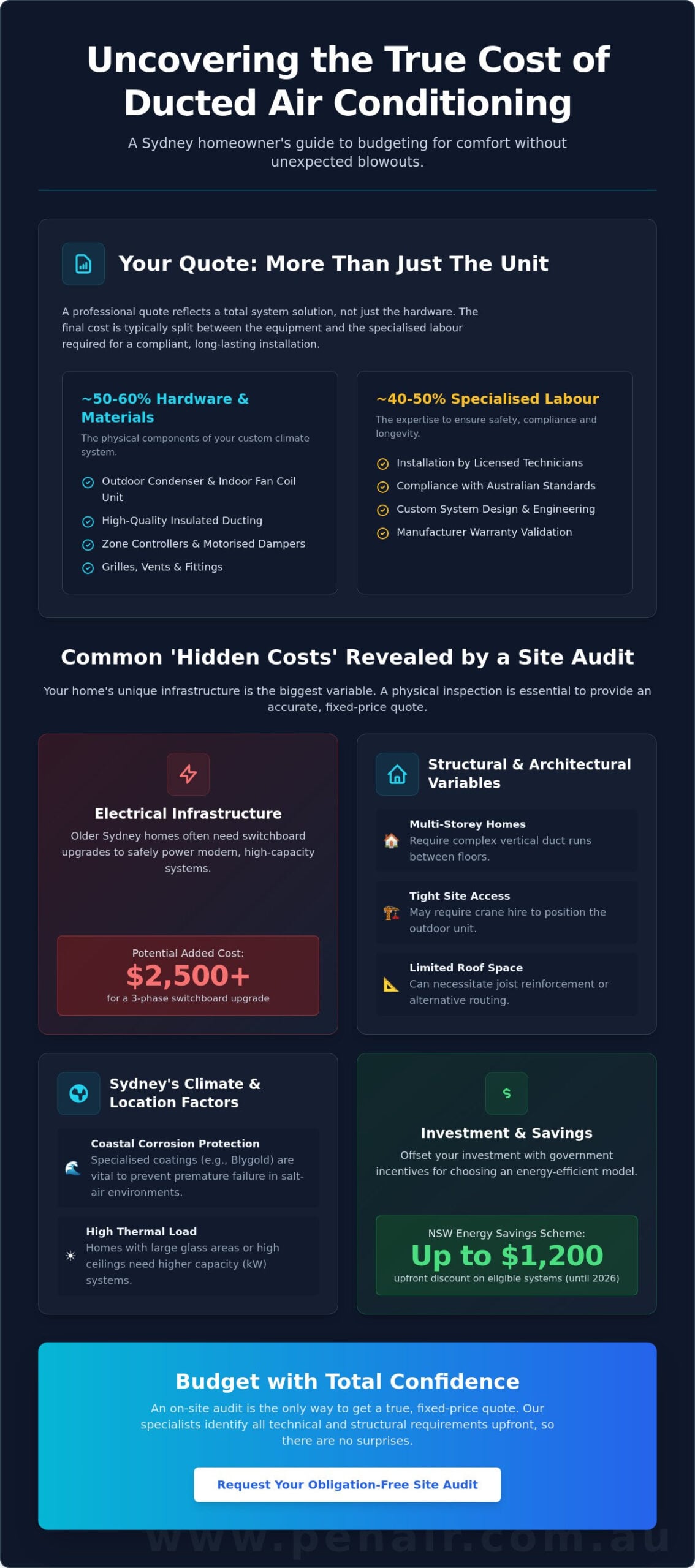
We’re here to provide the clarity you need to budget with total confidence. In this guide, we’ll explain the technical and structural variables that shape a professional quote, from the necessity of a 3-phase switchboard upgrade, which can cost upwards of $2,500, to the specialised Blygold coatings required for homes in our coastal areas. You’ll also learn how to take advantage of the 2026 NSW Energy Savings Scheme, which offers upfront discounts of up to $1,200 for eligible high-efficiency systems, ensuring your investment is both protected and affordable for the long term.
When you start looking at cooling options, it’s easy to focus on the price tag of the unit itself. However, the sticker price of the outdoor condenser and indoor fan coil is only one part of the story. For Sydney families, the true investment is the total installed cost. This figure accounts for the intricate network of Heating, ventilation, and air conditioning (HVAC) components required to make that unit functional. This distinction is where many people encounter the hidden costs of ducted air conditioning installation. Unlike a simple split system that might only require a basic back-to-back setup, a ducted system is a custom-engineered solution integrated into your home’s structure.
We always insist on a comprehensive site audit because your home’s “infrastructure readiness” dictates the final figure. A site audit allows our team to identify if your existing electrical setup or roof layout is ready for a high-capacity ducted air conditioning system. Without this physical inspection, a quote is just an educated guess that often leads to surprises later. We prefer to be upfront about the technical requirements of your specific property from day one.
In a typical professional installation, hardware usually accounts for roughly 50-60% of your total investment. This includes the main unit, the controllers, and the specialised motorised dampers that manage your zones. The remaining portion of the quote covers the skilled labour and specialised materials required for a safe, compliant installation. Our licensed technicians don’t just “fit” a unit; they ensure every connection meets strict Australian Standards. Using qualified specialists is also essential to maintain your Daikin warranty, providing you with peace of mind that your investment is protected for years to come.
Sydney’s architectural landscape is incredibly varied, and this diversity directly influences the complexity of your installation. We see everything from heritage-listed terraces to modern open-plan builds, and each requires a different approach. Your home’s specific layout can change the labour requirements significantly. Consider these common variables:
By understanding these factors, you can see that a quote is a reflection of your home’s unique infrastructure, not just the hardware you buy. Our goal is to ensure you have a clear, transparent understanding of these variables so there are no budget blowouts during the process.
One of the most frequent surprises for homeowners comes from the engine room of the house: the electrical switchboard. While the outdoor unit is the most visible component, its performance depends entirely on your home’s ability to deliver power safely and consistently. This is where the hidden costs of ducted air conditioning installation often emerge, particularly in older Sydney suburbs where wiring might not have been touched for decades. We believe in being transparent about these requirements early on so you can enjoy your new system without any technical hiccups.
Modern ducted systems are incredibly efficient, but they still require a dedicated circuit and, in many cases, a significant boost in power capacity. If your home’s electrical infrastructure isn’t up to the task, the installation cannot proceed safely. This isn’t just about making the unit work; it’s about protecting your home from electrical strain and ensuring your family’s safety under heavy load. If you’re unsure about your home’s current capacity, we can help you identify the right electrical requirements during our initial site visit.
Most residential properties in Sydney operate on single-phase power. While this is perfectly adequate for running your lights, fridge, and television, a high-capacity ducted system designed for a large family home pulls a significantly higher electrical load. When a system exceeds the capacity of standard single-phase power, a 3-phase upgrade becomes necessary. This upgrade allows the unit to operate more efficiently and prevents other appliances in your home from flickering or tripping when the air conditioning kicks in. Based on 2026 market data, a 3-phase switchboard upgrade in Sydney typically starts from $2,500 upwards, depending on the complexity of the connection to the grid and the requirements of providers like Ausgrid.
Current 2026 safety standards are non-negotiable for any major home improvement. Any electrical work, including the dedicated circuit for your air conditioner, must be carried out by a licensed professional and be accompanied by an Electrical Certificate of Compliance (CCEW). If your switchboard still uses old-fashioned ceramic fuses, it will require a total modernisation to include Residual Current Devices (RCDs), also known as safety switches.
A standard residential switchboard upgrade for a typical Sydney home can range from $800 to $2,000. While this might feel like an additional expense, it ensures your home’s fire safety and brings your entire property up to modern standards. By accounting for the hidden costs of ducted air conditioning installation before the first day of work, you can move forward with the peace of mind that your system is built on a solid, safe foundation.
While electrical upgrades are often the first hurdle, the physical layout of your home presents its own set of variables. The hidden costs of ducted air conditioning installation frequently stem from the ‘unseen’ work required to fit a large system into a space that wasn’t originally designed for it. Whether it’s a heritage terrace or a modern apartment, structural readiness is just as vital as electrical capacity. We look at your home’s bones to ensure the system doesn’t just fit, but operates at peak performance without compromising your ceiling’s integrity.
Structural readiness isn’t just about finding a spot for the unit. It involves calculating the weight distribution and the path the air must travel. If these physical factors aren’t addressed during the quoting stage, you might find yourself facing unexpected variations once the tools come out. Our goal is to identify these structural needs during our initial site audit so your budget remains intact.
For those living in older properties, particularly those built before 1990, asbestos safety is a critical consideration. If we suspect asbestos in the eaves or ceiling during our audit, professional testing and removal are mandatory before any work begins. Additionally, if your home has double-brick internal walls, ‘wall chasing’ to hide pipework and controllers takes significantly more time than working with modern timber studs. These are necessary steps to ensure a professional finish, but they do influence the final labour requirements.
If your home has a flat roof or you’re living in a multi-storey apartment, traditional roof space simply doesn’t exist. In these scenarios, we often use bulkheads. A bulkhead is a custom-built boxed section of the ceiling designed to house the unit and ducting discreetly. While bulkheads offer a sleek, integrated look, they represent a trade-off between aesthetics and cost. Unlike a standard install, a bulkhead requires additional trades like carpenters, plasterers, and painters to finish the job.
We also consider long-term accessibility. Every system requires regular service and maintenance to stay efficient. If a unit is tucked away without a proper access manhole, future repairs become significantly more expensive and invasive. We always design our installations to be ‘service-friendly,’ ensuring that the hidden costs of ducted air conditioning installation don’t follow you into the future through difficult maintenance access.
Sydney’s unique geography means a system that works perfectly in the western suburbs might struggle to survive on the Northern Beaches. When we discuss the hidden costs of ducted air conditioning installation, we are often referring to the specialised features required to make a system last in our local environment. Cutting corners on climate-specific protection might reduce your initial quote, but it frequently leads to premature system failure and higher energy bills later on. We focus on building a system that stands up to local conditions from day one.
A well-engineered design also prevents “short-cycling,” a common issue where a unit turns on and off too frequently because the airflow isn’t balanced correctly. This puts immense strain on the compressor and is a leading cause of early mechanical breakdown. By investing in the right infrastructure upfront, you ensure your system runs smoothly for its entire expected lifespan.
While a basic two-zone setup is standard for many homes, many Sydney families now opt for advanced individual room control using technology like Daikin Airbase. This allows you to precisely manage which rooms are cooled, preventing you from wasting energy on empty spaces. Some industry professionals report that smart zoning can reduce energy consumption by up to 30% compared to non-zoned systems. While adding these capabilities requires more complex motorised dampers and intricate control wiring, the long-term return on investment is significant. It transforms your air conditioner from a blunt instrument into a precise tool for home comfort.
If you live within five kilometres of the ocean, salt air corrosion is the single biggest threat to your outdoor unit. Over time, salt build-up eats away at the delicate aluminium fins of the heat exchanger, reducing efficiency until the unit fails entirely. To combat this, we recommend anti-corrosion treatments like “Blue Fin” or “Gold Fin” coil protection as a baseline. For homes in high-exposure areas like Mona Vale, specialised protective coatings such as Blygold are a necessary part of the hidden costs of ducted air conditioning installation that protect your long-term investment.
Beyond the initial coating, the importance of professional cleaning cannot be overstated for coastal properties. Regular maintenance washes away salt deposits and ensures the protective layers remain intact. We also prioritise high-quality insulated ducting, such as R1.0 or R1.5 rated materials, over cheaper alternatives. Cheap ducting often lacks the thermal resistance needed for Sydney’s hot roof cavities, leading to “thermal loss” before the cool air even reaches your rooms. If you want a system designed specifically for your local conditions, reach out to our specialist team today for a tailored assessment.
After exploring the electrical, structural, and environmental factors that influence a quote, it becomes clear that the cheapest price is rarely the best value. Choosing the right partner for your project is about more than just finding a low number; it’s about ensuring those hidden costs of ducted air conditioning installation are identified and managed before the first hole is cut in your ceiling. At Peninsula Air Conditioning, we’ve spent over 25 years serving the Sydney community as a family-owned and operated specialist. We believe that true reliability comes from a blend of traditional craftsmanship and modern technical expertise.
Our approach is built on transparency and long-term relationships rather than quick transactions. We know that your home is your most significant investment, and we treat it with the care it deserves. By choosing a local specialist with a deep understanding of Sydney’s specific building styles and climate, you aren’t just buying an air conditioner; you’re investing in a home environment that is safe, efficient, and built to last.
There is a significant difference between a general contractor and an Authorised Daikin Specialist Dealer. Our team undergoes rigorous specialised training that allows us to perform precise system sizing and custom duct design. If a system is incorrectly sized, it will either work too hard and fail early or “short-cycle” and drive up your energy bills. Our expertise ensures your system is balanced perfectly for your home’s unique layout.
Beyond the technical side, there is the peace of mind that comes from working with a local, licensed, and insured team. We take pride in our work and stand behind every installation we perform. This commitment to excellence is one of the many reasons why families across the region trust us with their comfort. You can learn more about our heritage and why choose Peninsula Air Conditioning for your next project.
The path to a perfectly cooled home should be logical and stress-free. We follow a steady, organised process that begins with your inquiry and moves through a comprehensive site audit. This audit is the “hidden value” in our service; it allows us to catch the electrical or structural requirements we discussed earlier, ensuring your final quote is accurate and transparent. Once the design is finalised, our professional team handles the installation and commissioning with minimal disruption to your daily life.
Don’t leave your home’s comfort to chance or risk unexpected budget blowouts with a generic quote. We invite you to book a professional site audit so we can help you navigate the hidden costs of ducted air conditioning installation with total confidence. Contact the PenAir team today for a transparent ducted AC quote and experience the difference that 25 years of local expertise makes.
Understanding the technical requirements of your property is the first step toward a successful home upgrade. By accounting for infrastructure needs like switchboard capacity and environmental factors like coastal corrosion protection, you can effectively manage the hidden costs of ducted air conditioning installation. A professional site audit ensures that your quote reflects the true scope of work, preventing any unexpected financial surprises once the project begins. We believe that clarity and transparency are essential for your peace of mind.
As an Authorised Daikin Specialist Dealer serving Sydney since 1999, our team of fully licensed and insured local technicians is here to look after your household’s well-being. We combine decades of local experience with a commitment to honest, hardworking service. When you’re ready to invest in a system that’s designed to last, we’re ready to help you navigate every variable with ease. Get a Transparent Ducted AC Quote from PenAir today and take the first step toward a perfectly controlled home environment. We look forward to helping you stay comfortable, no matter what the Sydney weather brings.
A 3-phase switchboard upgrade in Sydney generally starts from $2,500 upwards depending on your home’s layout and the specific requirements of your local network provider. This cost covers the specialised electrical work needed to handle the higher load of a powerful ducted system. It’s a vital investment for larger homes to ensure the unit operates efficiently without putting undue strain on your existing electrical circuits or causing power fluctuations during peak summer heat.
You usually don’t need to move out during the installation process as our team works to minimise disruption to your daily routine. Most residential installations are completed within one to three days depending on the complexity of the ductwork and structural requirements. We coordinate closely with you to ensure we maintain a tidy work environment and keep common areas accessible while we integrate the new system into your home’s infrastructure.
Daikin systems often carry a higher initial quote because they are engineered with premium components and advanced inverter technology designed for long-term reliability in Australian conditions. As an Authorised Daikin Specialist Dealer, we see firsthand how their superior energy efficiency and robust build quality reduce running costs over time. While the upfront price is higher, the investment often pays for itself through lower electricity bills and a significantly longer system lifespan compared to entry-level alternatives.
Yes, you can install ducted air conditioning in a flat-roof home by using specialised bulkhead units or slimline indoor fan coils. Since there is no traditional roof cavity to house the equipment, our team designs custom boxed sections within the ceiling to discreetly contain the unit and ducting. While this approach requires additional carpentry and plastering work, it provides a sleek, modern finish that brings whole-home comfort to even the most challenging architectural designs.
Adding smart zoning to your ducted system typically costs between $1,000 and $3,000 depending on the number of zones and the complexity of the control system. This investment allows you to manage temperatures in individual rooms, which is one of the most effective ways to manage the hidden costs of ducted air conditioning installation by reducing energy waste. By only cooling the rooms you’re using, you significantly lower your long-term household running costs.
If asbestos is identified in your roof cavity or eaves, work must stop immediately until a licensed specialist performs professional testing and safe removal. This is a mandatory safety requirement under NSW regulations to protect both your family and our technicians from hazardous fibres. While this adds a necessary step to the project timeline and budget, ensuring your home is safe and compliant is our absolute priority before any structural work continues.
A professionally installed ducted system is widely considered a high-value asset that can significantly increase the market appeal of a Sydney property. Local real estate experts often report that whole-home climate control is a top priority for buyers, particularly in suburbs prone to summer heatwaves. By choosing a reputable brand and a specialist dealer, you ensure the system is seen as a reliable, long-term improvement rather than a potential maintenance liability for future owners.
We recommend scheduling a professional service for your ducted system at least once every twelve months to maintain peak efficiency and catch minor issues before they become expensive repairs. Regular maintenance is the best way to avoid the hidden costs of ducted air conditioning installation over the life of the unit. This includes cleaning filters, checking refrigerant levels, and ensuring that coastal corrosion isn’t compromising the outdoor unit’s performance or your home’s air quality.