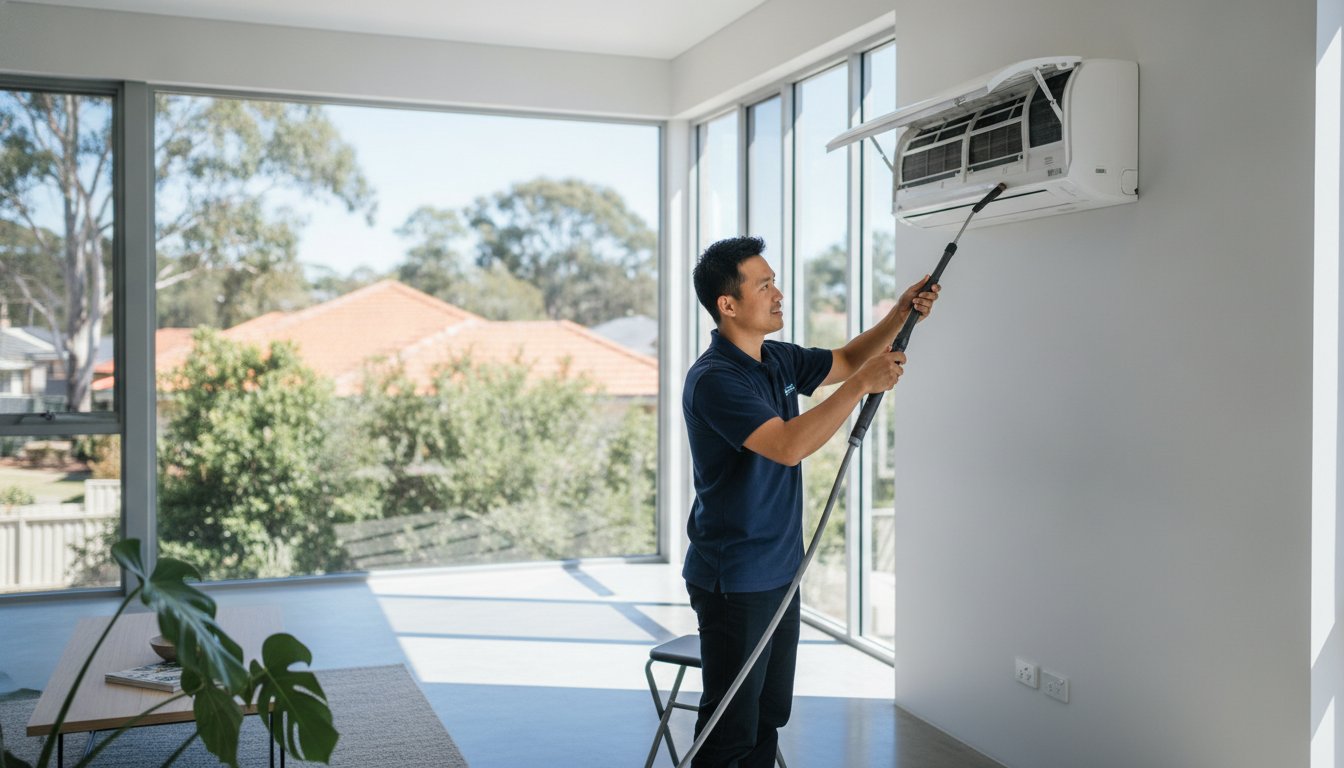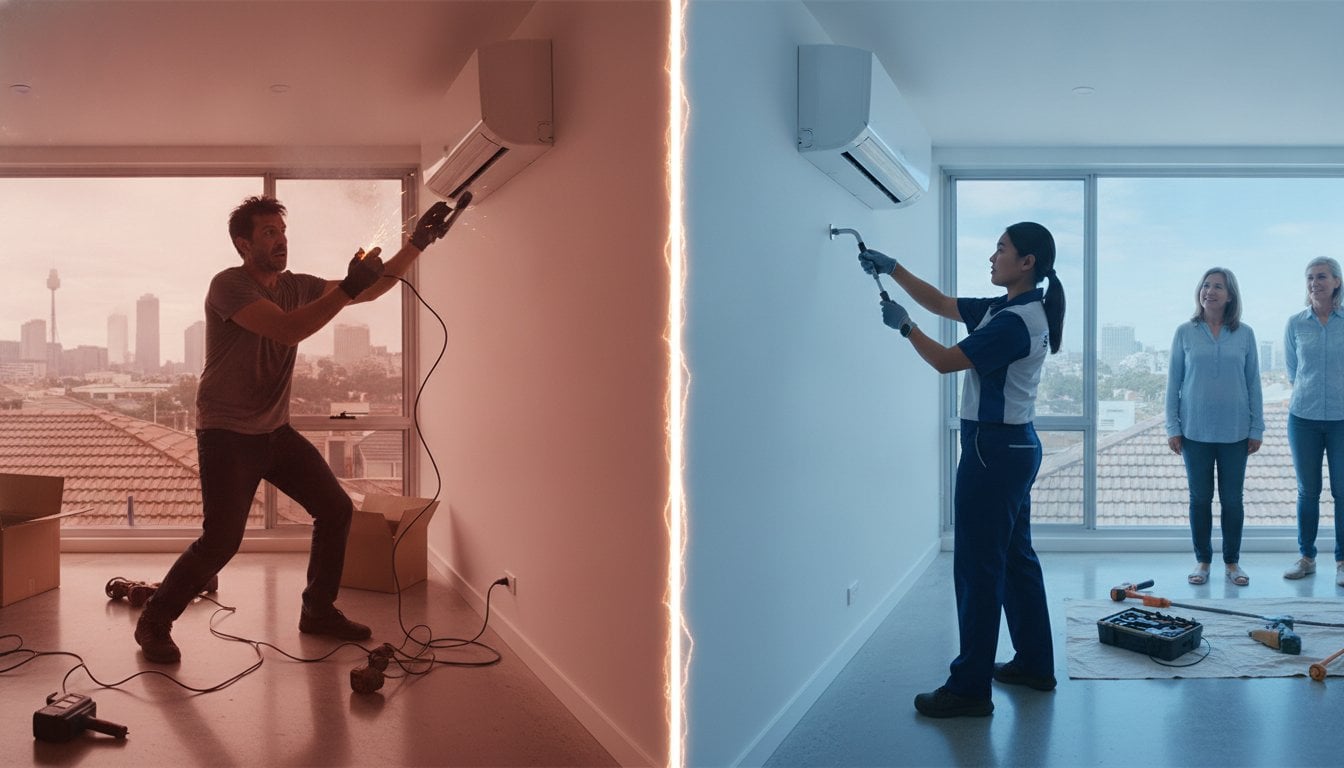

Did you know that letting an unlicensed worker touch your split system could result in a personal fine of up to $132,000? It sounds extreme, but as we move through 2026, the Australian Refrigeration Council (ARC) has made it clearer than ever that handling refrigerants is a specialist’s job. Finding a qualified ARC licensed air conditioning technician Sydney families can trust isn’t just about getting the cold air flowing again; it’s about protecting your home from legal and financial disasters.
We understand that when your aircon packs up on a humid January afternoon, you just want it fixed fast. However, the common confusion between a general electrician and a dedicated cooling specialist often leads to voided manufacturer warranties and accidental refrigerant leaks that harm our local environment. In this guide, we’ll show you exactly why that little “tick” logo matters more than ever this year. You’ll discover how the latest 2026 licensing updates safeguard your investment, help you stay compliant with strict environmental laws, and ensure your household stays comfortable without the stress of hidden risks.
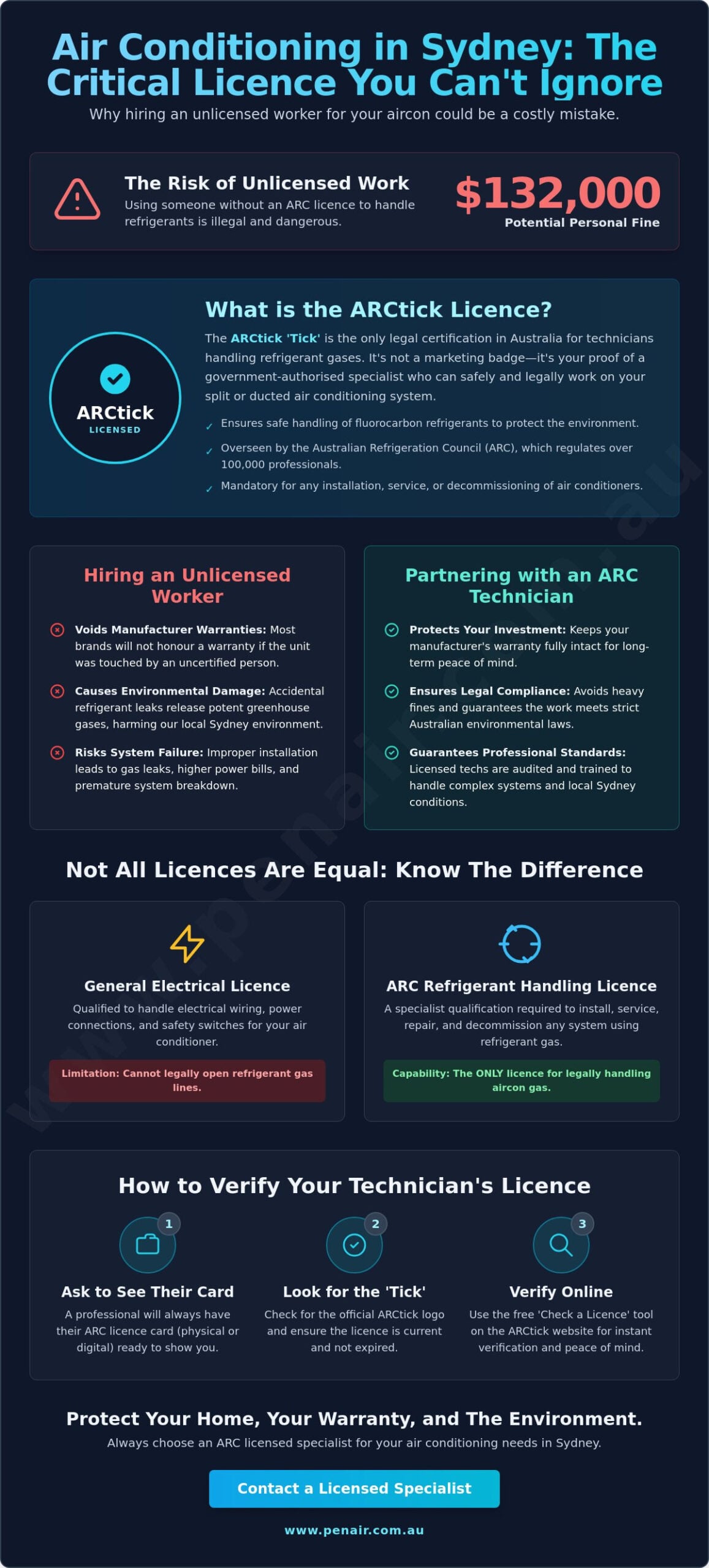
When you start looking for a professional to install or repair your cooling system, you’ll likely see a small blue and yellow “Tick” logo on their website or van. This isn’t just a marketing badge. It represents a specific legal qualification issued by the Australian Refrigeration Council (ARC). An ARC licensed air conditioning technician Sydney residents hire is someone who has proven they have the technical expertise to handle fluorocarbon refrigerants without harming the environment or your family’s safety.
It’s vital to understand that this is a separate requirement from a standard NSW Fair Trading contractor licence. While a general builder or electrician might be authorised to do certain types of work, they cannot legally “open” the gas lines of an air conditioner unless they hold an ARC licence. In Sydney, this is a strict legal mandate for anyone installing, servicing, or decommissioning any system that uses refrigerant gas. Because of the environmental impact of refrigerants, the government ensures only those with the right “Tick” can perform these sensitive tasks.
The ARC acts as the national regulatory body with a clear mandate: to reduce greenhouse gas emissions by ensuring high standards in the refrigeration and air conditioning industry. They currently oversee more than 100,000 individuals and businesses across Australia. To maintain these numbers, the ARC performs regular audits of technicians to ensure their craftsmanship meets current Australian Standards. By 2026, the industry has moved toward the ARC Smart Card, a digital identification tool that allows you to verify a technician’s credentials instantly on your phone before they start any work.
The “Tick” is your primary symbol of trust. In our local Sydney climate, air conditioners work incredibly hard. Whether you are dealing with salt air corrosion on the coast or the intense heat of the western suburbs, your system’s gas levels and seals must be perfect. An ARC licensed air conditioning technician Sydney specialist understands these local pressures. They ensure your high-performance system doesn’t leak gas, which would otherwise lead to higher power bills and potential system failure. We always recommend that you ask to see your technician’s ARC card before any tools are taken out of the van. It’s the simplest way to ensure you’re working with a professional who values quality and accountability.
Hiring an ARC licensed air conditioning technician Sydney residents can rely on isn’t just a matter of professional pride; it’s a critical legal safeguard. As of 2026, the Australian government has tightened its HFC phase-down, making the management of refrigerant gases a top priority for national environmental health. When a technician works on your split or ducted system, they are handling substances that, if released, contribute significantly to global warming. By choosing a licensed professional, you ensure that these gases are recovered and managed according to the strict standards set by the Australian Refrigeration Council (ARC).
The refrigerants used in modern systems, such as R32 or R410A, have a high Global Warming Potential (GWP). Even a minor leak caused by a poor flare connection or a botched repair can have a massive impact. In coastal areas like the Northern Beaches or the Eastern Suburbs, our systems face constant salt air corrosion. This makes high-quality seals and professional installation even more vital. If a system isn’t handled correctly, these gases escape into our local atmosphere, worsening the urban heat island effect that already plagues Sydney’s summer months. To put this in technical terms, the Ozone Depleting Potential (ODP) is a relative measure of how much damage a substance can cause to the ozone layer compared to an equivalent mass of CFC-11. While modern gases have a lower ODP than older chemicals, their impact on climate change remains a serious concern that requires expert handling.
The legal ramifications of bypassing the “Tick” are significant. Under the Ozone Protection and Synthetic Greenhouse Gas Management Act, the unlawful discharge of refrigerant can result in a penalty of up to $132,000 for an individual. While these fines often target the worker, homeowners who knowingly hire unlicenced labour can find themselves in a difficult position. Beyond the fines, there’s a massive insurance risk. If an unlicenced installation leads to a house fire or a toxic leak, your insurance provider may have grounds to reject your claim entirely. They often view unlicenced work as a breach of policy conditions, leaving you to foot the bill for repairs or property loss.
Safety is the final, non-negotiable piece of the puzzle. Some modern refrigerants are mildly flammable, and improper handling can lead to fire hazards or the release of toxic fumes within your home. It’s simply not worth the risk to save a few dollars on labour. If you have any concerns about your current system’s compliance or safety, it’s always best to chat with a local expert who can verify your setup is legal and safe.
One of the most frequent questions we hear from Sydney homeowners is whether their regular “sparkie” can simply pop in a new split system. It is a common misconception that a standard electrical licence covers everything related to air conditioning. While your local electrician is an expert at wiring lights, power points, and switchboards, they are licensed for power, not for gas. To legally handle the refrigerants inside your unit, a professional must be an ARC licensed air conditioning technician Sydney families can trust to manage high-pressure systems safely.
The distinction is critical because an air conditioner is a complex mechanical system, not just another electrical appliance. According to the government regulations for air conditioning, anyone working on these systems must have specific qualifications to prevent the accidental release of harmful gases. Most specialised AC technicians hold a “restricted” electrical licence. This allows them to safely connect the unit to your home’s power supply, but a general electrician rarely holds the reciprocal Refrigerant Handling Licence required to touch the gas lines.
Handling refrigerants requires years of specialised training that a general electrical apprenticeship doesn’t cover. For instance, a technician must know how to flare copper pipes to create a leak-proof seal and how to “vacuum down” a system to remove moisture and air before releasing the gas. These tasks require a specific set of tools that you won’t typically find in a standard electrician’s van. We use manifold gauges to monitor pressures, vacuum pumps to clear the lines, and dry nitrogen to pressure-test the system for leaks. Without this equipment and the knowledge to use it, a system is likely to fail prematurely or run inefficiently, costing you more in the long run.
Choosing a specialist means you are hiring someone who understands the thermodynamics and airflow science behind a comfortable home. This is especially important for complex ducted air conditioning installations, where duct sizing and vent placement determine whether your bedrooms actually stay cool. A qualified mechanic ensures the gas charge is exactly right; too much or too little gas can significantly reduce the lifespan of your compressor. This level of precision is what we provide through our PenAir servicing page, where we focus on maintaining these technical standards for every Sydney household we visit. By choosing a specialist team, you get the gold standard of care for your home’s climate control.
While knowing the benefits of the “Tick” is important, the real peace of mind comes when you can verify those credentials for yourself. The Australian Refrigeration Council has made this process incredibly simple for homeowners by providing a public register that is updated in real-time. Ensuring you have an ARC licensed air conditioning technician Sydney families can trust means doing a quick spot check before any work begins on your property.
A professional technician should never be offended if you ask to see their licence. In fact, most of us take pride in showing it because it represents years of hard work and specialised training. If a contractor seems hesitant or makes excuses about leaving their card in the ute, it’s a major red flag that they might not be authorised to handle the refrigerants in your system.
The most reliable way to confirm a tradie’s status is through the official Look for the Tick website. This digital register is the source of truth for the entire industry. You can follow these three simple steps to get an answer in seconds:
By 2026, the ARC Smart Card has become the standard identification for everyone in the industry. This physical card features a clear photo of the technician, the recognisable “Tick” logo, and a unique QR code. Every legitimate Sydney business, including our team at PenAir, will have this card ready for inspection the moment we arrive at your home. A single scan of the QR code with your smartphone camera allows for instant mobile verification of their current standing and qualifications.
Beyond the individual’s licence, you should also ensure the business holds a Refrigerant Trading Authorisation (RTA). While the technician needs a licence to handle the gas, the company needs an RTA to legally buy and possess it. Every reputable local specialist will be happy to provide both numbers for your records. If you’re ready to get your system sorted by a fully verified professional, book a consultation with our licensed team today.
When you choose a team to enter your home and manage your climate control, you aren’t just looking for a technician; you’re looking for a partner you can trust. Peninsula Air Conditioning, or PenAir as our locals know us, has been a family-owned Sydney institution since 1999. Over more than two decades, we’ve built our reputation on the belief that professional reliability should always come with a bit of local warmth. Every ARC licensed air conditioning technician Sydney homeowners meet from our team carries that heritage of quality and community care into every job.
Our status as an Authorised Daikin Specialist Dealer means we provide more than just a standard installation. We offer a level of technical expertise that is backed by one of the world’s leading manufacturers. This relationship ensures that our clients receive the latest energy-efficient solutions, installed to a standard that generic contractors simply can’t match. We don’t just install a box on the wall; we design a system that fits the unique layout and lifestyle of your household.
From our base in Warriewood, we’ve spent the last quarter-century looking after families from the Northern Beaches and the North Shore to the Inner West and Eastern Suburbs. We understand the specific challenges of the Sydney environment, from the humidity of the harbour to the salt air of the coast. Our commitment to the community is reflected in our unhurried, consultative approach. We take the time to explain your options and ensure you feel confident that your home is in safe hands. You can learn more about our values and our history on our Why Choose Us page.
A major risk that many homeowners overlook is the impact of unlicensed work on their manufacturer’s warranty. Daikin provides a comprehensive 5-year warranty on their systems, but this protection is strictly conditional. If a fault occurs and you cannot provide proof that the system was installed or serviced by a fully qualified professional, your claim may be rejected. This is where the “Tick” becomes your financial shield.
Our split system and ducted specialists document every aspect of your installation for full compliance. We ensure that your ARC-certified paperwork is in order, protecting your investment for the long term. Whether it’s a routine service or a complex multi-split setup, we provide the peace of mind that comes with knowing the job is legal, safe, and fully warranted. If you want to ensure your home’s comfort is handled by the best in the business, contact the ARC licensed experts at PenAir today for a reliable Sydney service.
Your home’s climate control is a significant investment that deserves the highest level of care. By insisting on the “Tick,” you aren’t just following the law; you’re ensuring your household stays safe, your power bills remain manageable, and your manufacturer’s warranty stays valid. The distinction between a general electrician and a specialist can make or break the longevity of your system, especially in our unique coastal environment.
As a family-owned and operated business since 1999, we take great pride in our heritage of craftsmanship and local service. Our fully ARC licensed air conditioning technician Sydney team is ready to help you maintain a perfect home environment through every season. As an Authorised Daikin Specialist Dealer, we have the specific expertise to look after your system with the precision it requires. Don’t leave your comfort to chance with unlicensed work. You can book a service with PenAir’s ARC licensed technicians today to ensure your setup is compliant and efficient. We look forward to looking after your home soon.
Yes, it is illegal under federal law to install or service any air conditioner involving refrigerant gas without a valid licence. The Australian Refrigeration Council regulates these activities to protect our environment from harmful emissions. Hiring an ARC licensed air conditioning technician Sydney specialist ensures you avoid the massive fines that apply to unlicensed work, which can reach $132,000 for individuals who discharge gas unlawfully.
A general electrician can only install your system if they hold a specific Refrigerant Handling Licence in addition to their electrical licence. While most “sparkies” are experts in power and wiring, they aren’t automatically qualified to touch gas lines. We recommend using a dedicated ARC licensed air conditioning technician Sydney expert to ensure your system is vacuumed, pressure-tested, and commissioned correctly to meet manufacturer standards.
You can verify a technician by asking to see their ARC Smart Card or by using the “Check a Licence” tool on the official ARC website. The card should feature their photo, a licence number starting with the letter ‘L’, and a QR code for instant mobile verification. We always have our physical and digital credentials ready for you to inspect the moment we arrive at your door.
Your Daikin 5-year warranty will almost certainly be voided if an unlicensed person performs repairs or installation on your unit. Manufacturers require proof that a system was handled by a licensed professional to honour any future warranty claims. We document every service and installation to ensure your investment remains protected and your paperwork is always in order for the manufacturer.
Most residential split and ducted systems are covered under a Full Refrigerant Handling Licence, though some technicians hold restricted licences. It is important to check that your technician’s licence class matches the complexity of your specific system. Whether you have a simple wall-hung unit or a large-scale ducted setup, our team maintains the high-level certifications required to look after every type of residential cooling.
Industry costs for licensed professionals reflect the high level of training, insurance, and specialised equipment required to perform the job safely. While we cannot provide a single fixed price without assessing your specific home and system needs, we always aim for fair and honest pricing. Investing in a qualified technician prevents the hidden costs of voided warranties and system failures that often follow cheap, unlicensed work.
The “Tick” is the national symbol of the Australian Refrigeration Council, signifying that a technician is legally qualified to handle refrigerants. Seeing this logo on a van gives you peace of mind that the business is environmentally responsible and authorised to work on your cooling system. It is a badge of honour that we proudly display to show our commitment to professional standards and local accountability.
No, it is illegal for an unlicensed individual to purchase or possess fluorocarbon refrigerants in Australia. Only businesses with a Refrigerant Trading Authorisation (RTA) can legally buy and store these gases. We manage the entire process for you, ensuring that the correct, high-quality gas is used and that all environmental regulations are strictly followed during any necessary recharges or repairs.