Is saving a few hundred dollars on labour worth risking a $66,600 fine and a voided home insurance policy? With the rising cost of living in Sydney, we understand why many homeowners consider picking up the tools themselves to keep budgets under control. However, the dangers of DIY aircon installation go far beyond a simple mechanical error. In Australia, handling fluorocarbon refrigerant without a proper licence isn’t just a risky weekend project; it’s a strict liability offence that can lead to massive penalties under the Ozone Protection and Synthetic Greenhouse Gas Management Act.
We want to help you make an informed decision that protects your family and your biggest investment. You’ll discover the hidden legal, financial, and safety risks of DIY air conditioning installation and why professional Sydney experts are essential for your peace of mind. We’ll walk you through the complexities of refrigerant handling, the reality of voiding a brand-new Daikin warranty, and how our local team ensures your home remains safe, compliant, and perfectly chilled for the long haul.
In Australia, air conditioning isn’t just another home appliance; it’s a piece of fixed infrastructure that requires specialised licensing to install and maintain. While you can pick up a toaster or a pedestal fan and plug it straight into a wall socket, split and ducted systems are entirely different beasts. These systems are hard-wired into your home’s electrical grid and contain pressurised chemical refrigerants that require expert handling. The dangers of DIY aircon installation begin the moment a non-professional attempts to bridge the gap between “handy” and “highly technical.”
Many homeowners fall into the trap of “false economy.” It’s tempting to think that watching a few online tutorials makes you capable of a weekend install to save on labour costs. However, those initial savings often lead to massive future debts. A minor mistake during the commissioning phase can lead to a slow refrigerant leak that destroys the compressor, turning a brand-new unit into a very expensive wall ornament. When you factor in the potential for legal fines and the total loss of equipment, the “cheap” DIY route becomes the most expensive mistake a homeowner can make.
Professional installers carry thousands of dollars in specialised gear, including vacuum pumps, manifold gauges, and nitrogen leak testing kits. Most DIYers lack these tools and often skip the critical step of “pulling a vacuum” on the lines. If moisture remains in the copper piping, it mixes with the oil in the system to create acid, which eventually eats the unit from the inside out. A “near enough is good enough” attitude simply doesn’t work with the precision required for flare connections. Even a microscopic gap in a pipe joint can lead to the dangers of handling refrigerant leaks, which are both environmentally damaging and toxic if they occur in unventilated spaces.
Modern Daikin split systems are marvels of engineering. They use sophisticated inverter technology and sensitive printed circuit boards (PCBs) to maintain precise temperatures and energy efficiency. One static shock or a single crossed wire during a DIY attempt can fry these electronics instantly. Beyond the wiring, the physical positioning of the unit is a science in itself. Incorrect placement affects thermoregulation and airflow, forcing the system to work twice as hard to cool the room.
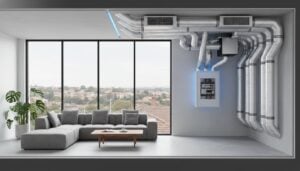
The complexity only grows with ducted air conditioning. These systems involve intricate ductwork design, structural modifications to your roof space, and complex zoning controls. Attempting to install a ducted system without professional training is virtually impossible and poses significant structural risks to your Sydney home. We always recommend leaving these high-stakes tasks to local experts who understand the specific climate demands and building codes of our region.
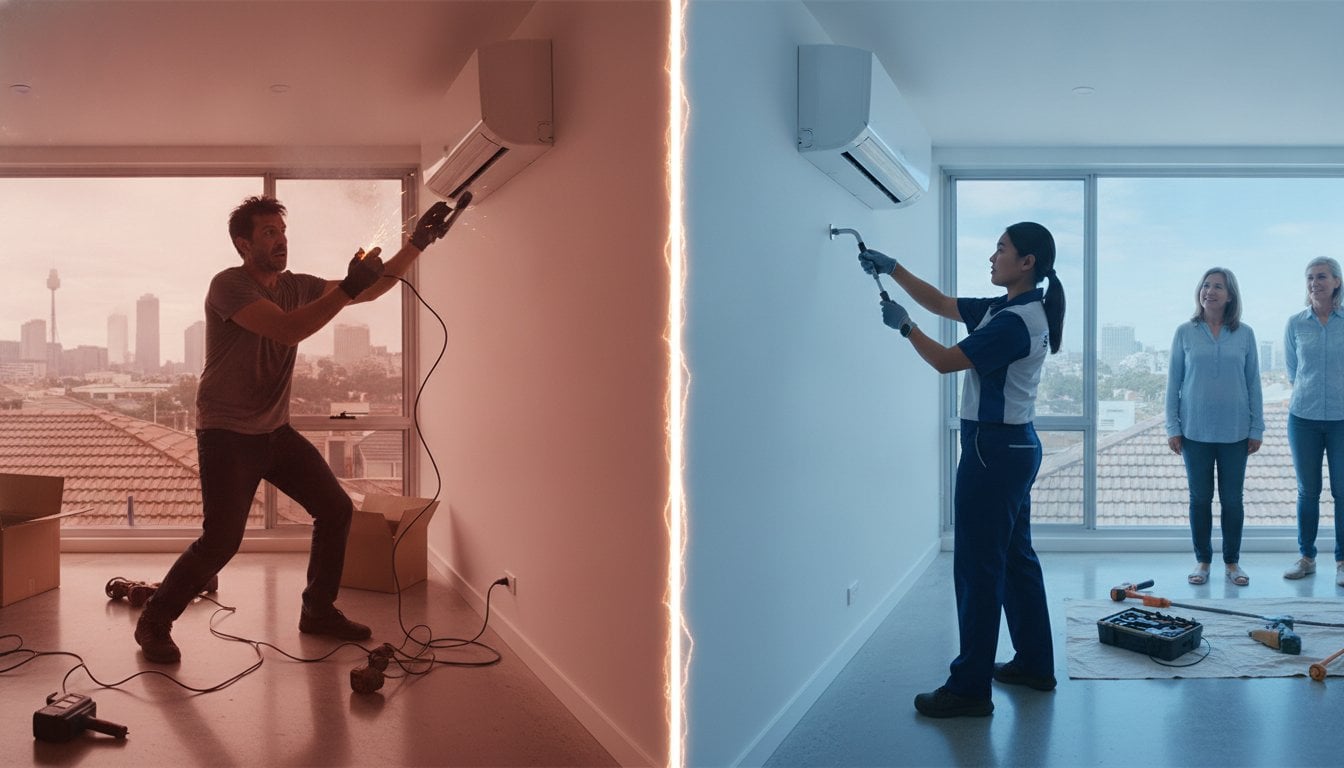
While the financial risks mentioned earlier are significant, they pale in comparison to the immediate physical threats you face during a botched install. The dangers of DIY aircon installation involve working with high-voltage electricity and chemical compounds that can cause permanent injury. We’ve seen many well-meaning homeowners underestimate the sheer weight of outdoor compressor units or the stability needed when working on a ladder near a second-storey roofline. Safety isn’t just about wearing gloves; it’s about knowing how to manage a high-risk environment with the right training.
Prioritising professional help is vital for maintaining a safe home environment, particularly for those with limited mobility or health concerns. For residents who require dedicated assistance, 24/7 Care Services is a registered NDIS provider delivering comprehensive disability support across New South Wales to ensure that daily life is managed with expert care and attention to safety.
Modern air conditioners pull a significant amount of power and require dedicated circuits with correct cable sizing to prevent overheating. A single loose connection at a terminal can lead to arcing, where electricity jumps across a gap and generates temperatures high enough to ignite house timber or insulation. Taking shortcuts with electrical wiring is a leading cause of house fires in Sydney. Without a valid electrical certificate from a licensed tradie, your home insurance provider will likely reject any claims related to a fire caused by DIY work.
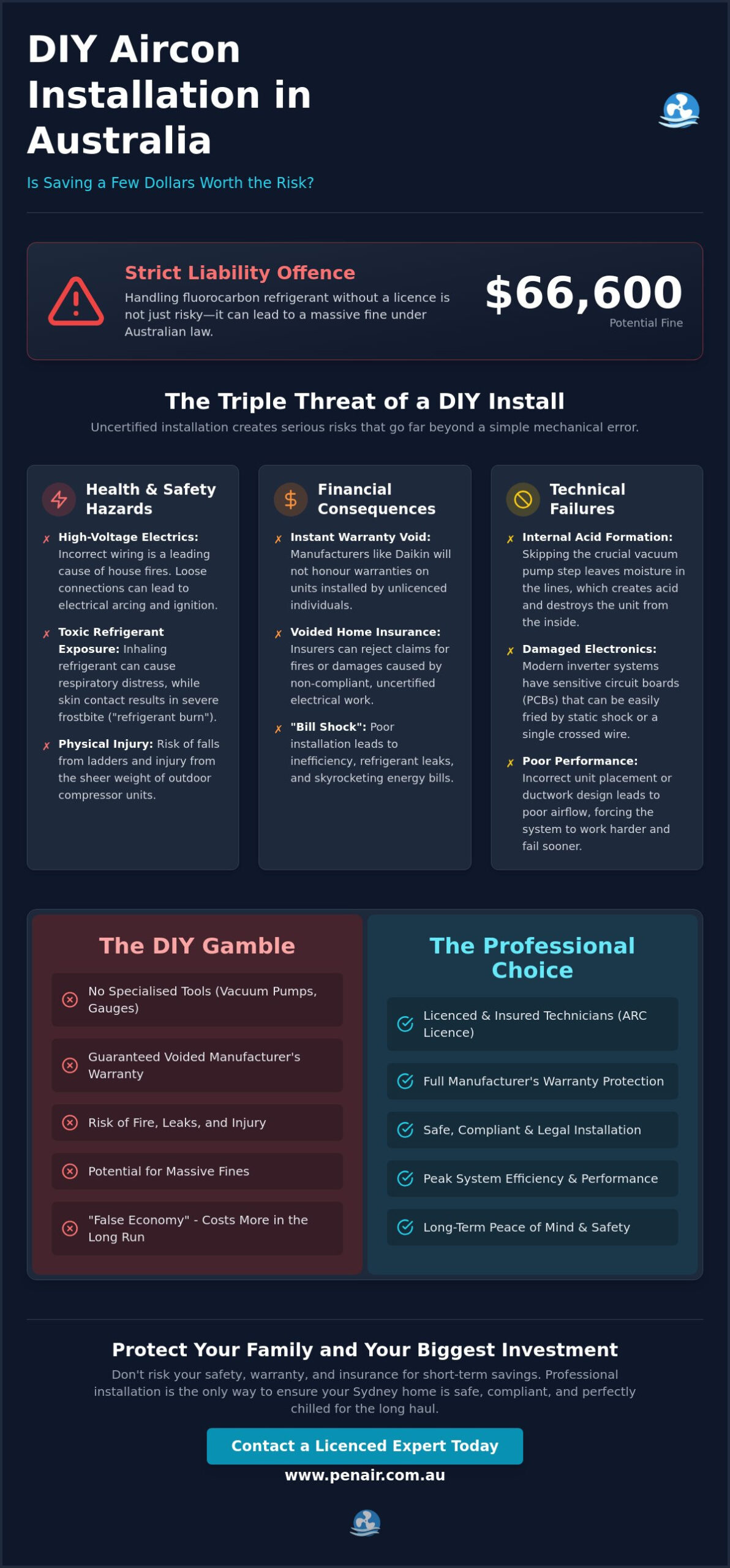
Handling fluorocarbon refrigerant is a task strictly reserved for those with an ARC licence. If a DIYer accidentally punctures a line, they risk “refrigerant burn,” a severe form of frostbite that can cause permanent tissue damage upon contact with skin or eyes. Inhaling these gases also leads to respiratory distress and heart rhythm issues. Why Professional Installation is the Only Safe Choice is underpinned by the fact that discharging these gases into our atmosphere is a federal offence, carrying fines of up to $66,600 for individuals.
Beyond the immediate hazards, poor installation often leads to long-term health problems. If the condensate drain isn’t installed with the correct fall, water will pool inside your wall cavity or the unit itself. This moisture creates a hidden nursery for toxic mould, which then blows through your living spaces every time you turn on the air. To keep your family breathing easy, it’s much safer to reach out to our friendly team for a compliant, professional setup that protects your health and your home.
With the cost of living in Sydney continuing to climb, we understand why many families look for ways to trim their household expenses. However, trying to save a few hundred dollars on labour is often a textbook example of being “penny wise and pound foolish.” The dangers of DIY aircon installation manifest as a series of expensive financial surprises that can haunt your bank account for years. When you bypass a professional, you aren’t just risking a mechanical failure; you’re gambling with your home’s most important financial protections.
This requirement for professional licensing isn’t unique to Australia; globally, homeowners rely on specialists like Trust Boilers & Renewables to manage residential boiler systems safely and efficiently, ensuring that complex climate control technology is handled by experts.
Repairing a botched DIY job almost always costs significantly more than a standard installation. If our team is called out to fix an amateur setup, we often have to decommission the unit, repair damaged components, and then start the entire process from scratch. You end up paying for the same job twice, plus the cost of any parts that were fried during the first attempt.
Premium brands like Daikin offer some of the best reliability in the industry, but their warranties are strictly conditional. To make a claim, you must provide proof that the system was commissioned by a licensed technician. If you attempt a DIY install and a compressor fails or a circuit board shorts out, the manufacturer will likely reject your claim immediately. This leaves you with a total system write-off and no legal recourse. Partnering with a Daikin Specialist Dealer ensures your investment is protected by the full weight of the manufacturer’s guarantee from day one.
Many homeowners don’t realise that their insurance policy is a legal contract that requires work to be performed by qualified tradespeople. If a DIY-installed air conditioner causes a house fire or a major leak that destroys your flooring, your insurer has every right to deny the claim. For those looking to better understand their risk profile and coverage requirements, mygenib.com.au offers professional guidance on navigating complex insurance landscapes. You could be left facing tens of thousands of dollars in repairs with zero assistance from your provider.
An uncertified installation also becomes a major hurdle when you decide to sell your property. During a pre-purchase building inspection, the lack of a compliance certificate for the air conditioning system is a massive red flag. Prospective buyers may demand a significant price reduction or insist that you pay for a professional to rip out and replace the unit before the sale proceeds. Keeping your home compliant isn’t just about safety; it’s about protecting your property’s market value and your long-term peace of mind.
The legal landscape surrounding home climate control is more complex than most people realise. In Australia, we have strict federal and state laws designed to protect both the environment and the safety of our neighbourhoods. While the dangers of DIY aircon installation often focus on physical injury, the legal consequences of bypassing regulations can be just as painful. Ignorance of the law is no defence when it comes to compliance, and the authorities take unlicensed work very seriously.
In New South Wales, air conditioning installation is a regulated trade that requires specific qualifications. These aren’t just “red tape” hurdles; they’re safeguards that ensure every system in our community operates without risking a house fire or environmental damage. When you choose to go the DIY route, you’re effectively stepping outside the protection of the law.
This commitment to professional integrity is mirrored across the sector, where firms like PK Services are dedicated to redefining excellence within the Australian construction industry by promoting higher standards of safety and compliance.
The Australian Refrigeration Council (ARC) administers the licensing scheme that governs who can touch the inner workings of your air conditioner. Only a technician holding a valid Refrigerant Handling Licence (RHL) can legally purchase, handle, or recover the gases used in these systems. This is mandated by the Ozone Protection and Synthetic Greenhouse Gas Management Act 1995. If your system has a leak, it is illegal for a DIYer to attempt to “re-gas” the unit. Doing so can lead to a strict liability fine of $2,200 for unlicensed handling. If your actions result in the unlawful discharge of these gases, an individual can be fined up to $66,600 under federal law.
Beyond federal gas laws, NSW Fair Trading has its own set of requirements for anyone performing residential work. Once a professional install is complete, you should receive a Certificate of Compliance for Electrical Work (CCEW). This document is your legal proof that the power supply meets Australian Standard AS/NZS 3000. Without this certificate, you have no evidence that the work was done safely.
Living in Sydney also means adhering to local council regulations regarding outdoor unit placement. There are specific rules about how close a compressor can be to a boundary fence and the decibel levels it can produce at night. A DIY install often ignores these “noise pollution” laws, leading to disputes with neighbours and potential orders from the council to move or remove the unit. You can avoid these headaches by trusting PenAir’s fully licensed and insured team, as we understand the local Sydney landscape inside and out.
We take pride in our craftsmanship and our commitment to absolute compliance. To ensure your new system is 100% legal and safely installed, book a professional consultation with our experts today.
While we have detailed the legal and safety dangers of DIY aircon installation, choosing a professional is about more than just avoiding a fine. It’s about ensuring your system actually performs the job you bought it for. A professional site audit is the first step in this process. We don’t just look at the size of the room; we calculate the “heat load” by considering ceiling height, window orientation, and insulation levels. If you guess the unit size, you’ll likely end up with a system that’s either too small to cope with a February heatwave or so large that it “short cycles,” wasting electricity and wearing out the motor prematurely.
In addition to professional cooling, managing how much sun enters your home is key; Aussie Online Blinds provides custom window solutions that work alongside your aircon to keep internal temperatures stable and energy costs down.
We have been looking after Sydney families since 1999. With over 25 years of local experience, our team understands the specific architectural styles of our region, from classic bungalows to modern apartments. As authorised specialists, we take the guesswork out of complex designs, such as multi-split systems that require precise pipe runs and balanced refrigerant charges across multiple indoor units. Being a family-owned business means we value long-term relationships over quick sales. When we install a system, we’re looking after our neighbours, and that pride in craftsmanship is reflected in every bracket we mount and every wire we connect.
Living on the Northern Beaches or along the harbour brings unique challenges that a generic DIY manual won’t cover. Salt air corrosion is a major factor that can significantly shorten the lifespan of an outdoor compressor if it isn’t positioned correctly or treated with protective coatings. Our technicians ensure that your unit is placed in the optimal spot to minimise salt exposure while maintaining the airflow needed for high energy efficiency. This attention to detail adds genuine value to your property, as a well-installed system is a major asset during any future building inspection.
Proper commissioning is the final, most critical stage. This involves pressure testing the lines with nitrogen and using a vacuum pump to ensure the system is completely moisture-free before the refrigerant is released. This level of care ensures your system achieves its advertised energy rating, keeping your running costs low for years to come. For total peace of mind and a system that will stand the test of time, contact PenAir today for a professional, stress-free installation. We are here to make sure your home stays comfortable, safe, and fully compliant.
Choosing to ignore the dangers of DIY aircon installation might save a few dollars today, but it risks your family’s safety and your property’s long-term value. We’ve explored how uncertified work leads to voided Daikin warranties, rejected insurance claims, and hefty federal fines. By trusting a professional, you ensure your system is sized correctly for Sydney’s climate and installed to the highest Australian standards.
Our team at PenAir has been family-owned and operated since 1999, bringing decades of local expertise to every household we serve. As an Authorised Daikin Specialist Dealer with fully licensed and insured NSW technicians, we provide the peace of mind that comes from knowing the job is done right the first time. We’re here to look after your comfort and safety without the stress of taking unnecessary risks.
Get a Professional Quote from Sydney’s Daikin Experts
We look forward to helping you create a perfectly cooled home you can truly enjoy.
Yes, it is illegal in Australia to install a split or ducted air conditioning system yourself. Only licensed professionals can handle the refrigerants required for these units under federal law. Additionally, NSW regulations require a licensed electrician for any fixed wiring. Attempting a DIY setup violates both environmental laws and state safety regulations, putting your household at risk.
Buying a unit yourself often leads to hidden costs and logistical headaches. If you are navigating the complexities of importing high-end HVAC equipment, you can check out Freight and More Pty Ltd for professional logistics guidance. Professional installers usually have access to wholesale pricing that isn’t available at retail stores. If a unit you purchased arrives with a fault, you’ll still have to pay the installer for their time and then manage the warranty return yourself. It’s usually more efficient to have your installer provide the system.
We strongly advise against performing any part of the installation, such as the “rough-in” of pipes or cables. Most licensed technicians won’t sign off on work they didn’t do because they take on the legal liability for the entire system. To ensure your home is safe and compliant, the whole process should be managed by a qualified professional from the beginning.
Yes, most home insurance policies in NSW exclude damage caused by unlicensed or non-compliant electrical and plumbing work. If a DIY-installed unit leads to a house fire or significant water damage, your insurer will likely reject your claim. This is one of the major dangers of DIY aircon installation, as it can leave you with no financial protection for your home.
An ARC Tick licence is a mandatory certification showing a technician is qualified to handle refrigerants safely. It’s a legal requirement administered by the Australian Refrigeration Council to protect the environment from harmful gases. Always check for this licence before hiring an installer, as it guarantees they follow national standards for leak prevention and system commissioning for your peace of mind.
You can face heavy financial penalties for performing unlicensed air conditioning work. Handling refrigerant without a licence carries a $2,200 fine, while discharging gases can lead to penalties up to $66,600 for individuals. NSW Fair Trading also issues fines for performing regulated electrical work without a licence. These costs far outweigh any potential savings from skipping a professional installer.
Professional installation costs in Sydney depend on several factors, including the type of system and the layout of your home. The distance between units, the complexity of the electrical run, and any structural modifications required will all impact the final investment. We suggest requesting a site-specific quote to get a clear understanding of the costs involved for a safe, compliant installation.
No, a general handyman cannot legally install a split system unless they hold specific refrigeration and electrical licences. A standard handyman licence doesn’t cover the specialised skills needed for HVAC systems. Hiring an unqualified person presents the same dangers of DIY aircon installation, such as voiding your manufacturer’s warranty and risking an electrical fire in your living space.