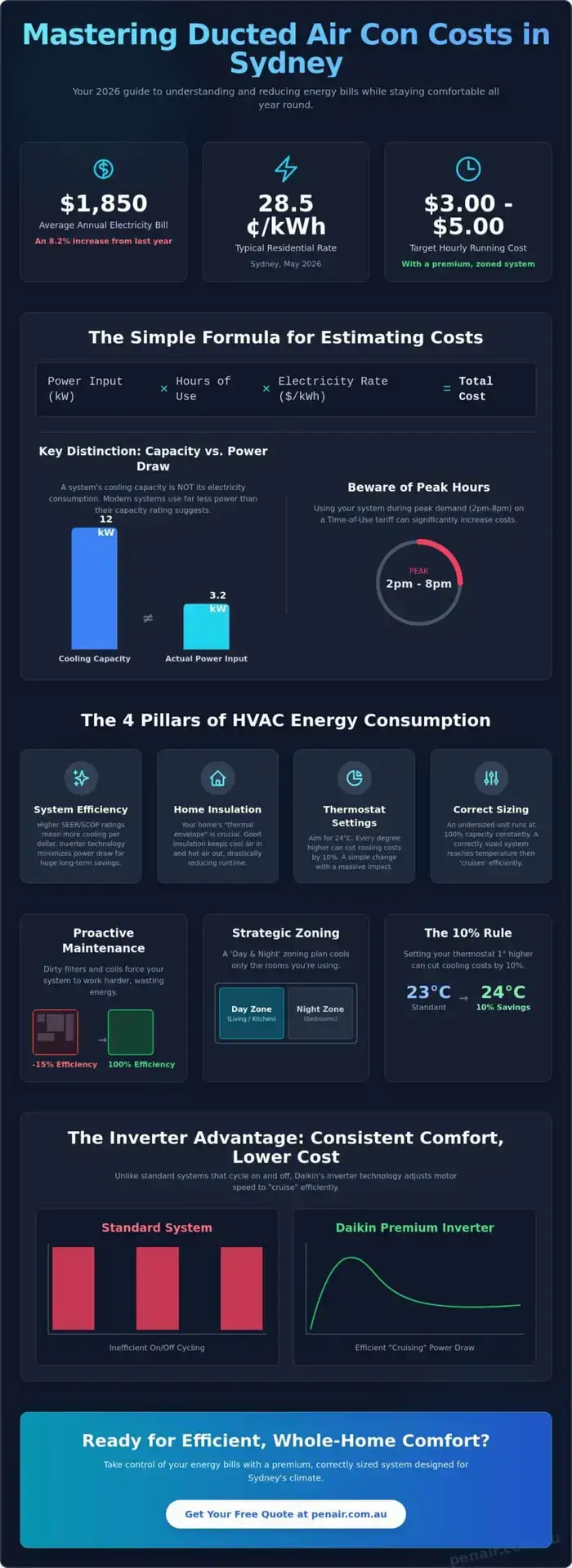
Did you know that the average Sydney household is now facing an annual electricity bill of $1,850, which is an 8.2% increase from just last year? If you feel a sense of dread when the summer heat arrives, you aren’t alone. Most families find it difficult to balance the need for whole-home comfort with the fear of unexpectedly high power bills. Understanding ducted air conditioning running costs Sydney is the first step toward peace of mind. With typical residential rates sitting around 28.5 cents per kilowatt-hour as of May 2026, it’s vital to know exactly where your money is going before the mercury rises.
Our family-owned team believes that climate control should be a source of comfort, not stress. This guide will help you master your energy budget by detailing current Sydney-specific electricity rates and the impact of the Australian Energy Regulator’s proposed 10.1% price reduction for July 2026. We’ve mapped out how a “Triple-Threat” strategy using premium Daikin hardware and precision zoning can keep your hourly costs between $3.00 and $5.00. You’ll learn how to choose a system with the best ROI and how simple habits, like setting your thermostat to 24 degrees, can cut your cooling costs by 10% for every degree adjusted.
Running costs aren’t just a single number on a product brochure. They are the result of how much power your unit draws (input kilowatts) multiplied by the rate your electricity provider charges per kilowatt-hour ($/kWh). For most Sydney families, the real concern isn’t the initial purchase price, but how much that daily comfort adds to the quarterly bill. As of May 2026, the benchmark for ducted air conditioning running costs Sydney typically falls between $3.00 and $5.00 per hour for a standard home during the peak of summer. A 12kW system, suitable for a medium three-bedroom home, usually sits at the lower end of that scale, while a larger 20kW system for an open-plan residence will naturally lean toward the higher end.
Your specific suburb also plays a role in how hard your system has to work. For instance, homes with ducted air conditioning Northern Beaches often benefit from coastal breezes that lower the ambient temperature around the outdoor compressor. This allows the system to reject heat more efficiently than a similar unit in Western Sydney, where inland temperatures can be 5 to 10 degrees hotter. To help consumers compare these variables, Australia uses the Energy Star rating system. These ratings show how effectively HVAC systems convert electricity into cooling, with each extra star potentially representing hundreds of dollars in savings over the life of the unit.
The average residential electricity rate in Sydney is currently approximately 28.5 cents per kilowatt-hour, though plans across the city range from 24c to 45c. You also need to account for a daily supply charge, which averages around 120 cents per day in May 2026. If you are on a Time-of-Use tariff, your costs will fluctuate significantly depending on the clock. Using your ducted system during the peak Sydney summer window of 2pm to 8pm can significantly increase your expenses compared to running the system during off-peak morning hours.
To get a baseline estimate for your home, use this formula: Power Input (kW) x Hours of Usage x Electricity Rate = Total Running Cost. It is vital to distinguish between “cooling capacity” and “power input.” A system with a 12kW cooling capacity might only draw 3.2kW of actual electricity. Because modern inverter systems modulate their speed rather than running at 100% all day, your actual draw is often much lower than the nominal rating. Many Sydney homeowners are now pairing these efficient systems with solar panels; since peak cooling demand aligns with peak sunshine, the return on investment for solar integration has reached an all-time high in 2026.
While your electricity retailer sets the rates, your home and your habits dictate how many kilowatts you actually consume. We often see families surprised by their ducted air conditioning running costs Sydney because they focus solely on the machine rather than the environment it operates in. To truly master your energy bills, you need to look at the four specific pillars that drive consumption: system efficiency, home insulation, thermostat settings, and correct equipment sizing. A reverse-cycle heat pump is widely considered the most energy-efficient combined heating and cooling system available for Australian homes, but its performance depends on these variables.
System efficiency is measured by SEER (Seasonal Energy Efficiency Ratio) and SCOP (Seasonal Coefficient of Performance) ratings. These numbers tell you how much cooling or heating output you get for every dollar spent on power. An undersized system is another common pitfall; if a unit is too small for your floor plan, it will run at 100% capacity indefinitely without ever reaching the set point. This constant strain is far more expensive than running a larger, correctly sized inverter system that can “cruise” at a lower power draw once the room is comfortable.
Your home’s “envelope” is what keeps the cool air inside. In the North Shore or Eastern Suburbs, many beautiful heritage homes struggle with thermal leakage due to a lack of ceiling insulation or original single-pane windows. Without proper insulation, your ducted system has to replace lost air constantly, which can add 20% to 30% to your seasonal expenses. We also find that “leaky” ducts in older installations are a major culprit, often wasting up to 15% of your conditioned air before it even reaches your living room. You can find more air conditioning Sydney home preparation tips in our comprehensive navigation guide.
How you interact with your controller is just as vital as the hardware itself. Pre-cooling your home at 10am when the outside temperature is 25°C is significantly cheaper than forcing the system to start at 4pm when the house has already reached 35°C. During Sydney’s notoriously humid February, using “Dry Mode” can often provide the comfort you need at a lower energy draw than the standard cooling cycle. For the best balance of comfort and economy, 24°C is the recommended “sweet spot” for Australian energy efficiency. If you’re concerned about your current system’s performance, our friendly team can help you assess your home’s layout to ensure you’re not overpaying for comfort.
Choosing the right hardware is the most permanent decision you’ll make for your home’s climate. While older systems relied on fixed-speed compressors that acted like an on-off switch, modern Daikin air conditioning units use advanced inverter technology to modulate power. This difference is critical for managing ducted air conditioning running costs Sydney. According to the CHOICE guide to air conditioner efficiency, the way a system handles partial loads is a major factor in its real-world energy consumption. A system that can run at 30% capacity to maintain comfort is always going to be cheaper than one that can only run at 0% or 100%.
Inverters function like the cruise control in your car. Instead of stopping and starting constantly, which consumes a massive amount of surge power, the compressor slows down or speeds up to maintain a precise temperature. This can save up to 30% on your quarterly power bill compared to a non-inverter model. Daikin’s Premium Inverter range takes this further with its “Reluctance DC Motor.” This motor uses high-strength magnets to generate additional torque, allowing the unit to operate with significantly less energy draw during those long “cruising” hours of a Sydney afternoon. You don’t just save money; you also avoid the “yo-yo” effect of the room getting too hot before the air kicks back in.
It’s true that a high-efficiency system requires a larger initial investment than a standard model. However, for a typical Sydney home, the payback period is usually between 3 and 5 years. If you live near the coast, such as in the Northern Beaches, Daikin units offer extra value through their durability. Their outdoor units feature specialized anti-corrosion treatments that protect the heat exchanger from salt-laden air. This ensures the system maintains its efficiency over its 15 to 20 year lifespan rather than degrading and becoming a power hog after just a few seasons. When you look at the long-term math, the “cheaper” unit often ends up being the most expensive choice you can make.
With the 2026 shift toward more complex Time-of-Use tariffs, Daikin’s “Peak Demand” management features are a game changer. These units can be programmed to limit their maximum power consumption during high-tariff windows, such as the 2pm to 8pm peak period in NSW. By capping the energy draw during these expensive hours, you avoid high-tariff penalties while still keeping your home comfortable. When you combine this with “Eco-mode,” which limits the maximum power consumption to about 70% of its normal capacity, you gain a level of control that standard systems simply cannot match. This proactive management is the key to keeping ducted air conditioning running costs Sydney predictable and low.
Zoning is the most effective tool we have for managing ducted air conditioning running costs Sydney. Most homes have several rooms that remain empty for the majority of the day. If your family is gathered in the living room at 2pm, there is no reason to pay for cooling in the bedrooms. By dividing your home into specific zones, you can direct the airflow exactly where it is needed, which significantly reduces the load on your compressor and lowers your kilowatt consumption. We recommend a simple five-step blueprint to maximize these savings.
Modern Wi-Fi controllers have changed how Sydney homeowners manage their energy. If you leave the house and realize you forgot to turn off the upstairs zone, you can simply fix it from your smartphone. Some advanced systems now include occupancy sensors that detect when a room is empty and automatically dial back the airflow. Integrating your AC with Sydney’s growing smart home ecosystems allows for even tighter control, ensuring your system only runs when it adds value to your day. This level of automation is a primary reason why modern installations are so much more cost-effective than systems from just a decade ago.
Multi-storey homes present a unique challenge because heat naturally rises. This often results in an upstairs area that stays five degrees warmer than the ground floor. Strategic zoning allows you to prioritize the upstairs zones in the early evening to flush out the heat before bedtime. However, in some complex architectural layouts, a single ducted unit might struggle with efficiency across two floors. In these cases, we often suggest a multi split system as a more flexible alternative. This allows for independent control of different levels without the energy waste associated with overworking a single large compressor. If you want to see how a custom zoning plan could work for your home, contact our expert team today for a consultative assessment of your layout.
Even the most advanced Daikin system with perfect zoning will eventually succumb to the laws of physics if it is neglected. Maintenance is not just about preventing a total breakdown; it’s the final piece of the puzzle in controlling ducted air conditioning running costs Sydney. When your system is clean and well-calibrated, it moves air with minimal resistance. When it’s dirty, every component has to work harder, pulling more electricity from the grid just to achieve the same level of comfort you enjoyed on day one.
One of the most common issues we see is the impact of dirty filters. When filters become clogged with dust and household particles, your indoor fan motor is forced to work approximately 15% harder to pull air through the return plenum. This directly increases your energy draw every minute the system is active. Similarly, the “Coil Factor” plays a massive role in your quarterly bill. Your outdoor unit relies on clean coils to reject heat. If these coils are covered in dust or garden debris, the heat exchange process slows down. This forces your system into longer cooling cycles, which is a silent killer of your energy budget.
Refrigerant levels are another critical factor. A system with even a small leak is perhaps the most expensive system to run. Because it lacks the necessary gas to transport heat efficiently, the compressor often runs at 100% capacity indefinitely without ever reaching your set temperature. Our local Warriewood team focuses on “Efficiency Audits” during every standard service to catch these hidden costs before they impact your wallet.
The financial impact of skipping a service is often much higher than the service fee itself. A 20% drop in system efficiency due to poor maintenance can easily add $400 or more to an average annual Sydney energy bill. Beyond the quarterly power cost, the risk of component failure is a major concern. Overworked compressors and fan motors have a significantly shorter lifespan. Replacing these major parts is a significant expense that usually far outweighs the cost of regular preventative care. You can find our full maintenance checklist in our air conditioning service Sydney guide.
As an authorised Daikin Specialist Dealer, we have a deep understanding of how to keep these premium systems running at their peak. We don’t just “check the box” during a service; we ensure your system’s commissioning settings are still optimized for your specific home layout. Our family-owned accountability means we design for long-term efficiency rather than just making a quick sale. We take pride in helping our neighbors manage their ducted air conditioning running costs Sydney through honest advice and expert craftsmanship. Request a comprehensive ducted AC efficiency audit or quote from Peninsula Air Conditioning (PenAir) today.
Managing the long-term ducted air conditioning running costs Sydney homeowners face is about more than just picking a brand; it is about a holistic approach to efficiency. By integrating high-performance hardware with the strategic zoning and maintenance practices we have discussed, you can achieve a level of climate control that is both luxurious and affordable. Whether you are battling the humidity in the Eastern Suburbs or looking for coastal-grade durability on the Northern Beaches, the right strategy ensures your home remains a sanctuary without the burden of excessive power bills.
As a family-owned and operated business since 1999, Peninsula Air Conditioning (PenAir) is dedicated to helping our neighbors find the perfect balance between comfort and cost. Our status as an Authorised Daikin Specialist Dealer allows us to provide expert guidance on the latest inverter technology and smart automation. We believe in providing quality service you can trust, ensuring your investment pays for itself through years of reliable, low-cost operation. Get a Professional Quote for a High-Efficiency Ducted System from our friendly team today and start mastering your energy budget.
Based on May 2026 electricity rates of approximately 28.5 cents per kilowatt-hour, running costs typically range between $3.00 and $5.00 per hour for a standard home. This estimate depends on your system’s capacity and the outdoor temperature. A 12kW unit will sit at the lower end of this scale, while a 20kW system cooling a large open-plan home will naturally draw more power during peak summer days.
It is generally cheaper to leave your inverter system running at a steady temperature rather than turning it on and off repeatedly. Modern inverters modulate their speed to maintain comfort, whereas restarting a hot house requires the compressor to run at 100% capacity for a long period. This initial surge is often the most expensive part of your ducted air conditioning running costs Sydney.
Strategic zoning can reduce your energy consumption by up to 50% by directing airflow only to occupied rooms. If you only cool your living area during the day and bedrooms at night, you effectively halve the thermal load on your system. This simple habit is one of the most effective ways to manage your quarterly electricity budget in a large Sydney home with multiple living spaces.
Ducted systems draw more total electricity than a single split system because they condition a much larger area. However, if you were to run four or five split systems simultaneously to cool an entire house, a single ducted unit with smart zoning is often more efficient. It provides a holistic climate solution that multiple independent units cannot match in larger, multi-room floor plans.
The most energy-efficient temperature for a Sydney summer is 24°C. Setting your thermostat just one degree lower can increase your running costs by approximately 10% according to December 2025 energy data. By maintaining this “sweet spot,” you ensure your home stays comfortable without putting unnecessary strain on the compressor or your electricity bill during the expensive 2pm to 8pm tariff window.
We recommend a professional service at least once every 12 months, ideally before the summer heat arrives in November. Regular maintenance ensures your filters are clean and your refrigerant levels are optimal. A system that hasn’t been serviced can lose up to 20% efficiency, which can add over $400 to your annual power expenses due to the fan and compressor working harder than necessary.
Solar panels are an excellent way to offset your cooling costs since peak air conditioning demand usually aligns with peak solar production hours. A standard 6.6kW solar array can significantly reduce the net cost of running your ducted system during the day. Many of our customers find that their daytime cooling is almost entirely covered by their solar generation, leaving only the evening usage for the grid. For homeowners also interested in off-grid solutions for site safety, you can explore Solar Security Camera options that provide 24/7 protection without drawing from the mains.
A premium inverter system, like the latest Daikin models released in late 2025, features more advanced modulation and specialized motors. While a standard inverter is efficient, premium models use “Reluctance DC Motors” to reduce energy draw during cruising speeds. This technology provides better temperature stability and lower long-term ducted air conditioning running costs Sydney compared to entry-level units that lack these high-torque magnets.