
It’s 2 am on a humid Sydney night, and just as you finally drift off, a sharp metallic rattle erupts from the ceiling. Instead of the gentle, cooling breeze you expect, you’re left staring at the cornices, wondering if a major repair bill is about to land on your doorstep. We understand that sinking feeling. A noisy air conditioner isn’t just a nuisance that keeps the kids awake; it’s often a cry for help from a mechanical system working under too much strain.
If you’ve been asking, “why is my ducted aircon so loud?” you aren’t alone. Whether it’s a persistent hum from the outdoor unit or a strange whistling in the hallway, these sounds are your system’s way of signalling a fault. We’ve put this guide together to help you decode exactly what those strange rattles and whistles mean, giving you the confidence to restore peace and quiet to your home. We’ll look at the most common causes, explain the difference between a simple filter clean and a mechanical failure, and provide a clear path to getting your system back to its whisper-quiet best.
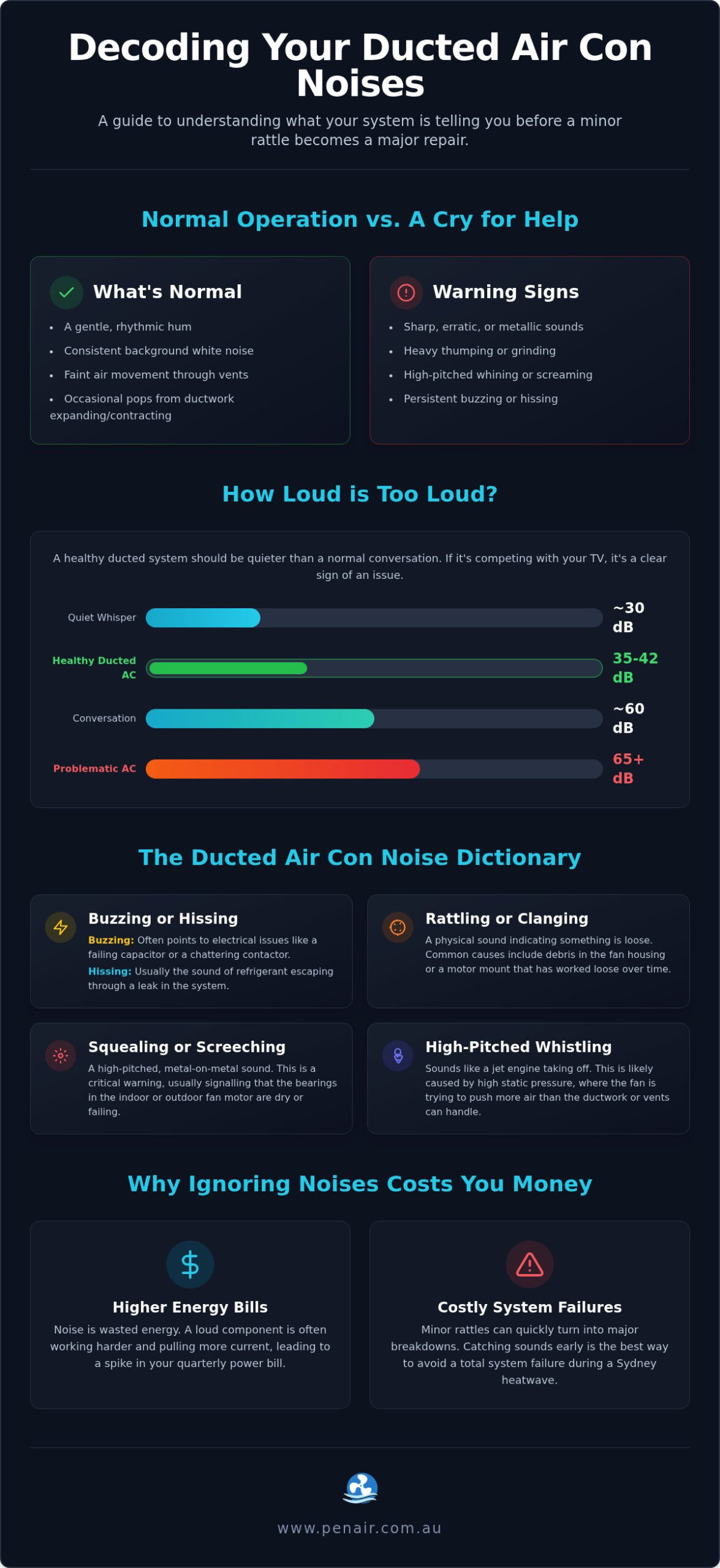
Every home has its own unique rhythm, and for many of our neighbours across Sydney, that rhythm includes the steady, rhythmic hum of a Heating, ventilation, and air conditioning (HVAC) system. When your unit is running perfectly, it should provide a background white noise that eventually fades into the subconscious. However, if you’ve recently started asking, “why is my ducted aircon so loud?” it’s likely because that baseline has shifted. A healthy system shouldn’t produce sharp, erratic, or metallic sounds. Modern Daikin systems, which we’ve been installing and servicing since 1999, are engineered for whisper-quiet performance. If that silence is replaced by a heavy thumping or a high-pitched whine, your system is no longer just cooling your home; it’s struggling to stay operational.
At PenAir, we’ve seen how easily a minor annoyance can transition into a serious mechanical failure. While a slight increase in air rush might just mean a dirty filter, sounds like metal-on-metal grinding often indicate a bearing failure in the indoor fan motor. Catching these sounds early is the best way to avoid the stress of a total system breakdown during a Sydney heatwave. We always remind our customers that your air conditioner is a complex machine; any change in its acoustic profile is a signal that something under the hood requires attention.
To put things in perspective, a quiet whisper usually registers around 30 decibels, while a standard conversation sits at 60 decibels. Ducted systems are naturally quieter than split systems because the loudest components are tucked away in your roof space rather than hanging on your wall. For high-performance systems in 2026, an acceptable decibel range for a ducted return air vent is generally considered to be between 35 and 42 dB(A) during standard operation. If your vents are competing with the volume of your television, it’s a clear sign that the airflow is restricted or the fan is off-balance.
A loud air conditioner is rarely an efficient one. Noise is essentially wasted energy, often caused by mechanical friction or air turbulence. When a component like a motor or compressor starts making excessive noise, it’s usually pulling more current to overcome that resistance. This means you aren’t just losing your peace and quiet; you’re also seeing a spike in your quarterly power bill. The good news is that most of these sounds are early warning signs. Regular service and maintenance can often resolve these issues before they lead to a complete compressor failure, ensuring your system remains both quiet and cost-effective to run.
Identifying the specific sound is the first step in solving the mystery of why is my ducted aircon so loud. Each noise tells a story about what’s happening inside the casing or the roof space. While some sounds are harmless, others indicate that a component is nearing the end of its life. By listening closely, you can often provide our technicians with the clues they need to find a fix faster.
Many residential areas have state noise regulations or local council rules regarding equipment volume. This makes it even more important to address these sounds before they bother the neighbours or lead to a total system shutdown.
If your system sounds like a jet engine taking off, you’re likely dealing with high static pressure. This happens when the indoor fan is trying to push more air than the ductwork or the return air grille can handle. It’s a common issue in Sydney homes where a system has been retrofitted into a space with undersized vents. If the air can’t flow freely, it creates a whistling effect as it’s forced through small gaps. Beyond the noise, restricted airflow causes your coils to freeze, which can lead to water damage in your ceiling. Checking your filters for a heavy build-up of dust is a great first step, as a blocked filter is the most common cause of this “screaming” air.
When you hear a rhythmic thumping or vibration from above, the issue is often located in the roof space. Ducted systems rely on a network of flexible pipes. If these connections aren’t secured correctly during installation, they can vibrate against the timber rafters. We also frequently find that a failing zone motor is the culprit. These small motors open and close dampers to direct air to different rooms. If the internal gears strip, they will click or rattle incessantly. If you’re losing sleep over these ceiling sounds, it might be time to reach out to our local team for a professional assessment.
In most Sydney homes, the return air vent is the largest single component you’ll see inside your living space. Its job is simple but vital: it draws warm air from your rooms and pulls it back to the indoor unit to be cooled. Because this vent is the direct gateway to the indoor fan motor, it essentially acts as a megaphone. If you are constantly asking yourself why is my ducted aircon so loud, the return air vent is often the first place we look during a service call. The noise you hear is typically air turbulence, which happens when the fan has to work harder to pull air through a restricted space.
This “whooshing” sound is a classic sign of airflow resistance. When everything is sized correctly and the filters are clean, the air should move at a low velocity, making it almost silent. However, if the return air grille is too small for the system’s capacity, or if the ducting behind it is kinked, the air speeds up. This creates a localized wind-tunnel effect. Reducing this noise isn’t just about comfort; it’s about ensuring your system doesn’t burn out its motor prematurely by fighting against its own intake.
A clogged filter is the most common reason for a noisy return air vent. As dust and pet hair build up on the mesh, the surface area available for air to pass through shrinks. This forces the same volume of air through a smaller space, which significantly increases the volume of the “whoosh.” We’ve found that a thorough professional air conditioning cleaning and a fresh filter can often cut perceived noise levels by half. To check your filter safely, simply unclip the frame of the return air grille. If you can’t see light through the mesh when holding it up, it’s time for a clean. Regular maintenance here keeps the system quiet and prevents dust from settling on the internal cooling coils.
Sydney’s two-storey homes often face unique acoustic challenges. Return air vents are frequently placed in hallways or near stairwells, which naturally act as echo chambers. Because these areas have hard floors and high ceilings, the sound of the indoor fan can bounce and amplify throughout the house. You don’t have to just live with this distraction. We often solve these issues by adding acoustic lining to the plenum box, which is the internal chamber behind the grille. This material absorbs sound waves before they enter your hallway. In some cases, we might also suggest upgrading to a larger, high-flow linear grille to reduce the air velocity and restore peace to your home.
While the internal vents cause the “whoosh” inside your home, the outdoor unit is usually the culprit behind heavy vibrations and low-frequency hums. This unit houses the compressor, the condenser fan, and the sensitive control boards that keep the system running. If you are asking why is my ducted aircon so loud in the backyard, you’re likely hearing the physical strain of these components. For our neighbours on the Northern Beaches and in coastal Sydney, salt-air corrosion is a unique challenge. Salt build-up on the fan blades can cause an imbalance, leading to a rhythmic wobbling sound that vibrates through the wall and into your living room.
Addressing these noises isn’t just about your own comfort; it’s about being a good neighbour. In Sydney, residential noise is regulated by the Protection of the Environment Operations Act. Your air conditioner must not exceed the background noise level by more than 5 dB(A) when measured at the property boundary. There are also restricted hours to keep in mind. Noise shouldn’t be audible in a neighbour’s habitable room from 10 pm to 7 am on weekdays, or 10 pm to 8 am on weekends. Keeping your unit well-maintained ensures you stay on the right side of these local council rules.
A healthy compressor should have a steady, purposeful hum. You might hear a brief “thump” when it starts up, which is often normal for older fixed-speed units. However, a constant grinding or metallic shrieking suggests that the internal lubrication is failing or the valves are worn. We often recommend Daikin inverter technology because these systems ramp up speed gradually. This eliminates the aggressive “clunk” of a traditional compressor starting at full tilt, making them significantly quieter for both you and the house next door.
Sometimes, the loudest outdoor rackets have the simplest fixes. We frequently find that the rubber isolation pads under the unit have perished or hardened over time. When these pads fail, the unit’s natural vibration transfers directly into the concrete slab or the brackets on your wall. Another common Sydney issue is garden debris. A single dry leaf or a small stick caught in the fan housing can create a loud clicking sound, similar to a playing card in bicycle spokes. If your unit is vibrating against the house, it’s a good idea to check out our guide on air conditioning repairs Sydney to see how we can stabilise your system. If your neighbours have started dropping hints about the noise, book an inspection with our team today to restore the peace.
At Peninsula Air Conditioning, we believe your home should be a sanctuary of comfort and quiet. When you find yourself asking why is my ducted aircon so loud, you don’t just need a quick fix; you need a thorough investigation. Our family-owned team has been looking after Sydney households since 1999, focusing on long-term reliability rather than high-pressure sales. We take pride in our diagnostic process, which treats the noise as a symptom of an underlying issue. Whether it’s a mechanical imbalance in the roof or an electrical component nearing its limit, we find the root cause to ensure the silence lasts.
Our status as an authorised Daikin Specialist Dealer means our technicians are trained to the highest industry standards. We understand the specific acoustic engineering behind premium climate control systems, allowing us to calibrate your unit for peak performance. By focusing on precision, we help you avoid the anxiety of potential high repair costs down the track. Professional maintenance is the most effective way to restore peace to your home before the peak of a Sydney summer.
A quiet system is an efficient system. During a standard visit, our team works through a rigorous checklist designed to eliminate friction and turbulence. We check refrigerant levels to prevent hissing, verify fan balance to stop vibrations, and tighten all electrical connections to silence buzzing relays. We also place a heavy emphasis on cleaning and sanitising the internal coils. This reduces the strain on the motor and ensures air flows freely without the loud “whooshing” caused by blockages. To keep your system running at its whisper-quiet best, you can book your air conditioning service with our local specialists.
There comes a point where the cost of ongoing repairs outweighs the benefits of keeping an ageing unit. If your system is over 10 years old, you’ll find that the technological leap in acoustic engineering has been significant. Modern Daikin ducted systems are designed with advanced vibration-dampening materials and inverter compressors that are worlds apart from the noisy models of the past. We provide honest, consultative advice on whether a repair or a full replacement is the most cost-effective path for your home. If you’re ready to enjoy cooling without the racket, Contact the PenAir team for a quiet home today.
Identifying the specific sounds of your air conditioning is the first step toward a more peaceful household. Whether you’re dealing with a vibrating outdoor unit or a whistling return air vent, these noises are early warning signals that shouldn’t be ignored. By understanding why is my ducted aircon so loud, you can address minor issues like blocked filters or loose mounts before they escalate into expensive mechanical breakdowns. Taking action now ensures your system stays efficient and your energy bills remain manageable throughout the year.
Our team at Peninsula Air Conditioning has been serving the Northern Beaches and North Shore since 1999. As a family-owned business and an authorised Daikin Specialist Dealer, we bring a wealth of local expertise to every service call. We don’t just patch up the symptoms; we find the root cause to ensure your system runs efficiently and silently for years to come. Our expert technicians are dedicated to looking after your household’s well-being with honest, reliable service that you can trust.
Restore the quiet to your home with a PenAir service; Book Now. We look forward to helping you reclaim the peace and quiet your family deserves.
A single click or a few soft pops are usually normal operational sounds for a Sydney home. These are typically the electrical relays engaging to start the compressor or the metal ductwork expanding as cold air begins to flow through the roof. However, if you hear rapid, persistent clicking, it might indicate a faulty relay or a struggling zone motor. If the clicking is accompanied by the system failing to start, it is time to call a technician.
Whistling in a specific room usually points to an airflow imbalance or a partially blocked vent. When the system tries to push a high volume of air through a small opening, it creates a high-pitched whistle. This often happens if the zone damper is stuck or if the ducting has become pinched in the roof space. Adjusting the louvres on the ceiling register can sometimes help, but persistent whistling often requires a professional airflow balance to resolve.
A clogged filter is a primary reason why is my ducted aircon so loud, especially near the return air vent. When dust restricts the filter, the fan motor has to work significantly harder to pull air through the mesh. This creates a loud, turbulent whooshing sound and puts unnecessary strain on the motor. We recommend cleaning your return air filter every three months to maintain whisper-quiet operation and keep your energy efficiency high throughout the year.
Vibration is usually caused by the transfer of mechanical energy from the compressor to the mounting surface. If your unit is bolted to a wall bracket, the rubber isolation pads may have hardened or perished, losing their ability to absorb shock. Replacing these pads is a simple, cost-effective fix. You should also check if the unit has shifted on its base or if garden mulch and debris have built up around the bottom of the external casing.
If you hear a loud screeching or squealing sound, you should turn the system off immediately. This metallic noise usually signals that a bearing in the fan motor is failing or has run dry of lubrication. Running the unit in this condition can lead to the motor seizing entirely, which is a much more expensive repair. Our team can typically replace these bearings or the motor assembly to restore quiet operation before any permanent damage occurs.
Yes, there is a noticeable difference in acoustic engineering between manufacturers. As an authorised Daikin Specialist Dealer, we often recommend Daikin systems because they prioritise low noise levels in both their indoor and outdoor units. Modern inverter technology allows these systems to run at lower speeds once the desired temperature is reached, significantly reducing the sound profile compared to older, fixed-speed units. Choosing a premium brand ensures your home stays peaceful even during peak summer.
We recommend a professional service at least once a year, preferably before the summer heat arrives. Regular maintenance allows our technicians to identify loose mounts, worn bearings, and electrical hums before they become major distractions. We also check the tension of components and the balance of the fan blades. This proactive approach prevents the common mechanical failures that lead to a noisy home and ensures your system remains reliable for the long term.
In most cases, a loud system is an inefficient one. Noise is often caused by mechanical friction or airflow resistance, both of which force the motor and compressor to pull more current to do their job. If your system is struggling against a blocked filter or a worn motor, your quarterly power bills will likely reflect that extra effort. Restoring the silence usually pays for itself through lower energy consumption and a significantly longer system lifespan.