Did you know that heating and cooling currently account for approximately 40% of the average Sydney household’s total energy usage? With electricity rates in New South Wales sitting at an average of 28.5 cents per kWh in 2026, many of our neighbors are facing significant bill shock during the summer peaks. It’s stressful to feel like you have to choose between a cool home and a manageable budget, especially when running a ducted system can cost up to $5.00 per hour. We believe you shouldn’t have to sacrifice comfort for affordability. This guide explains exactly how to reduce air conditioning electricity bill costs using proven professional strategies and smarter daily habits.
We’ll help you move past the confusion of eco-modes and uneven cooling to find a setup that actually works for your home. You’ll learn about the latest NSW Government rebates, the impact of the 7-star thermal performance standards, and how professional maintenance keeps your unit running at peak efficiency. We’ve gathered our best local expertise to ensure your system provides reliable relief from the Sydney heat without breaking the bank. Let’s look at the practical steps you can take today to lower your costs and gain total peace of mind.
Most Sydney homeowners see their summer electricity bills and wonder where it all went wrong. There’s a significant difference between a system that’s simply “on” and one that’s performing at its peak. If your unit is over a decade old, it’s likely operating with a massive efficiency gap compared to 2026 standards. Modern systems are now designed to meet strict 7-star NatHERS ratings, while older models often struggle to maintain temperature, leading to a constant, heavy power draw. Understanding how air conditioning works helps clarify why an aging compressor has to work twice as hard to achieve the same cooling effect. Modern inverter technology allows a system to slow down once it reaches a set temperature, whereas older units often cycle on and off at full power, which is incredibly wasteful.
For those of us living near the coast, from Cronulla to the Northern Beaches, salt-air corrosion is a silent budget killer. It eats away at the delicate fins of your outdoor condenser coils over time. This damage reduces the system’s ability to transfer heat, which forces the internal components to work overtime. It’s a common reason why many people look for ways on how to reduce air conditioning electricity bill totals without realizing their hardware is fighting an uphill battle against the elements. We see this often in local service calls where a simple cleaning isn’t enough because the metal itself has degraded, causing the unit to pull more current just to keep up.
Sydney’s humidity is a unique challenge that many homeowners overlook. When the air is thick with moisture, your AC spends a huge amount of energy just removing water before it can even start lowering the temperature. This process is known as removing latent heat. In coastal areas, using “Dry Mode” can often be more efficient than “Cool Mode” because it focuses specifically on dehumidification. It’s the primary reason why 24 degrees in the humid CBD feels much heavier and more expensive to maintain than 24 degrees in the dry air of the Blue Mountains.
In NSW, your bill isn’t just about how much power you use, but exactly when you use it. Most Sydney residents are now on time-of-use tariffs where peak rates apply during the hottest parts of the afternoon. We often recommend “pre-cooling” your home during shoulder or off-peak periods in the morning. By lowering the temperature of your walls and furniture early in the day, you can coast through the expensive peak window without your system running at full tilt. When you combine this strategy with a smart meter, you gain the visibility needed to see exactly how to reduce air conditioning electricity bill spikes in real-time.
Many of us have a habit of cranking the air conditioner down to 18°C on a scorching Sydney afternoon, hoping it will cool the room faster. In reality, your system doesn’t work that way. It simply runs at full capacity for longer, driving up your costs without any immediate benefit. Mastering your settings is the fastest way to understand how to reduce air conditioning electricity bill totals without spending a dollar on new hardware. It starts with the “Golden Rule” of thermostat management: aim for 24°C in the summer and between 18-20°C during the winter months.
Thermodynamics in a coastal climate like ours can be unforgiving. Setting your unit to 24°C provides the perfect balance between dehumidification and cooling comfort. If you’re used to keeping the house at 21°C, shifting your target just a few degrees higher can lead to significant seasonal savings. Every degree you raise the thermostat can reduce cooling costs by up to 10%. This adjustment is one of the most practical tips to lower your electric bill because it reduces the load on your compressor during the hottest parts of the day.
We also recommend using the “Auto” fan setting rather than manual high-speed modes. When the fan is on “Auto,” the system intelligently adjusts its speed to maintain the temperature you’ve set. This is far more efficient than forcing the fan to run at maximum speed constantly, which can actually increase humidity levels if the air moves too quickly across the cooling coils. Modern inverter systems thrive when they can reach a steady state, rather than constantly cycling on and off. Avoiding these “start-up” power spikes is a core part of how to reduce air conditioning electricity bill expenses over the long term.
If you have a larger home, zoning is your best friend. There’s no reason to cool a guest bedroom or a formal dining area that isn’t being used. Focus your cooling on “heat load” rooms, which are typically west-facing areas that bake in the afternoon sun. For residents looking at ducted air conditioning Northern Beaches wide, proper zoning can make a massive difference in whole-home comfort. Keep your internal doors slightly ajar or ensure your return air grilles aren’t blocked; this allows the system to breathe and circulate air efficiently. If your current zones aren’t keeping you comfortable, our team can provide a professional service and maintenance check to recalibrate your dampers and airflow.
Don’t forget to utilize your sleep modes and timers. Sydney nights often bring a welcome sea breeze. Setting your AC to turn off an hour after you fall asleep, or using a sleep mode that gradually raises the temperature overnight, prevents unnecessary energy waste while you’re dreaming. These small, automated habits ensure you aren’t paying for cooling when the outside air has already done the job for you.
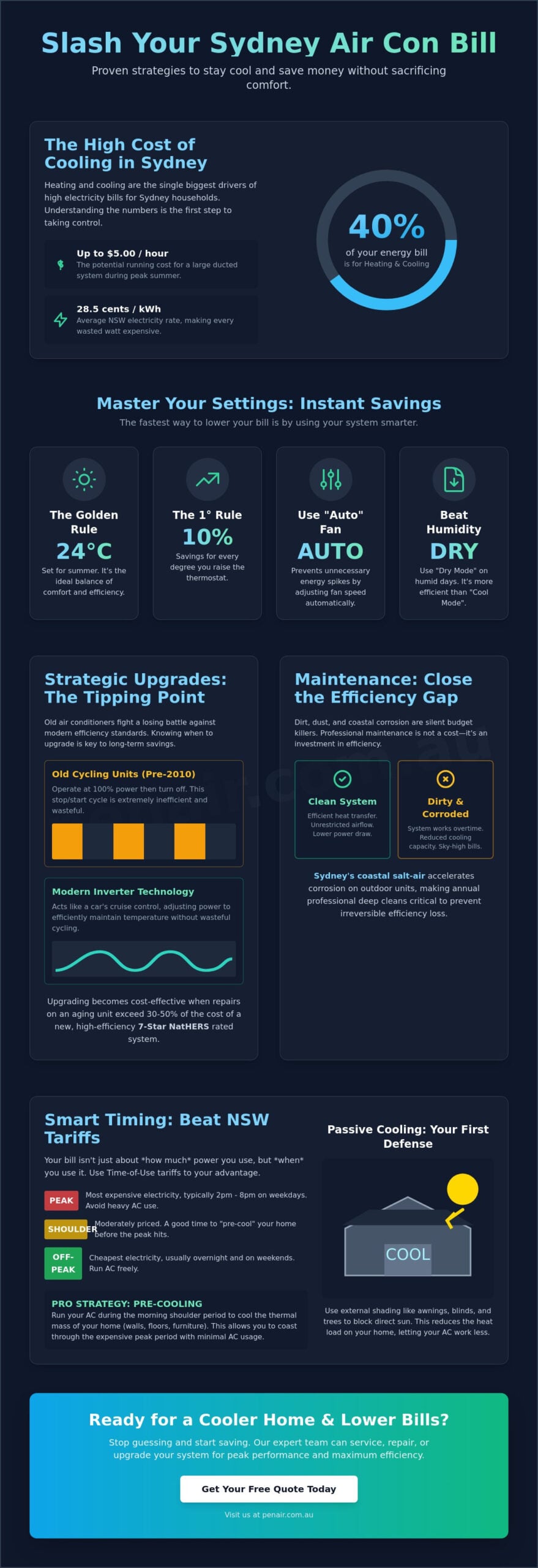
Your air conditioner is a powerful tool, but it’s only as effective as the space it’s trying to cool. Think of your home as a thermal envelope. If that envelope has holes, your expensive cooled air is escaping while the Sydney heat crawls inside. We often see homeowners searching for how to reduce air conditioning electricity bill costs while their windows are baking in the direct sun. Dealing with heat before it enters your living space is always cheaper than trying to remove it mechanically later. This is why passive cooling is the perfect partner for your mechanical system.
External shading is your first line of defense. Awnings, outdoor blinds, or even well-placed trees can block a massive amount of solar heat gain. While internal curtains help, they only stop the heat once it’s already passed through the glass and into your room. By stopping the sun at the window, you significantly lower the mechanical load on your system. It’s a simple shift in perspective that leads to long-term savings and a much more stable indoor environment.
Older homes across Sydney often have “silent leaks” that let your comfort slip away. Check your window seals and use simple door snakes to block gaps under external doors. It’s a small task that makes a big difference. We also recommend looking at your exhaust fans in the kitchen and bathroom. Many older models don’t have dampers, meaning they act like open chimneys for your cool air. Finally, ensure your roof insulation is up to 2026 standards. Good insulation is the most effective passive cooling investment you can make, as it acts as a permanent barrier against the harsh Australian sun.
We love seeing ceiling fans used alongside our split or ducted installations. It’s important to remember that fans cool people, not rooms. They create a “wind chill” effect on your skin, which makes you feel significantly cooler than the actual air temperature. This synergy is a secret weapon for anyone wondering how to reduce air conditioning electricity bill totals during a heatwave.
By running a ceiling fan, you can typically raise your AC thermostat by about 2°C without noticing any loss in comfort. If your standard setting is 24°C, the fan might let you bump it to 26°C. In a large open-plan living area, place fans where they can assist the natural airflow from your vents. This helps distribute the air more evenly, preventing “hot spots” and reducing the time your compressor needs to run at full speed. This simple combination keeps your home feeling fresh and your energy usage under control.
Maintenance isn’t just a chore; it’s a strategic investment in your home’s comfort and your wallet. While we’ve discussed smart settings and home sealing, the mechanical health of your system is what actually does the heavy lifting. A neglected unit is the most common reason homeowners struggle with how to reduce air conditioning electricity bill spikes. When components are dirty or worn, the system has to run for significantly longer periods to achieve the same cooling effect, creating a massive drain on your power. We often find that a system’s efficiency gap is caused by simple, preventable issues that have compounded over time.
A dirty filter is the leading cause of preventable energy waste. It creates airflow resistance, forcing the fan motor to consume more electricity to push air through the blockage. In our local Sydney environment, the “Salt Air Factor” is also a major concern. Salt spray causes microscopic corrosion on the outdoor condenser coils. This buildup acts like an insulating blanket, preventing the system from releasing heat efficiently. Keeping these coils clean and protected is vital for maintaining the efficiency standards we discussed earlier in this guide. Without this care, your unit will pull more current every single year it stays in service.
You can handle several tasks yourself to keep things running smoothly. We suggest cleaning your indoor filters every three months, or more often if you have pets. Simply vacuuming or washing them in warm water makes a world of difference. Outside, ensure your condenser unit isn’t choked by overgrown garden beds or fallen leaves. A clear path for airflow is essential for the heat exchange process. Finally, do a quick visual check of any visible ductwork in your roof space. Ensure no flexible ducts have been crushed or disconnected, as this leads to cooling your attic instead of your lounge room.
While DIY care is great, some tasks require a specialist’s touch to truly understand how to reduce air conditioning electricity bill costs. During a professional air conditioning service, our team goes much deeper than a basic filter clean. We check refrigerant gas levels, as even a small leak can cause your compressor to run 24/7 without ever reaching your target temperature. We also inspect electrical connections and calibrate the system for peak performance. Preventative care is always more affordable than emergency air conditioning repairs during a February heatwave. If your system hasn’t been checked in over a year, you can book a maintenance visit with our team to ensure your unit is ready for the Sydney summer.
Even with the best maintenance habits, every mechanical system eventually hits a “tipping point.” If you’re frequently paying for repairs on a unit that’s over a decade old, you’re likely fighting a losing battle against your power meter. Modern technology has moved so fast that the most effective answer to how to reduce air conditioning electricity bill costs is often a strategic upgrade. Moving from an old fixed-speed unit to a modern inverter system can slash your running costs because the hardware is built to meet the rigorous 7-star thermal performance standards required in 2026. We help our customers calculate whether the cost of another repair is worth more than the immediate energy savings of a new installation.
The NSW Government’s Energy Savings Scheme provides a great incentive to make this move now. As of May 2026, Sydney homeowners can access point-of-sale discounts of up to $550 for new installations or $560 when replacing an old, inefficient unit. These aren’t cash-back rebates you have to chase; they’re direct discounts that make professional, high-efficiency cooling much more accessible for local families. When you combine these incentives with the lower wholesale electricity prices we’re seeing from increased solar uptake, the return on investment for a new system has never been clearer.
We’ve seen firsthand why Daikin remains the gold standard for our local climate. As a Daikin Specialist Dealer, we know how their specialized compressors handle Sydney’s humidity with ease. Their “Human Sensor” technology is a standout feature for energy conscious homes. It detects when a room is empty and automatically switches to an energy-saving mode, preventing you from cooling a space no one is using. When paired with the Daikin Airbase controller, you get granular tracking that shows exactly how your system is performing in real-time.
Investing in a modern split system air conditioning unit is a proven way to increase your property value while lowering your monthly overheads. Over a five-year period, the cumulative savings from moving from an old 2-star unit to a 5-star model are substantial. It’s about trading the stress of “bill shock” for the peace of mind that comes with a reliable, calibrated system. If you’re ready to see how much you could save, you can contact PenAir for a professional efficiency audit and quote. Our local team will ensure your new system is sized perfectly for your home’s unique layout.
Managing your home’s climate doesn’t have to be a source of financial stress. By combining the “Golden Rule” of thermostat settings with effective passive cooling strategies like external shading, you’ve already taken the first steps toward a more sustainable home. It’s important to remember that your mechanical system is the heart of your comfort. Keeping it well-maintained is the most reliable way to understand how to reduce air conditioning electricity bill costs while protecting your hardware from the harsh Sydney elements. Small changes in your daily habits, paired with a well-calibrated unit, will lead to significant long-term savings.
We’ve been looking after our local community as a family-owned Sydney business since 1999. As an Authorised Daikin Specialist Dealer with fully licensed and insured HVAC technicians, we’re here to ensure your system is running at its absolute best. Whether you need a deep clean to close an efficiency gap or a professional audit of your current setup, our team provides the expert, honest guidance you need for total peace of mind. Book a Professional Efficiency Service with PenAir Today to secure your home’s comfort. We look forward to helping you enjoy a cooler, more affordable summer.
It’s generally more efficient to leave a modern inverter system running at a steady pace rather than turning it off and on constantly. Inverter technology allows the system to slow down once your home reaches the target temperature, whereas restarting a system forces it to run at maximum power to overcome the heat load. This steady operation is a key strategy when looking at how to reduce air conditioning electricity bill spikes during the hottest parts of a Sydney afternoon.
Yes, a dirty filter significantly increases your running costs by forcing the fan motor to work much harder against air resistance. When airflow is restricted, your system has to run for longer periods to cool the room, which can increase energy consumption by 5% to 15%. Regularly cleaning your filters every few months ensures your system breathes easily and maintains the high efficiency levels it was designed for.
The most energy-efficient temperature for a Sydney summer is 24°C. Every degree you set the thermostat below this point can increase your cooling costs by approximately 10%. Maintaining a setting of 24°C provides a comfortable balance between removing coastal humidity and managing your power usage, ensuring your home stays cool without causing unnecessary financial stress during peak billing periods.
Zoning can save you a substantial amount by ensuring you aren’t wasting energy on unoccupied spaces like guest rooms or formal dining areas. By only cooling the zones you’re actually using, you reduce the total volume of air the system needs to process. This directly lowers the mechanical load on your outdoor unit and helps keep your hourly running costs within the typical Sydney range of $3.00 to $5.00.
A ceiling fan is a highly effective partner for your air conditioner because it creates a wind chill effect that makes you feel cooler than the actual air temperature. Using a fan often allows you to set your AC thermostat about 2°C higher without any loss in comfort. This simple habit is one of the most practical ways to understand how to reduce air conditioning electricity bill totals during a heatwave.
This issue is often caused by low refrigerant levels, dirty condenser coils, or a severely blocked filter. If your system is running but the air isn’t cold, it’s pulling a full power load without providing any relief, which is incredibly expensive. It’s usually a clear sign that your unit needs a professional service or a repair to restore its cooling capacity and stop the energy waste.
Yes, the NSW Government offers upfront discounts through the Energy Savings Scheme to encourage homeowners to switch to energy-efficient models. For a 6kW system, you could receive a point-of-sale discount of up to $550 for a new installation or $560 for replacing an old unit. These discounts vary based on the model’s efficiency, and we can help you identify which systems provide the best value for your home.
We recommend having your system professionally serviced at least once a year to keep it running at peak performance. Regular maintenance allows us to catch small issues like minor gas leaks or electrical wear before they lead to high bills or total system failure. A well-maintained unit lasts longer and operates much more affordably, giving you peace of mind that your home environment is in safe hands.