You have finally sat down to relax in your North Shore lounge room, but as the cooling kicks in, a damp, “wet sock” scent begins to drift through the house. It is an awkward moment, especially when you have guests over, and it immediately makes you wonder why your aircon smells musty and what to do to fix it before the Sydney humidity settles in for good. At PenAir, we have looked after local families since 1999, so we know that a strange smell is often more than just a nuisance; it is a sign that your system needs a bit of professional care to keep your indoor air healthy.
We agree that your home should be a sanctuary, not a place where you worry about mould spores or looming repair bills. This guide will help you identify the common culprits behind those stale odours and show you the practical steps needed to restore crisp, clean airflow to your property. We will walk you through simple DIY maintenance, explain when a specialised deep clean is necessary, and highlight how the 2026 NSW regulatory updates affect your system’s efficiency and compliance. You can regain confidence in your home environment and ensure your air conditioner runs perfectly all summer long.
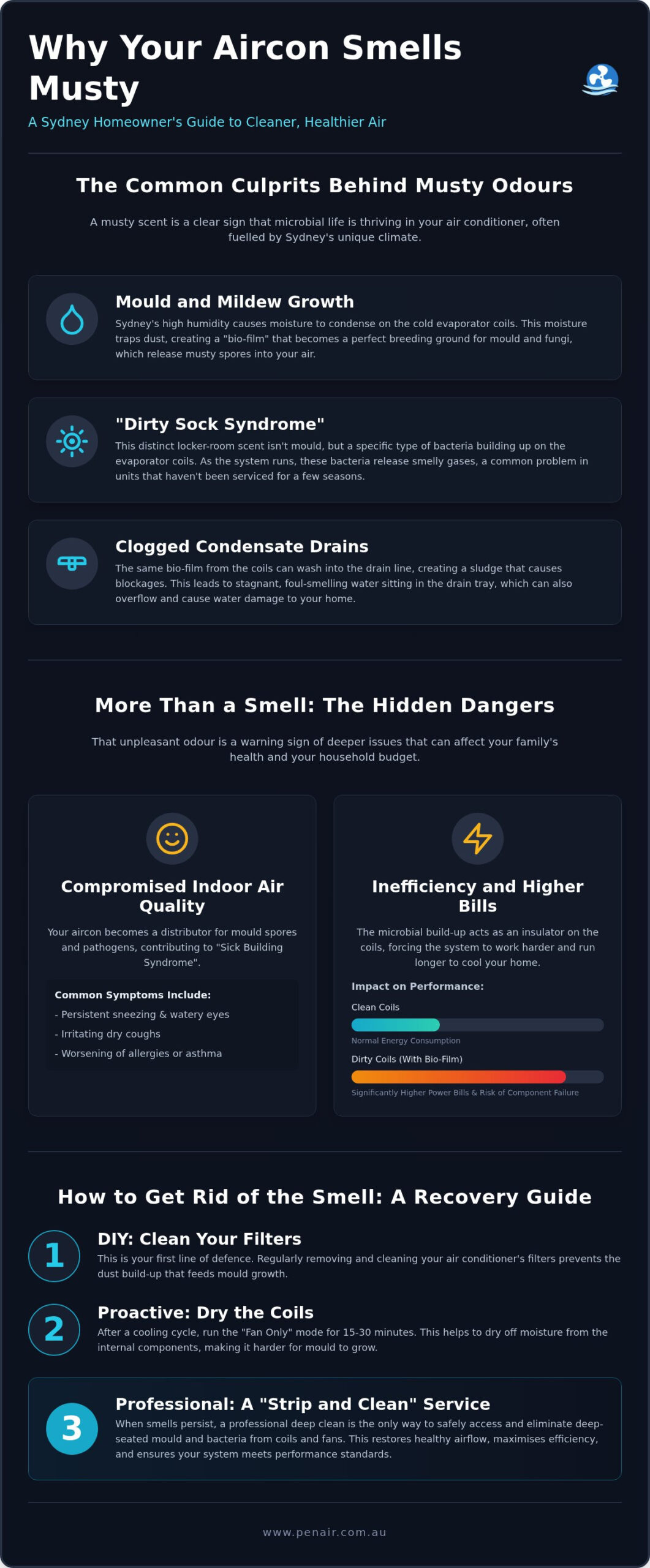
A musty aircon smell is almost always a sign of microbial life thriving where it shouldn’t. When your aircon smells musty what to do is usually the first question on your mind. This scent comes from mould, mildew, and bacteria colonising the internal components of your system. In the context of Heating, ventilation, and air conditioning (HVAC), these microorganisms thrive in dark, damp environments. Sydney’s unique climate, particularly during our humid summers, provides the perfect conditions for these unwanted guests to settle in.
You might notice a sharp, pungent aroma often called “Dirty Sock Syndrome.” This isn’t actually mould but a specific type of bacterial buildup on the evaporator coils. As the system cycles through heating and cooling, these bacteria release gases that create that unmistakable locker-room scent. It’s a common issue we see in older units that haven’t been serviced for a few seasons.
When your unit runs, the evaporator coils become very cold. Moisture from the humid Sydney air condenses on these coils, much like it does on a cold glass of water. While most of this liquid should drain away, dust particles often get trapped on the wet surfaces. This combination of dust and moisture creates a biological “film” or “slime” that feeds fungal growth. For our neighbours in coastal suburbs like those on the Northern Beaches, the salt-laden air and higher humidity levels mean this process happens much faster. Without regular air conditioning cleaning, this film thickens and begins to circulate spores every time you turn the unit on.
The condensate tray and drain line are designed to channel all that excess moisture safely outside. However, the same biological film that grows on your coils can eventually slough off and enter the drain. Over time, this creates a thick “sludge” or algae that blocks the pipe. When the water can’t escape, it sits stagnant in the tray. This standing water quickly turns into a source of foul, earthy odours. In a high-humidity environment like the North Shore, a blocked drain can lead to water overflowing back into your home, causing both a nasty smell and potential structural damage to your ceiling or walls.
While aircon systems have specific needs, the importance of clear drainage is a universal rule for home maintenance. Experts like Pioneer Plumbing CDA highlight how professional waterline and drainline repairs are essential to preventing the stagnant water and moisture buildup that often lead to structural damage and unpleasant smells.
While the scent is embarrassing when guests visit, it is actually a vital warning from your system. When your aircon smells musty what to do involves looking beyond the odour and considering your household’s health. This smell indicates that your air conditioning unit is actively circulating microbial contaminants throughout your living spaces, which can lead to a drop in indoor air quality (IAQ).
Your air conditioner acts as the lungs of your home. If there is mould growth inside the fan barrel or coils, the system essentially becomes a distribution hub for airborne pathogens. This is a primary contributor to “Sick Building Syndrome,” where residents experience health issues that seem linked to time spent indoors. Typical symptoms include persistent sneezing, watery eyes, and a dry, irritating cough.
We are particularly concerned about vulnerable residents, such as young children and the elderly, whose respiratory systems are more sensitive to these irritants. While some might think a quick spray of perfume solves the problem, the EPA guide to air duct cleaning highlights that visible mould or persistent odours are clear signals that a deeper cleaning is required to protect your health.
Beyond the health implications, that musty smell is a sign of mechanical distress. Biological growth doesn’t just sit there; it creates a physical barrier on the evaporator coils. These coils rely on clean surfaces for efficient heat exchange. When they are coated in a layer of microbial “slime” or dust, the system has to work significantly harder to reach your desired temperature.
This struggle translates directly to higher electricity bills. A system forced to run for longer cycles to compensate for restricted airflow consumes more power, which is a major concern given the 2026 NSW energy price trends. Ignoring these early warning signs often leads to more serious air conditioning repairs down the track. Components like the compressor or fan motor can burn out prematurely under the constant strain. If you have noticed a drop in cooling performance alongside a stale scent, it might be time to chat with our local team about a professional hygiene inspection.
If you are standing in your hallway wondering why your aircon smells musty what to do next, the answer begins with a simple safety check. Before you open any panels or touch any components, you must turn off the power at the isolator switch. This is usually a large rotary switch located near your outdoor unit. Safety is our priority, and ensuring the system cannot accidentally start while you are inspecting it is the first step toward a fresher home.
Most minor odours are trapped right at the surface. Your filters act as a net for dust, pet dander, and skin cells. When these organic materials combine with Sydney’s humidity, they create a buffet for bacteria. Cleaning these filters is the most effective way to eliminate surface-level scents without needing a technician immediately.
For split systems, you can usually pop open the front indoor panel to reveal two mesh filters. Slide them out carefully and wash them in lukewarm water with a mild detergent. Avoid using harsh chemicals that could leave their own lingering scent. Let them dry completely in the shade before sliding them back in. In a typical Sydney summer, we recommend doing this every two to four weeks.
Ducted systems are slightly different. The main filter is usually located behind the return air grille, often found in a central hallway ceiling. You will need to unscrew or unclip the grille to access the filter material. If you have a disposable pleated filter, it is often better to replace it entirely if it looks grey or furry. If it is a permanent electrostatic filter, a gentle vacuum and wash will suffice.
Once the filters are clean, take a torch and look at the visible sections of the indoor unit. Check the louvres and the return air grille for any small black dots, which are a sure sign of mould. If you have a ducted system, check the area around the vents for dampness or discolouration. These signs suggest that the issue is deeper than just a dirty filter.
Don’t forget the outdoor condenser. For our neighbours on the Northern Beaches, salt crust can build up on the delicate fins, while garden debris like leaves can block airflow. Gently brush away any leaves and ensure there is at least 30cm of clear space around the unit. If the smell persists after you have cleaned the filters and cleared the outdoor area, the contamination is likely deep within the internal coils or fan barrel. When you reach this point, it is time to book a professional air conditioning service to perform a specialised hygiene treatment.
If basic filter maintenance hasn’t cleared the air, you are likely dealing with moisture trapped deep within the internal components. When your aircon smells musty what to do next involves a systematic approach to drying and sanitising the system. We recommend starting by running your unit in “Fan Only” mode for at least two hours. This process helps evaporate any condensation that has pooled on the evaporator coils or inside the fan barrel, which is often the primary source of that damp, earthy scent.
For minor surface odours that persist after drying, you can use a specialised pH-neutral coil cleaner. These are designed to break down the biological film without damaging the delicate aluminium fins. Understanding aircon smells musty what to do involves both immediate action and long-term habit changes. If the scent remains pungent, it usually indicates that the microbial growth has reached the condensate drain line, requiring a more thorough flush to clear out stagnant sludge.
Reaching the evaporator coils requires removing the filters and occasionally the front fascia of the indoor unit. Once the coils are exposed, you can apply a specialised sanitising spray that targets bacteria and mould. It is vital to use products that are safe for your specific system. As an authorised Daikin Specialist Dealer, we always warn against using harsh household chemicals like bleach. These can corrode the protective coatings on Daikin components and lead to refrigerant leaks or system failure. After treating the coils, we recommend flushing the condensate drain line with a mild anti-bacterial solution to ensure any remaining “jelly” or algae is washed away completely.
Once you have restored a fresh scent, establishing a preventative maintenance schedule is the best way to stop odours from returning. During humid Sydney afternoons, consider using the “Dry” mode on your remote. This specialised setting focuses on removing moisture from the air without over-cooling the room, which prevents the internal components from becoming overly saturated.
Another simple but effective habit is leaving the fan running for 20 minutes after you have finished using the cooling function. This gives the unit a chance to dry out the coils before it shuts down completely, denying mould the damp environment it needs to grow. For a more detailed look at protecting your system, you can explore our Air Conditioning Service Sydney: The Complete 2026 Maintenance Guide. If you find that the odour returns despite these efforts, it is a sign that a professional deep clean is necessary. You can contact our local team to organise a comprehensive hygiene inspection and restore your home’s air quality.
When basic troubleshooting and surface sprays don’t clear the air, it is usually because the contamination has moved beyond the reach of a homeowner. If your aircon smells musty what to do next involves looking for a professional hygiene solution that treats the root cause. At PenAir, our specialised air conditioning cleaning services go much deeper than a standard filter wash. We focus on the areas you can’t see, such as the fan barrel and the rear of the evaporator coils, where mould colonies often hide in the dark, damp recesses of the unit.
Our “strip and clean” process is the gold standard for restoring indoor air quality. We don’t just spray a sanitiser and leave; we physically remove the buildup of microbial “slime” that causes those persistent odours. This level of decontamination is essential for Sydney homes, where the combination of coastal humidity and dust can create a stubborn biological film that restricts airflow. By removing this barrier, we don’t just fix the smell; we also help your system run more efficiently, which is vital for keeping your energy costs manageable in 2026.
As an authorised Daikin Specialist Dealer, we understand the specific engineering behind these premium systems. Daikin units are designed with precision components that require expert handling during a deep clean to avoid damage to the sensitive sensors and fins. A Daikin Specialist Dealer is an authorised partner who has undergone the manufacturer’s most rigorous technical training to ensure every system is maintained to the highest industry standards.
Choosing a specialised team for your hygiene service also helps protect your manufacturer warranty. Many modern systems, including the latest 2026 models, require documented professional maintenance to remain compliant with warranty terms. Our technicians use approved, non-corrosive cleaning agents that effectively kill mould and bacteria without risking the integrity of your heat exchangers or internal electronics.
We have been a part of the Sydney community since 1999, and our family-owned heritage is at the heart of everything we do. Based in Warriewood, our team provides reliable service across the Northern Beaches and North Shore, treating every home as if it were our own. We believe in honest, hardworking service without the high-pressure sales tactics often found elsewhere. You can rest easy knowing that our licensed and insured technicians are focused on the long-term health of your household environment.
If you have tried the DIY steps and that stale scent still lingers, it is time to bring in the experts. We are here to help you breathe easier and ensure your system is ready for the peak of the Sydney summer. Contact the PenAir team today to organise a professional deep clean and restore the fresh, healthy atmosphere your family deserves.
Restoring your home’s freshness starts with understanding that a stale scent is a signal for action. By keeping your filters clean and using “Fan Only” modes to dry internal components, you can manage minor moisture issues. However, when microbial growth settles deep within the coils or fan barrel, professional decontamination is the only way to protect your family’s health and maintain system efficiency under the latest 2026 NSW energy standards. These proactive steps ensure your unit doesn’t just mask odours but actually provides the clean environment you deserve.
If you’re still worried about your aircon smells musty what to do next, our local team is here to provide a permanent solution. As an Authorised Daikin Specialist Dealer and a family-owned Sydney business since 1999, we take pride in looking after our neighbours across the Northern Beaches and North Shore. Our expert technicians have the specialised tools to perform a thorough hygiene deep clean that restores your peace of mind and protects your manufacturer warranty.
Book your professional aircon deep clean with PenAir today to ensure your home remains a cool, healthy sanctuary. We look forward to helping you stay fresh and comfortable all year round.
Breathing in musty air is generally not considered safe for long periods because the odour indicates the presence of mould spores and bacteria. These airborne particles can trigger allergies, asthma, and respiratory irritation, especially in children or the elderly. If your aircon smells musty what to do is prioritise a hygiene check to ensure your indoor air quality remains healthy. Ignoring the scent allows contaminants to circulate freely throughout your living spaces.
You can use a diluted vinegar solution for surface cleaning, but it is rarely a permanent fix for deep-seated odours. While vinegar is a natural antifungal, it cannot reach the mould colonies living behind the fan barrel or deep within the coils. We also suggest caution as the acidity in vinegar can occasionally react with certain metallic coatings. For a thorough and safe result, specialised pH-neutral cleaners are a more reliable choice.
A professional hygiene deep clean in Sydney typically ranges from $250 to $450 for a standard split system unit. This specialised service involves stripping the unit down to treat the fan barrel and coils for mould. Standard maintenance services, which cover filter cleaning and basic checks, are generally more affordable, often starting around $120. Factors like the system’s size and the level of contamination will influence the final cost of the service.
That initial burst of odour happens because moisture sits on the evaporator coils and in the condensate tray while the unit is switched off. When you first turn the system on, the fan immediately blows the stagnant, damp air into your room. Once the unit has been running for a while, the cooling process may temporarily mask the scent, but the underlying microbial growth remains present and will return every time you restart the system.
A musty smell will not go away on its own and typically worsens over time as the microbial colonies grow. While running the unit in a “Dry” mode might temporarily reduce moisture, it won’t kill the mould or bacteria already established on the internal components. If you find your aircon smells musty what to do is address the root cause early to prevent the contamination from spreading further into your ductwork or internal insulation.
We recommend a professional deep clean at least once every twelve months to maintain optimal air quality. However, for homes on the Northern Beaches or North Shore, more frequent servicing may be necessary due to higher humidity and salt air. Regular maintenance ensures your system runs efficiently and helps identify potential issues before they lead to expensive repairs, keeping your home fresh and your power bills manageable throughout the Sydney summer.
“Dirty Sock Syndrome” is a common industry term for a pungent, locker-room odour caused by bacterial buildup on the evaporator coils. This occurs when bacteria settle on the damp, dusty surfaces of the coils during the cooling cycle. As the system cycles, these bacteria release volatile organic compounds that create a sharp, unpleasant scent. It is a specific type of contamination that usually requires professional chemical treatment to fully eradicate.
A blocked condensate drain is a primary cause of musty odours because it allows water to sit stagnant in the tray. This standing water becomes a breeding ground for algae and biological “sludge,” which releases a heavy, earthy smell. If the blockage isn’t cleared, the tray can overflow, potentially causing water damage to your walls or ceiling. Ensuring your drain line is clear is a critical part of any professional hygiene service.