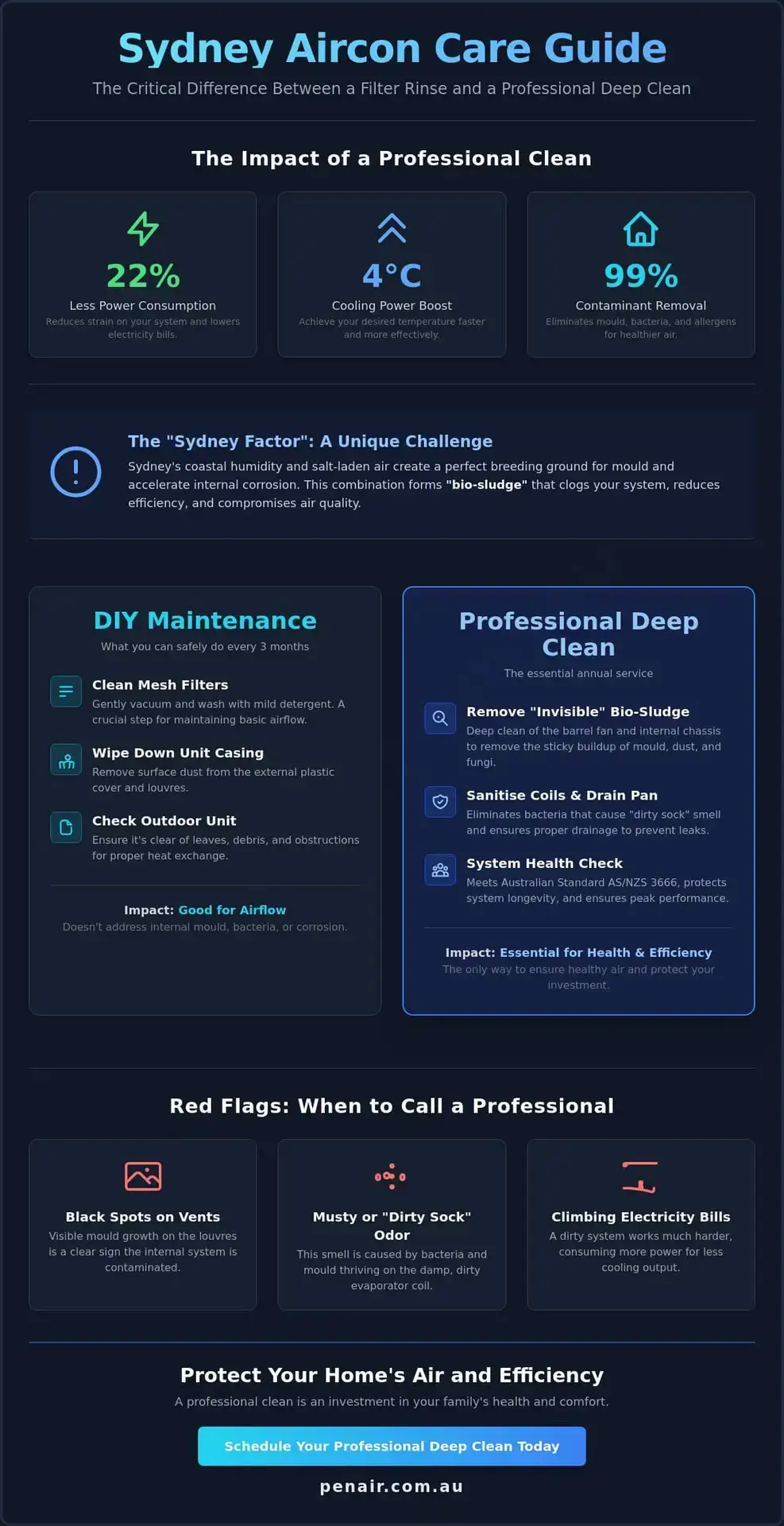
Did you know that a professional aircon cleaning can reduce your home’s power consumption by up to 22% while boosting cooling power by as much as 4°C? We understand the frustration of a humid Sydney summer when your vents start blowing musty odors and your electricity bills climb higher than expected. It’s tempting to grab a ladder and try to fix it yourself, especially when you’re looking for ways to protect a significant investment like a Daikin or Mitsubishi system.
As a family-owned business, we’ve seen firsthand how the right maintenance keeps local homes healthy and comfortable. This guide clarifies the critical differences between routine DIY filter rinsing and the professional deep cleaning required to remove “invisible” bio-sludge and salt-air corrosion. You’ll learn about the latest 2026 pricing for split and ducted systems, the strict NSW licensing requirements, and how to ensure your indoor air quality meets Australian Standard AS/NZS 3666. We’ll help you decide when to DIY and when it’s time to call in the specialists to protect your home’s efficiency and your family’s peace of mind.
Many homeowners believe that a quick dust of the plastic cover or a rinse of the mesh filters constitutes a job well done. However, true aircon cleaning involves a meticulous process of sanitising the internal components that you can’t see from the ground. It’s about reaching deep into the chassis to clear out the coils, the barrel fan, and the drain pan. Without this level of attention, your system becomes a hidden reservoir for contaminants.
Sydney residents face a unique set of environmental challenges we call the “Sydney Factor.” Our coastal humidity and salt-laden air don’t just feel heavy; they actively accelerate the growth of mould and the progression of corrosion within your unit. This is particularly true for homes in the Northern Beaches and Eastern Suburbs, where the proximity to the ocean means your system is constantly breathing in corrosive particles. Over time, these particles combine with moisture to form bio-sludge. Bio-sludge is a thick, gelatinous accumulation of bacteria, dust, and fungi that blocks drainage and insulates cooling coils, forcing your system to consume more power while delivering less relief.
Regular HVAC system maintenance is the only way to combat these local environmental pressures. It ensures your unit remains a source of comfort rather than a mechanical burden.
When your evaporator coils are layered with dust and moisture, they become the perfect nursery for mould spores. Every time you switch on the unit, these spores are circulated throughout your bedrooms and living spaces. In high-density Sydney apartments, this often leads to “Sick Building Syndrome,” where residents experience persistent headaches or respiratory irritation without a clear cause. If you notice a pungent “dirty sock” smell when the air starts flowing, it’s a definitive sign that bacteria are thriving on your evaporator coil and require professional intervention.
The financial cost of neglect is often higher than the price of a service. A dirty barrel fan, weighed down by grime, forces your motor to work up to 30% harder to move the same volume of air. This unnecessary strain doesn’t just spike your quarterly electricity bill; it drastically shortens the lifespan of premium systems. High-end brands like Daikin are engineered for precision, and keeping them hygienic is essential for their long-term performance. By staying on top of hygiene, you prevent the overheating issues that lead to expensive air conditioning repairs, ensuring your investment serves your family for many years to come.
Taking care of your cooling system doesn’t always require a technician. In fact, we encourage our neighbors to handle basic aircon cleaning tasks to keep things running smoothly between professional visits. For the average Sydney home, checking your filters every three months is the gold standard. If you live near a busy road or have pets, you might want to do this every month to prevent dust buildup from choking the airflow. Before you begin, safety is our top priority. Always isolate the power to your unit at the outdoor switch or the main electrical board. This simple step ensures you can work without any risk of electrical mishaps.
The tools required for basic maintenance are likely already in your cupboard. You’ll need a vacuum with a soft brush attachment, some mild detergent, and a clean, soft cloth. By maintaining your air conditioner through these simple DIY steps, you can help the system breathe easier and perform better during those sweltering January days. It’s a small investment of time that pays off in consistent comfort.
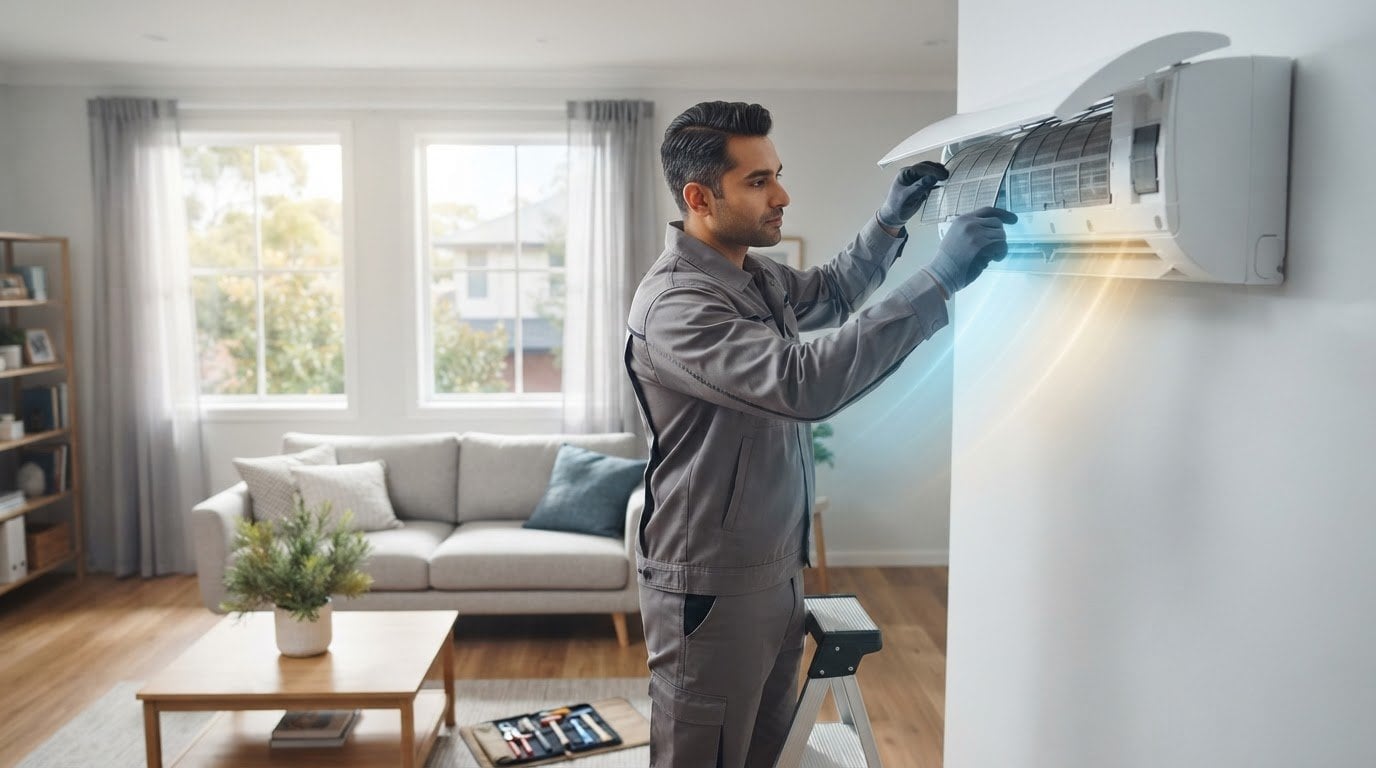
Most modern split systems are designed for easy filter access. Gently pull the front panel toward you; you’ll usually find small indentations on the sides. Be careful not to force it, as the plastic clips can be brittle, especially on older units. Once open, slide the mesh filters out. Use your vacuum to remove the loose dust first, then wash them in a sink with lukewarm water and a drop of dish soap. It is vital to let the filters dry completely in the shade before putting them back. Replacing damp filters can lead to mould growth inside the unit, which defeats the purpose of cleaning them in the first place.
Your outdoor unit needs space to work effectively. Sydney backyards can get cluttered with fallen leaves, overgrown shrubs, or stored items that block the airflow. Keep a clear zone of at least 50cm around the unit to ensure the fan can exhaust heat efficiently. While you’re out there, look for signs of salt-air corrosion on the delicate aluminium fins. This often looks like a white, powdery residue or a slight crumbling of the metal. If you see this, a gentle wipe with a damp cloth can help. However, never use a high-pressure hose on the outdoor unit. The intense water pressure can bend the fins and damage the sensitive electronics housed inside. If you notice significant debris inside the unit that you can’t reach, it’s a good idea to consult a professional to avoid accidental damage.
A standard domestic vacuum cleaner lacks the precision and suction power to clear a clogged barrel fan. These fans are the heart of your airflow, and when they become impacted with dust, your unit struggles to push air into the room. We often see well-meaning residents try to use hardware-store chemicals to dissolve this grime, but this is a risky move. Many generic cleaners are too acidic or alkaline for sensitive aluminium fins, leading to permanent corrosion that ruins the heat exchange process. Opting for a professional air conditioning service in Sydney ensures that the right pH-neutral agents are used to protect your equipment from chemical damage.
Professional technicians use specialized pressure-washing bags and low-pressure pumps to deep-clean the barrel fan and evaporator coils without flooding your living room. This process removes the stubborn bio-film that acts as a breeding ground for bacteria. We also prioritize flushing the condensate drain line. Over time, Sydney’s humidity causes “slime” to build up in these pipes, which eventually leads to water leaking down your walls. Finally, we apply hospital-grade anti-fungal treatments. These are key strategies to improve indoor air quality, as they prevent mould from returning to the damp internal environment of your system.
The perceived savings of a DIY deep clean often evaporate when things go wrong. It’s incredibly easy to accidentally bend the delicate aluminium fins or cause an electrical short by spraying water near the control board. Beyond physical damage, there are warranty implications to consider. Most manufacturers, including Daikin, require a log of professional maintenance to honor warranty claims. If a major component fails and you can’t prove the system was professionally serviced, you might find yourself footing a massive repair bill. Using a licensed, family-owned team provides peace of mind through professional liability insurance, ensuring your home and your expensive HVAC system are in safe hands. For a comprehensive overview of what a proper care schedule looks like, our guide to air conditioning maintenance in Sydney outlines exactly what’s involved in protecting your warranty and your investment.
While we’ve discussed how you can manage basic filter maintenance, there are specific warning signs that your system requires a deeper level of aircon cleaning. Catching these red flags early, ideally before the first 35°C day in December, prevents total system failure when you need relief the most. If you notice black, speckle-like spots appearing on the plastic louvres where the air exits, you’re looking at active mould growth. This isn’t just a cosmetic issue; it indicates that the internal barrel fan is likely covered in spores that are being blown into your living space.
Performance cues are equally important. If your unit is running for hours but the room temperature won’t drop, the internal heat exchange coils are likely choked with dust or bio-sludge. This blockage prevents the refrigerant from absorbing heat effectively. You should also listen for unusual auditory cues. A whistling sound often suggests a significant blockage in the intake, while a persistent rattling from the indoor head unit can mean debris is caught in the fan or a component has come loose due to excessive vibration from an unbalanced, dirty fan blade.
Spring is the optimal time for a professional service in Sydney. Booking your clean in September or October ensures your system is sanitized and efficient before the summer humidity hits. It’s also vital to consider a clean before winter. Switching a dirty unit to heating mode can bake existing dust and mould onto the coils, leading to that unpleasant “burnt” smell. For main living area units used more than 8 hours a day, we recommend a professional deep clean every 12 months. Guest room units or those used less than 15 days a year can usually wait for a 24-month cycle. Understanding the full scope of what a yearly plan should include is made easier with a dedicated air conditioning maintenance Sydney reference guide that covers seasonal scheduling, NSW Energy Savings Scheme discounts, and warranty protection in one place.
To help our technicians provide the most efficient service, a little bit of preparation goes a long way. Please clear a space of approximately 1.5 metres around the indoor unit. This allows us to set up ladders and our specialized cleaning bags safely without risking your furniture. If your system has been displaying specific error codes on the wall controller or the indoor unit’s LEDs, write these down before we arrive. For a full guide on getting your home ready, check out this air conditioner service near me checklist. If you’ve noticed any of the warning signs mentioned above, contact our friendly team to restore your home’s comfort and air quality.
Since 1999, our family-owned and operated business has been a staple in the Sydney community. We don’t just see ourselves as technicians; we’re your neighbors who understand exactly how a humid summer can impact your home’s comfort. When we perform aircon cleaning, we bring over 25 years of local experience to every job. We’ve built our reputation on honesty and quality craftsmanship, ensuring that every split or ducted system we touch is treated with the highest level of care. We believe in providing a service that offers genuine peace of mind, making sure your family breathes easier after every visit.
Our comprehensive process goes far beyond a quick wipe-down. We use specialized equipment to deep-clean and sanitise both split and ducted systems, removing the buildup that limits performance. Protecting your home is a non-negotiable part of our approach. Our team maintains clean work zones by using protective floor coverings and specialized catchment bags to ensure no water or debris touches your furniture or walls. We take pride in our professional courtesy, arriving on time and leaving your living space exactly as we found it, only with a much more efficient cooling system.
As a Daikin Specialist Dealer, we have access to specific cleaning protocols and genuine parts that general contractors simply can’t provide. This is a critical factor for homeowners who want to protect their investment. Many people aren’t aware that improper cleaning methods or using unauthorized technicians can actually void your manufacturer’s warranty. Our HVAC-specific training ensures that we handle the delicate internal electronics and aluminium fins of your Daikin unit with the precision required by the brand. You can learn more about our Daikin air conditioning expertise and how we help local residents maintain their systems to the highest standards of hygiene and efficiency.
We’re proud to serve the Northern Beaches, the North Shore, and the surrounding Sydney suburbs. Our service calls are unhurried because we believe in doing the job right the first time. We prioritize transparent communication, so you’ll always know what we’re doing and why it matters for your system’s longevity. Whether you have a single split system or a complex multi-split setup, we’re here to help. Don’t wait for the next heatwave to discover your unit is struggling. Contact our friendly team today to schedule your professional aircon cleaning and get your home ready for a healthy, cool, and comfortable Sydney summer.
Maintaining a healthy home in Sydney means staying ahead of the humidity and salt air that can compromise your climate control. While your three-monthly filter checks are a vital first step, they can’t replace the deep, microbial sanitisation that professional aircon cleaning provides. By addressing the hidden bio-sludge on your internal coils, you ensure your system runs at peak efficiency, potentially lowering your energy bills by up to 22% while extending the life of your unit.
As a family-owned and operated business since 1999, we take pride in looking after our local community. We’re fully licensed and insured HVAC experts and an authorised Daikin Specialist Dealer, which means we have the specific technical knowledge to protect your manufacturer’s warranty. You don’t have to wait for the next heatwave or a musty odor to take action.
Book your professional Sydney aircon clean with the PenAir team today and enjoy the peace of mind that comes with a truly fresh, efficient home. We look forward to helping you keep your family comfortable all year round.
For most Sydney homes, we recommend a professional deep clean every 12 to 24 months. If you live in high-humidity coastal areas or have indoor pets, an annual schedule is best to prevent mould. For ducted systems, a full hygiene clean is typically required every 3 to 5 years to maintain efficiency and air quality according to local industry standards.
You should never use a pressure washer on any part of your air conditioning system. The intense force of a pressure washer will flatten the delicate aluminium fins on the condenser coil, which permanently restricts airflow. This leads to overheating and potential motor failure. Instead, use a gentle stream from a garden hose to rinse away salt and dust safely.
Yes, a professional aircon cleaning can reduce your power usage by up to 22%. When dust and bio-sludge insulate the coils, the compressor must run longer and harder to reach your desired temperature. By restoring optimal heat exchange, your system consumes significantly less electricity during the peak of a Sydney summer, providing both comfort and savings.
Musty or vinegar-like smells are never normal and usually indicate a buildup of bacteria and fungi on the evaporator coil. This “dirty sock” syndrome occurs when moisture combines with dust to create a breeding ground for microbes inside the dark, damp unit. A professional sanitisation treatment is necessary to kill these organisms and refresh your home’s air properly.
A standard service focuses on mechanical reliability, such as checking refrigerant levels and electrical connections. In contrast, a deep clean is a hygiene-focused process. It involves pressure-washing the internal barrel fan and sanitising the coils with anti-microbial agents to remove impacted grime that a standard mechanical check-up simply doesn’t address.
Dirty units can certainly impact your family’s health by circulating mould spores, dust mites, and allergens throughout your living spaces. This is a common cause of respiratory flare-ups for those with asthma or hay fever in Sydney. Keeping your system clean ensures your indoor air quality meets the safety expectations outlined in Australian Standard AS/NZS 3666.
Yes, a thorough professional service includes the outdoor condenser unit. Our technicians clear away foliage and debris that might block airflow and check the fins for signs of salt-air corrosion. This holistic approach ensures the entire system, not just the indoor head unit, is operating at its maximum cooling capacity and is protected from the elements.