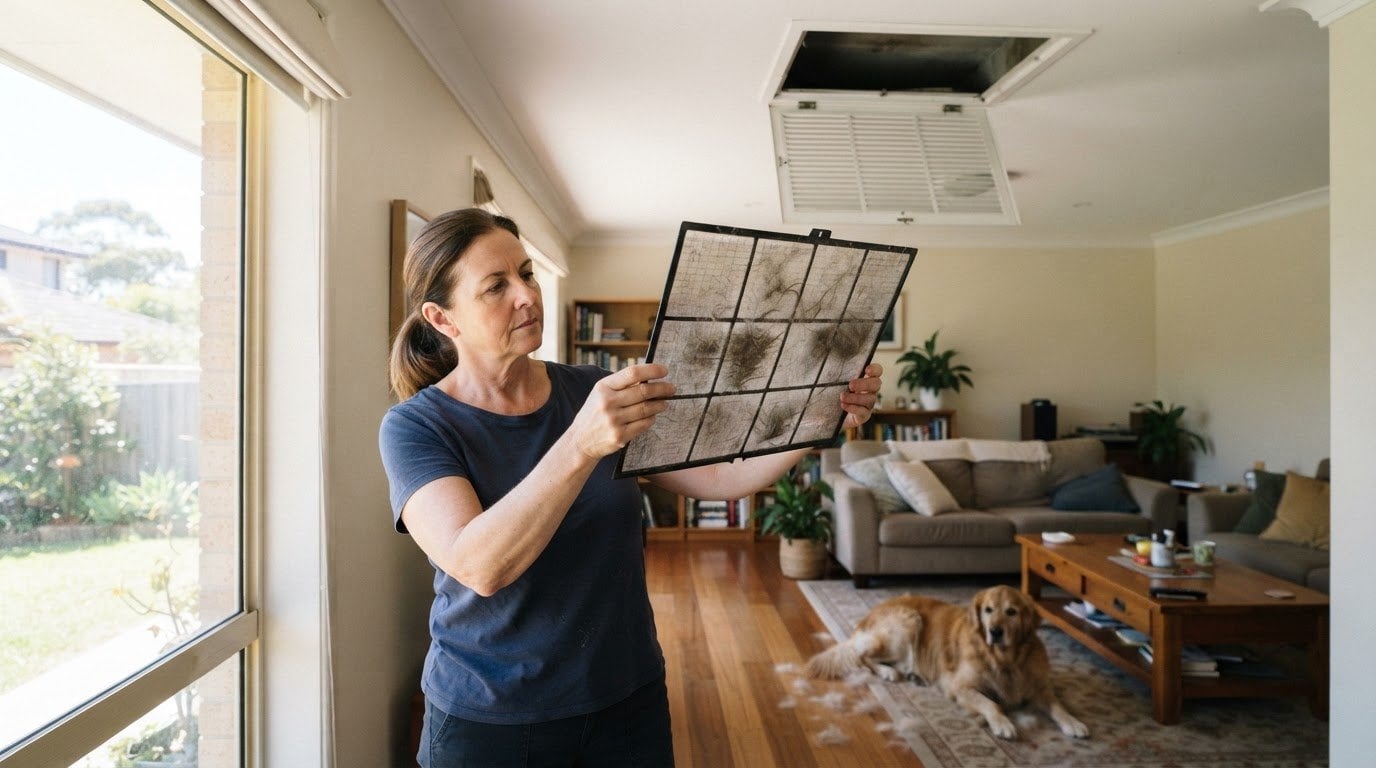

Pets can clog an aircon filter sooner than a standard replacement schedule suggests. In a pet household, inspect the filter monthly and clean or replace it according to its condition and the unit’s instructions. Pet friendly aircon filters still need regular attention because hair and dander build up as air circulates through the system.
Don’t wait for airflow to drop before checking the filter. Visible hair and dust can be an earlier warning. When choosing pet friendly aircon filters, match the filter to the unit: a higher rating alone does not make it suitable for every system. Homes with several pets, especially those that shed heavily, may need more frequent checks.
This guide explains how pet friendly aircon filters relate to dander and clogging, when cleaning makes sense and when replacement is the better option. You’ll also learn how filter types compare and what to consider when arranging professional care for your air conditioning system.
For pet households, arrange monthly filter inspections and annual professional servicing. The right cleaning interval depends on the air conditioner’s instructions, how often it runs and what the filter looks like. Sydney owners with several shedding pets may see hair and dust build up sooner than households with one short-haired pet.
A professional can assess whether the filter needs cleaning or replacement, then follow the care requirements for that exact model. This matters because washable mesh filters and specialised or disposable filters can need different treatment. A filter that looks similar in size may still be the wrong replacement, so its type should match the unit. For Sydney homes, pet friendly aircon filters must suit the equipment as well as the household’s needs.
Activated carbon filters are a separate consideration for pet odours. Carbon can absorb volatile organic compounds that contribute to smells, but it doesn’t remove every source of odour or dander. In homes with an indoor litter box or multiple large dogs, activated carbon filters may need replacing every 30-45 days. The interval depends on the filter and its condition.
Humidity also affects indoor air and lingering smells. A humidity range of 30% to 50% supports comfort and good air quality. Excess humidity can encourage mould and mildew growth, which may worsen allergies. A professional assessment can help identify whether odours relate to the filter, moisture or another system issue. Regular servicing can assess the air conditioner without treating the filter as the only possible cause.
Filter options differ in what they capture and how they’re maintained. Compatibility with the equipment and the instructions in its manual should guide your decision.
| Filter option | Main role | Cleaning or replacement consideration |
|---|---|---|
| Washable mesh | Captures larger dust and hair | Clean only as the unit instructions allow; dry fully before refitting |
| Disposable filter | Collects airborne particles | Replace when dirty or at the interval suited to its type |
| Activated carbon | Absorbs some odour-causing compounds | Homes with litter boxes or multiple large dogs may need replacement every 30-45 days |
| Specialised filter | Provides filtration specific to the unit | Follow the model’s care and replacement instructions |
| Specified replacement filter | Matches the air conditioner’s requirements | Use the correct type, not just a filter with a similar grille size |
Choose professional cleaning when a washable filter needs attention or visible build-up returns quickly. Replace the filter if it is damaged, no longer fits correctly or is disposable. Choosing pet friendly aircon filters means prioritising compatibility and household conditions, not adding an improvised filter layer.
Air conditioning circulates indoor air, carrying pet hair and dander towards the filter. A suitable filter can capture some airborne particles, but filtration alone won’t remove every allergen or pet odour from a Sydney home.
For allergy concerns, combine filtration with regular cleaning and reducing loose hair near return-air grilles. A professional can assess filter compatibility and airflow together, as denser filtration can affect system performance.
Pet hair is visible and can collect on the filter surface, while smaller dander particles travel through the home in circulating air. Particle sizes vary, so a filter that catches larger hair may be less effective at capturing smaller airborne material.
Build-up depends on how much pets shed, how often the system runs and the filter design. Pets that spend time near a return-air grille, for example, may leave more hair around the intake. A professional inspection considers both visible accumulation and less obvious dust.
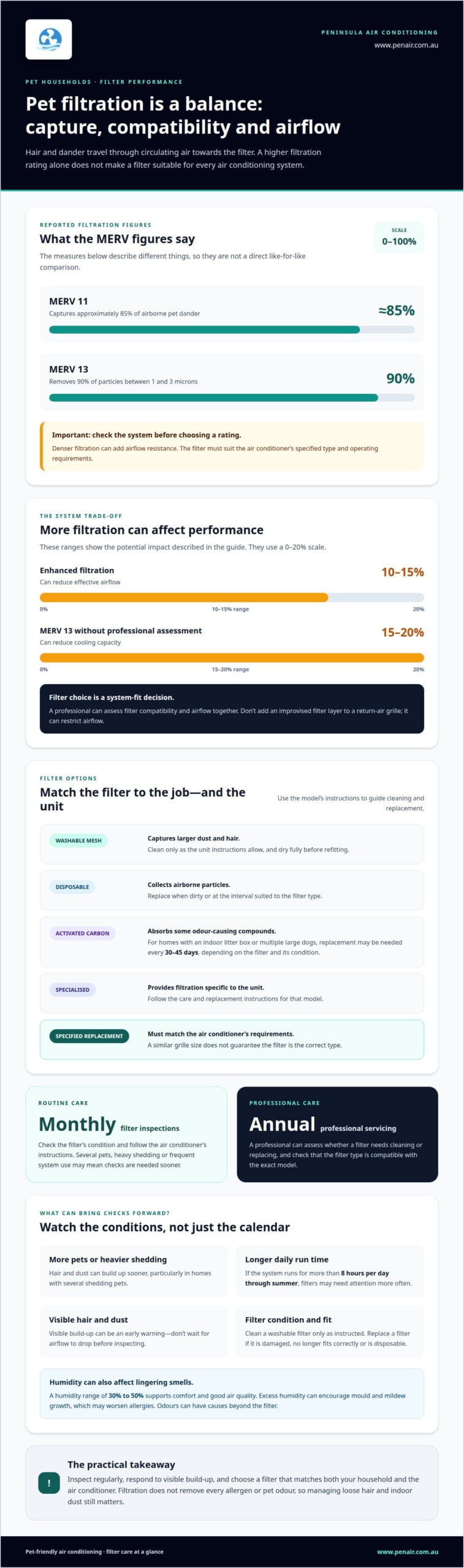
MERV ratings describe air-filter performance on a scale from 1 to 16. MERV 11 filters capture approximately 85% of airborne pet dander, while MERV 13 filters remove 90% of particles between 1 and 3 microns.
Those figures don’t mean every residential air conditioner can use either rating. Higher filtration can add airflow resistance, so the specified filter and the equipment’s operating requirements matter. Filters also don’t replace steps such as managing loose pet hair and indoor dust.
For a new Sydney build, consider filter access and airflow during design. A professional can assess filtration with household pets, room layout and expected system use in mind. In ducted installations, accessible return-air grilles make inspection and maintenance more practical. Adding an improvised filter layer to a return can restrict airflow, so it isn’t a suitable way to catch extra hair.
Inspection frequency should follow the exact model instructions and the filter’s observed condition. Professionals also consider shedding and how often the system runs. If air conditioning operates for more than 8 hours per day through summer, filters may need attention more often. Regular inspections help identify changes in build-up before deciding whether cleaning or replacement is appropriate.
Enhanced filtration can reduce effective airflow by 10-15%. Installing a MERV 13 filter without professional assessment can reduce cooling capacity by 15-20%. These figures show why filter choice and system performance need to be considered together, particularly when a Sydney household uses air conditioning frequently.
For a new installation or a system with changing airflow, arrange a professional assessment to discuss filter access and household needs.
Pet households can use one to two months as a starting point for replacement, then adjust for filter condition and the air conditioner’s instructions. Filter prices depend on type, dimensions and equipment, with the applicable price provided after a quote request.
A replacement filter must match the air conditioner’s specified type, not just the grille dimensions. For a split system, a filter that appears to fit may still be unsuitable for its airflow requirements. Professionals identify the unit and filter specification before replacement, then consider household shedding and system use when judging the interval.
Custom sizing doesn’t mean any material or rating will suit the equipment. A professionally selected replacement must fit correctly and support the system’s intended airflow. Choosing by size alone can overlook the filter design needed for effective filtration.
Reusable electrostatic filters can last nearly 8 years, with regular maintenance every 1-3 months. They differ from disposable filters because cleaning, rather than routine replacement, is central to their upkeep. A professional can recommend a reusable option only when the air conditioner’s instructions allow that filter type.
Washable mesh also needs care suited to the specific unit. The filter must be fully dry before refitting, and specialised elements may need different handling. For homeowners, compatibility and the maintenance routine matter more than choosing a washable filter for convenience alone.
Replacement schedules vary by filter thickness and pet load. A 1-inch filter in a pet household may need monthly replacement, while a 4-inch filter may need replacement every 3-4 months. Pleated filters can last up to 3 months, but visible dirt or heavy shedding can bring replacement forward.
For multiple pets, the interval may shorten further. MERV 11 filters are recommended for replacement every 45-60 days in homes with multiple pets. With three or more animals, intervals can drop to 30-45 days; homes with several shedding breeds may need replacement every three weeks during peak shedding seasons.
Treat these intervals as filter-specific guidance, not one schedule for every system. A professional compares the filter’s condition with its instructions and the household’s use. For example, a heavily used system with several shedding pets may need a different replacement rhythm from a lightly used system in a home with one pet.
Clean a reusable filter only if its instructions permit washing. Replace disposable filters rather than washing them. A professional can identify when a filter is damaged or no longer fits correctly, then specify a suitable replacement that supports filtration and comfortable airflow.
In a multi-pet home, hair and dander arrive at the return air filter from several rooms and animals. Each pet adds material to the airflow, while shedding can increase the amount reaching the system. A single cat produces approximately 3.5 grams of dander weekly, so several pets can contribute a steady load even when loose hair isn’t obvious.
Clogging depends on more than the number of animals. A professional considers coat type, shedding periods, where pets spend time and how often the air conditioner runs. Pets that regularly rest near a return-air grille, for example, may leave more hair close to the intake. A system running for long periods also draws more indoor air through its filter.
As hair and dust accumulate, they cover the filter’s open area and can impede airflow, making the system work less effectively. Pet owners may notice weaker air delivery or uneven cooling, but these signs don’t identify the cause by themselves. A professional inspection can assess the filter alongside the system’s airflow and condition.
Set filter checks according to household conditions rather than following one fixed timetable. A professional can compare visible build-up across inspections, then adjust maintenance timing for the number of pets, shedding and system use. A home with several animals and frequent cooling may need closer attention than one with a single pet and occasional use.
In ducted systems, return-air grilles may be positioned across the home, so a professional checks the relevant filter access points. A multi-split system serves separate indoor areas, where household activity can affect where hair and dander gather. Assessing the whole system is more useful than judging the filter condition in just one room.
Regular household vacuuming can reduce the loose pet hair that might enter the air-conditioning system. It doesn’t replace professional filter inspection, particularly when cooling use increases or the filter becomes visibly loaded. Professionals can determine whether cleaning or replacement better suits the filter and equipment.
If several pets are affecting airflow or cooling, contact us to arrange professional advice about inspection and maintenance.
Peninsula Air Conditioning (PenAir) helps Sydney households keep their air conditioning systems maintained when pet hair and dander contribute to filter build-up. During Service & Maintenance, our team can assess the system, consider its filter requirements and identify whether cleaning or further attention is appropriate. This is useful when filters clog repeatedly, airflow changes or cooling feels uneven, despite regular filter care. We work with ducted, split and multi-split systems, so the assessment can account for the type of equipment in your home. The right approach depends on the system and its specified filter, not simply the number of pets. For help with your household’s air conditioning, contact Peninsula Air Conditioning (PenAir).
Choosing pet friendly aircon filters helps support comfort at home, but the filter must also suit your air conditioner. Note your system type, how many pets live at home and any changes in airflow or cooling. These details help guide a practical conversation about what the system needs.
Peninsula Air Conditioning (PenAir) provides Service & Maintenance for households with ducted and split systems in Sydney. If recurring filter build-up or changing system performance makes it difficult to decide what to do next, a professional assessment can help clarify what your equipment needs.
Contact Peninsula Air Conditioning (PenAir) to discuss your air conditioning needs and take the next step towards a more comfortable home.
The right type depends on whether your main concern is hair, airborne dander or odours. Washable mesh can capture larger debris where the unit permits washing, while a compatible pleated filter provides disposable filtration. Activated carbon can help absorb odour-causing compounds, but it serves a different purpose from particle filtration. For example, a household concerned about litter-box smells may need a different approach from one focused on shedding.
They can only be used if they suit the particular air conditioner’s requirements. HEPA filters capture particles 0.3 microns and larger, but that rating alone doesn’t establish compatibility with a residential unit. Higher-MERV filters can capture smaller particles, yet may add airflow resistance. In Australia, EN 779 has been superseded by ISO 16890, and those ratings don’t convert directly to MERV, so don’t treat the labels as equivalent.
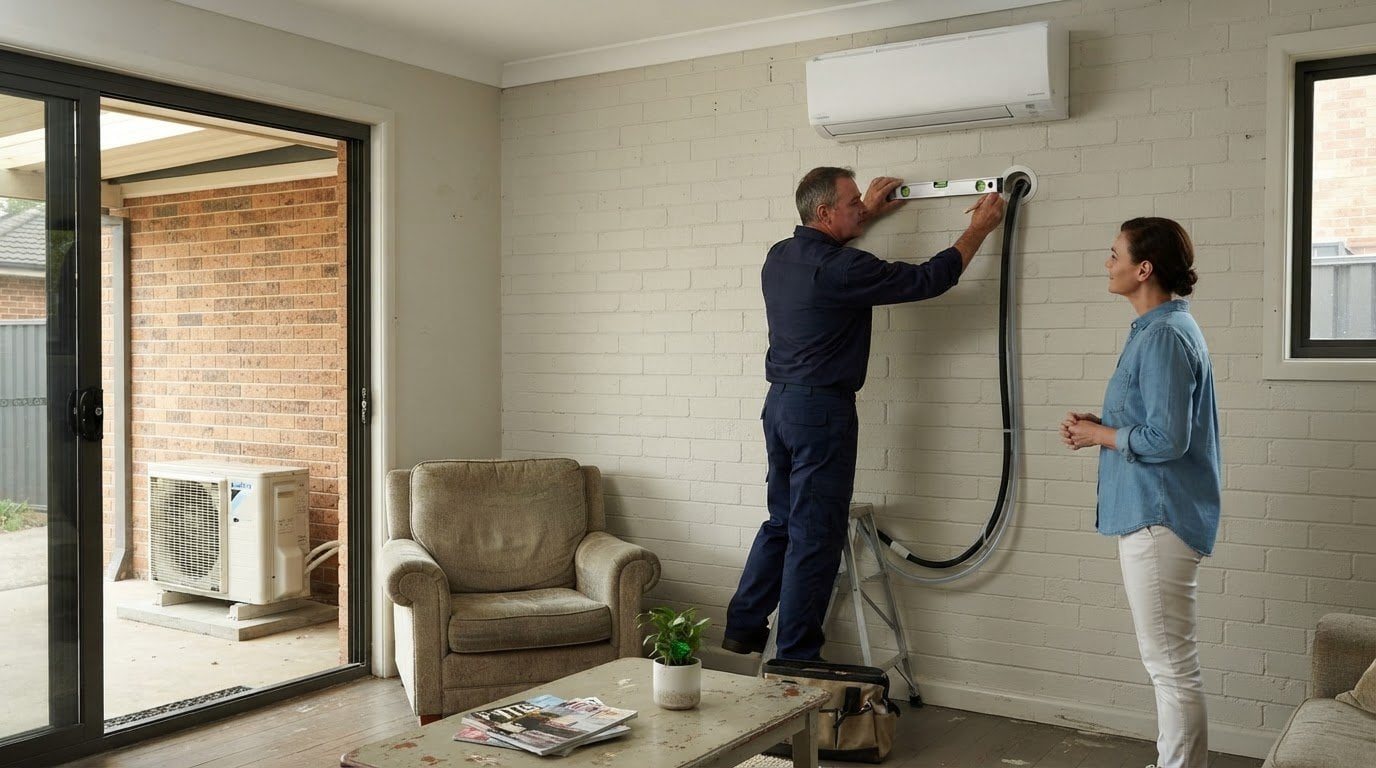
A professional can recommend a compatible replacement based on the air conditioner’s make, model and specified filter type. Options may include disposable filters, washable mesh or a reusable electrostatic filter where the equipment supports it. For a Sydney split system, the replacement must suit the model’s filter compartment and airflow requirements. Pet-related marketing or similar dimensions alone don’t establish that a filter is suitable.
Monthly filter inspections and annual servicing are a practical starting point for a pet household. Replacement may be needed every one to two months, but the filter instructions and its condition should guide the decision. A professional can distinguish filters that can be cleaned from disposable ones that need replacing. More pets, active shedding and longer cooling periods can mean the filter needs attention sooner.
A professional identifies the air conditioner model and checks the specified filter type, dimensions and fit within the filter compartment. They also assess whether the replacement sits correctly and suits the system’s airflow needs. A filter that matches a grille’s measurements may still differ in construction or suitability. For ducted systems, the technician also considers the relevant return-air filter access points.
Yes, a higher-efficiency filter can restrict airflow if the system isn’t designed to use it. Enhanced filtration can reduce effective airflow by 10-15%, and installing a MERV 13 filter without professional assessment can reduce cooling capacity by 15-20%. That doesn’t mean the filter will automatically damage the unit. A professional assesses compatibility and airflow before recommending a higher-rated filter for a Sydney home.