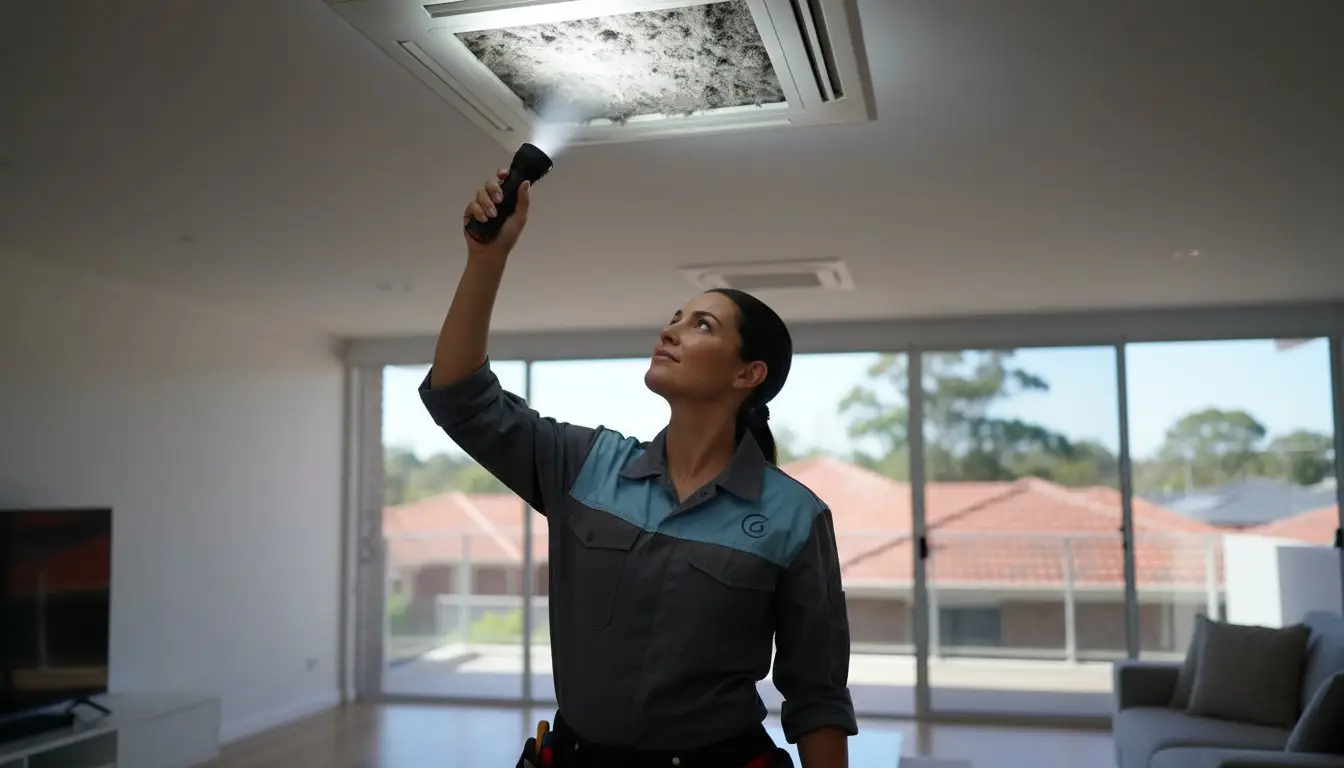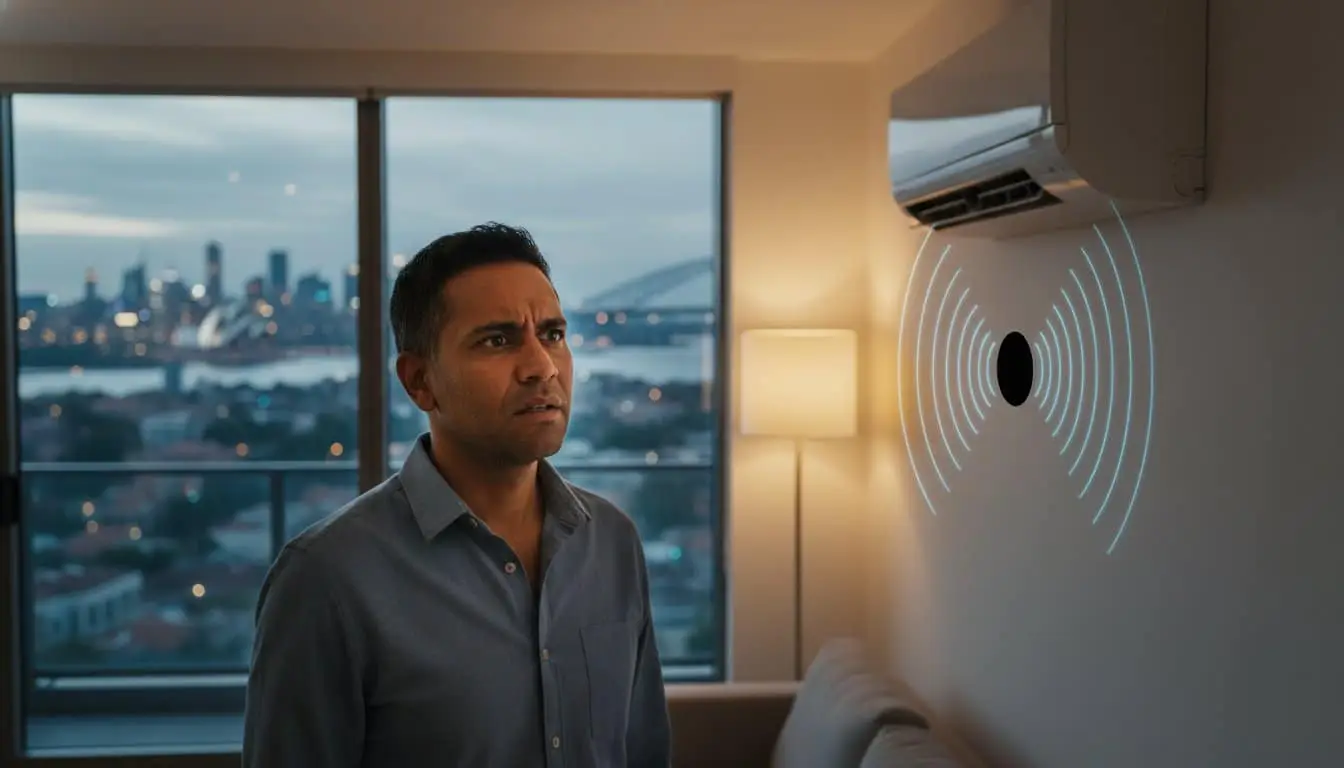

You’ve settled in for a quiet evening, but a persistent, low-frequency hum is coming from your hallway. It’s unsettling to realize your air conditioner making buzzing noise when off isn’t just a figment of your imagination. We understand the immediate wave of anxiety this causes. It’s natural to worry about electrical safety or the potential for a massive repair bill when a machine seems to have a life of its own.
Our team knows how much you value your home’s peace and safety. Considering that nearly 30% of HVAC service calls are now related to noise issues, you aren’t alone in your concern. This 2026 guide will help you pinpoint exactly why your system is vibrating or buzzing while in standby mode. You’ll learn how to tell if it’s a minor quirk or a serious electrical warning sign that requires professional attention. We’ll walk through common culprits like failing capacitors and faulty contactors, while explaining the mandatory Australian safety standards that keep our local community protected.
When you press the “off” button on your remote, your air conditioner doesn’t actually shut down completely. Instead, it enters a state known as standby power. This allows the system to stay alert, waiting for your next command. To do this, a small internal transformer remains active 24/7 to step down the standard household power to the lower voltage required for the unit’s sensitive electronics. It’s quite common to hear a very faint, rhythmic hum if you put your ear right up to the unit; this is simply the transformer doing its job.
There is a clear line between a healthy hum and an air conditioner making buzzing noise when off. If the sound is loud enough to be heard from across the room, it usually indicates that an electrical component is under stress. It is also important to distinguish between “System Off” at your thermostat and “Power Off” at your wall. Your unit remains live and connected to the grid unless you turn it off at the lockable isolating switch. Since December 2012, these switches have been a national requirement in Australia for any unit with a compressor, providing a way to fully de-energize the system for safety or maintenance.
The control board acts as the brain of your HVAC system. It stays powered up even in standby mode so it can instantly recognize signals from your remote or smart home app. A standby hum is the baseline vibration of an active transformer on this board. Problems arise when components like capacitors begin to age or leak. A failing capacitor on the control board can produce a distinct, high-pitched electrical buzz that sounds much more aggressive than the standard operating hum. If you notice this change in pitch, it’s often a sign that the board requires a professional inspection to prevent a total system failure.
At PenAir, our team has extensive experience as specialist Daikin dealers, and we often guide Sydney homeowners through the specific quirks of these high-end systems. Daikin units are designed with sophisticated energy-saving standby modes, but they also include protective components like the Crankcase Heater. This heater stays active during colder Sydney nights to keep the compressor oil warm, ensuring the system starts up smoothly. This component can sometimes produce a low-frequency hum that is perfectly normal. However, if that hum transforms into a sharp, persistent buzz, our technicians can help determine if the heater or the associated wiring needs attention. We pride ourselves on knowing these model-specific behaviors to save you from unnecessary worry or expensive diagnostic fees.
Identifying why an air conditioner making buzzing noise when off is often an electrical warning sign rather than a simple mechanical quirk. In our years of serving the Sydney community, we’ve found that these sounds usually stem from three specific areas. While some are minor, others require immediate attention to prevent permanent damage to your system. Our local climate, particularly the high humidity and salt air found in the Northern Beaches, can accelerate the wear on these internal components, making regular check-ups essential for coastal homes.
The electrical contactor is a heavy-duty switch that controls the flow of high-voltage electricity to your compressor. Think of it as the gatekeeper for your system’s power. Over time, the contact points can develop “pitting” or carbon buildup, which prevents the switch from closing firmly. This leads to a phenomenon called “chattering,” where the switch vibrates rapidly between an open and closed state. This creates an angry, persistent buzz that you can hear even when the thermostat is set to off. This type of electrical struggle is a major cause of heat buildup and is exactly the kind of issue that Arc-Fault Circuit Interrupters (AFCIs) are designed to protect against in modern home wiring. If you ignore a chattering contactor, it can eventually lead to a total compressor burnout, which is a far more expensive fix than simply scheduling a professional repair early on.
Many indoor units, especially in multi-split or ducted configurations, rely on a small condensate pump to remove moisture. This pump is triggered by a float switch that rises as the reservoir fills with water. If this switch becomes stuck due to dust or algae buildup, the pump may continue to run and buzz long after the cooling cycle has finished. It is a common mechanical failure that sounds like a continuous vibration coming from the indoor head unit. You can often verify this by checking your external drain line. If the unit is buzzing but no water is dripping, the pump might be running dry and struggling to clear a blockage.
The third most common cause is refrigerant expansion. As your system shuts down, the internal pressures must equalize. This can sometimes cause a faint vibrating or hissing sound as the liquid refrigerant moves through the expansion valve. While this is usually a normal part of the system’s “resting” phase, it should never be a loud or sharp electrical sound. If the noise is loud enough to disturb your sleep, it is likely one of the electrical issues mentioned above. Keeping your system clean and free of debris is the best way to ensure these components operate quietly and reliably for years to come.
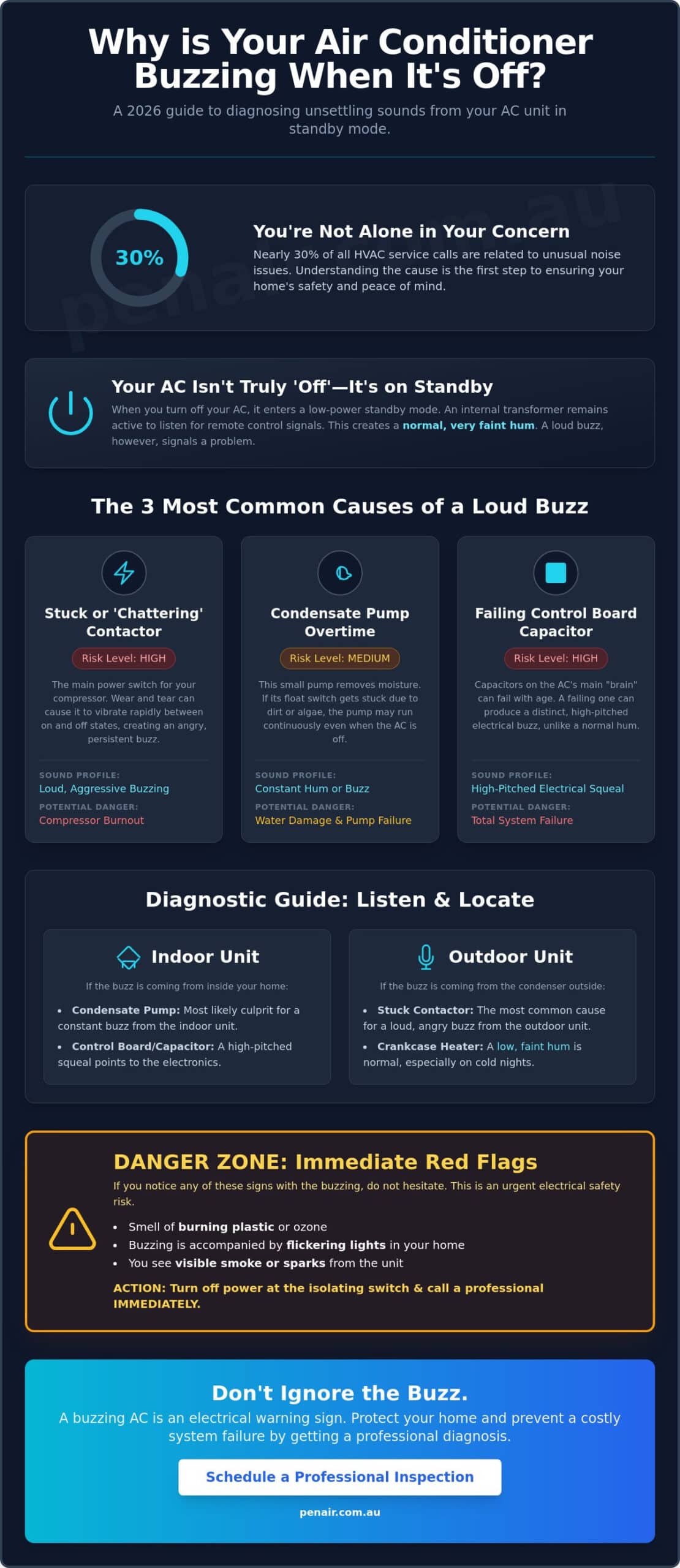
To solve the mystery of your air conditioner making buzzing noise when off, you first need to play detective. Identifying exactly where the sound originates is the most helpful information you can provide when you call for professional assistance. We find that most “ghost noises” are localized to either the indoor head unit or the outdoor condenser unit. Pinpointing the location helps us understand which components are still drawing power during standby mode.
If the buzz is coming from your indoor unit, the culprit is typically a low-voltage component. This might include the control board, a small transformer, or a fan motor trying to engage. If you hear the sound inside your walls or ceiling, it is often a condensate pump that has become stuck. It is also helpful to distinguish this electrical buzz from the occasional “popping” or “creaking” sounds heard in ducted systems. Those sounds are usually just thermal expansion as the metal ducts cool down, whereas a buzz is a constant, rhythmic vibration that suggests an electrical struggle.
An outdoor buzz almost always points to a high-voltage issue. This typically involves the contactor, the transformer, or the compressor itself. Because the outdoor unit handles the bulk of the electrical load, noises here are often louder and more “angry” in tone. If you notice a sound coming from the condenser while the system is supposedly resting, it’s a clear sign that power is reaching a component that should be idle.
We suggest a simple two-step test to narrow down the cause. First, ensure the unit is turned off using your remote or thermostat. If the sound continues, head to your outdoor unit and locate the wall isolator switch. Switch this to the “off” position. If the buzzing stops instantly, you have confirmed an electrical fault that requires a licensed technician. If the sound persists for a few minutes and then slowly fades away, it is more likely related to refrigerant pressure equalizing. While pressure equalization is often normal, a persistent noise should still be checked to ensure your system remains reliable.
Living in Sydney brings unique challenges for HVAC systems. Our intense summer humidity significantly increases the workload for condensate pumps, leading to more frequent mechanical fatigue and buzzing. Additionally, local wildlife like geckos and ants are notorious for nesting inside outdoor electrical cabinets. These small visitors can bridge electrical gaps, causing short circuits and chattering contactors. Because Home electrical fires are a serious risk when circuits are compromised, we always prioritize safety. If you suspect an infestation or an electrical struggle, it is best to look into professional air conditioning repairs Sydney homeowners trust to keep their families safe and their systems running at peak performance.
Hearing an air conditioner making buzzing noise when off is more than just a nuisance; it is often a cry for help from your system’s electrical heart. While some sounds are minor, an electrical buzz should never be ignored overnight. Electrical faults don’t resolve themselves and usually escalate into more dangerous territory. If you find yourself wondering if that hum is a safety risk, there are three critical warning signs that mean you should cut the power immediately.
We often see homeowners wait until the system fails completely before calling for help. This is a risky strategy. Addressing a chattering contactor or a failing capacitor early might involve a relatively small part replacement. However, leaving that component to struggle can eventually lead to a $4,000 compressor failure. Beyond the financial cost, arcing electrical contactors pose a genuine fire risk. If you ever smell smoke or see a faint wisp of vapor coming from your unit, switch off the AC isolator immediately and step away from the system.
It can be tempting to open the electrical cabinet to see what’s vibrating, but this is incredibly dangerous. Modern HVAC systems contain high-voltage capacitors that can hold a lethal electrical charge for days after the power is disconnected. In Australia, any work on these systems must comply with the AS/NZS 3000:2018 Wiring Rules. Only a licensed technician has the training to handle these components safely. Investing in a regular air conditioning service Sydney residents rely on is the best way to catch these issues before they become emergencies. If your unit is acting up, please contact our local team for a professional assessment to keep your home safe and your cooling reliable.
PenAir has been the trusted name for cooling solutions in Sydney for over 25 years. Since we opened our doors in 1999, our family-owned business has focused on building long-term relationships with our neighbors. We understand that an air conditioner making buzzing noise when off can be a source of significant stress. You might worry about the safety of your family or the cost of a major repair. Our goal is to provide the reassurance that comes from knowing your home is in capable, honest hands. We pride ourselves on being a helpful, consultative partner for residents in several key areas:
As specialist Daikin dealers, our technicians possess deep knowledge of specific model behaviors that others might miss. We don’t just look for a quick fix; we look for the root cause. Whether it’s a model-specific standby quirk or a failing electrical component, we have the expertise to diagnose the issue accurately. We favor a direct and honest approach, offering clear explanations and fair pricing without the high-pressure sales tactics often found in the industry.
We believe in using the right tools for the job. To identify why your system is struggling, our team utilizes advanced thermal imaging and high-precision multi-meters. These tools allow us to see heat signatures from arcing components and measure electrical resistance with total accuracy. By finding the exact fault, we avoid the guesswork that leads to unnecessary part replacements. Beyond reactive repairs, we focus heavily on preventative service and maintenance. A well-timed tune-up can catch a chattering contactor or a worn capacitor before it ever starts making noise, ensuring your system remains reliable for years to come.
Don’t let a small buzz turn into a major headache. If you’ve noticed your air conditioner making buzzing noise when off, it’s best to have a professional take a look before a minor electrical fault causes a total system failure. Based in our local Warriewood base, our team is perfectly positioned to provide fast response times across the Northern Beaches and surrounding suburbs. We are here to look after your household’s well-being with traditional values of integrity and punctuality. Book your AC repair with PenAir today and enjoy the quiet, reliable comfort your home deserves.
An air conditioner making buzzing noise when off is your system’s way of asking for professional attention. We’ve looked at how standby power works and why components like contactors or condensate pumps can struggle. While a faint hum is often normal, a persistent or loud buzz usually signals an electrical issue that shouldn’t be ignored. Identifying the source and watching for safety red flags like heat or unusual smells are the best ways to protect your household from potential fire risks or expensive compressor failures. Don’t wait for a total breakdown.
Our team is here to provide the expertise you need to keep your home environment safe and comfortable. As an Authorised Daikin Specialist Dealer and a family-owned business operating since 1999, we bring decades of local experience to every service call. Our fully licensed and insured Sydney technicians are ready to help you resolve these unsettling noises before they lead to more significant system damage. Stop the buzz and protect your system; book a PenAir technician now. We look forward to helping you regain your peace of mind and ensuring your air conditioning remains a reliable source of comfort for your family.
A very faint hum is perfectly normal for modern units in standby mode. This sound comes from the internal transformer that stays active to receive signals from your remote or smart home app. If the sound is loud enough to be heard from across the room, it’s no longer a normal hum. An air conditioner making buzzing noise when off at high volume usually indicates a component is struggling with electrical flow.
A loud electrical buzz can be a fire hazard if it’s caused by arcing or a faulty contactor. When electrical components “chatter” or fail to close properly, they generate excessive heat that can melt insulation or ignite nearby debris. If you smell ozone or burning plastic, you should turn off the system at the isolator immediately. While rare, ignoring these signs increases the risk of a dangerous electrical event in your home.
Daikin systems often feature a crankcase heater designed to keep the compressor oil warm during Sydney’s cooler nights. This protective feature ensures a smooth startup and extends the life of your unit. While it may produce a low-frequency hum, it should never sound like a sharp or angry buzz. As authorized Daikin specialists, we can verify if your specific model’s standby behavior is within the manufacturer’s normal operating range.
Turning off the circuit breaker or the local isolator switch will stop the buzzing if the cause is electrical. This cuts all power to the unit, de-energizing the transformers, contactors, and control boards that usually produce these sounds. If the noise continues after the power is cut, it is likely a mechanical sound, such as refrigerant pressures equalizing or a physical vibration from wind, rather than an electrical fault.
Repair costs in Sydney depend entirely on which component is causing the noise. Replacing a simple part like a capacitor or a contactor is generally a straightforward and affordable fix. However, if a struggling component is left until it causes a compressor failure, the costs increase significantly. We recommend a professional diagnostic visit to identify the exact fault and provide an accurate quote based on your specific system’s needs and the required replacement parts.
A buzzing sound can occasionally come from a thermostat if there is a loose wire or a failing internal relay. Most modern digital thermostats are silent, so any audible buzz from the wall unit suggests an electrical struggle or a transformer issue behind the mounting plate. If the noise is definitely coming from the wall controller rather than the AC unit, it still requires a licensed technician to ensure the wiring is safe and secure.
A buzzing noise rarely means you need a full system replacement. Most common causes, such as a stuck condensate pump or a chattering contactor, are individual parts that our team can replace to restore your unit to quiet operation. We only suggest a new system if the buzzing has already led to a catastrophic failure of the compressor or if the unit’s age makes repairs uneconomical for your long-term comfort and energy efficiency.
The isolator switch is typically a large, weather-protected toggle or rotary switch located on the wall right next to your outdoor condenser unit. Since December 2012, these have been a mandatory safety requirement for all air conditioning installations in Australia. If you cannot find one outside, you can also turn off the dedicated “Air Conditioning” switch in your home’s main electrical meter box to safely cut all power to the system while waiting for a technician.